August: Animals in Oregon
Want to learn about Oregon History every day? Like The OE Facebook and Twitter pages to see our daily history posts.
|
Oregon Zoo
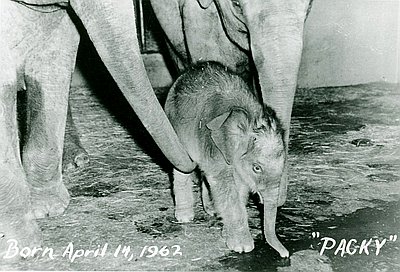
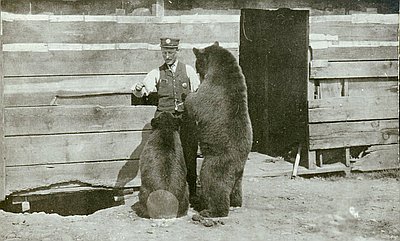
For over a hundred years, the Oregon Zoo has given visitors the opportunity to see and learn about animal species, their habitats, and the conservation efforts taken to protect them. Located west of downtown Portland, the Oregon Zoo has about 2,200 different types of animals—including Asian elephants, African lions, Amazonian poison dart frogs, and Peruvian penguins—and over 1,000 species of plants in a botanical garden. Following many years of active involvement in animal conservation, the zoo has 21 species of animals that are endangered and 33 that are threatened. Seven main exhibits depict different geographical locations and the animals that live there: the Great Northwest, Pacific Shores, Fragile Forests, Asian Islands, Asia, and Africa.
|
|
 |
Animal House
National Lampoon’s Animal House, one of the most successful American film comedies of all time, was filmed in the Eugene area in the fall of 1977. The producers needed a campus setting for their story of the disreputable Delta Tau Chi fraternity and the mayhem it creates in 1962 at fictional Faber College.
Alice Day Pratt
Alice Day Pratt was forty years old in 1912 when she set out on her own to homestead on 160 acres in Crook County. After eighteen years of ranching and teaching in rugged central Oregon, she moved to New York and published her experiences in national magazines and in books. Her articles, published in Sunset and Atlantic Monthly, extolled the animals and the Oregon high desert environment she dearly loved. She also published Homesteader's Portfolio (1922), (her account of her first five years of homesteading), Three Frontiers (1953), and two children's books: Animals of a Sagebrush Ranch (1931) and Animal Babies (1941). A vegetarian and lover of animals, she wrote with a sensitivity to animals and the natural environment that sets her apart from most homesteaders. She commented upon the impact of humans and domesticated animals upon nature, and her descriptions painted a vivid picture for her readers.
Dirty Shame Rockshelter
Dirty Shame Rockshelter, in the Owyhee Uplands of southeastern Oregon, preserved many artifacts made of wood, woven plant fiber, and animal hide, as well as identifiable seeds and other vegetal foods and the bones of food animals ranging from bison to small rodents. The site's C-14 dates span the period 9500-365 cal BP (that is, calendar years before the present). A complete lack of materials dating between 5850-2750 cal BP shows that the site was abandoned during the Middle Holocene Altithermal or Hypsithermal period, when a warmer global climate restricted human occupation in western North America. In both its earlier and later occupation periods, hunting-gathering people came to Dirty Shame for the varied late summer-early fall harvest. Plant and animal remains found in dried human excrement, as well as those discarded in the shelter, show that its pre-Altithermal and post-Altithermal visitors ate a varied and healthy diet.
U.S. Fish and Wildlife Forensics Lab
Who nailed a protected spotted owl to a park sign? Are ivory tusks from modern elephants or Ice Age mammoths? Are fish eggs sold as caviar actually from a sturgeon, or are they really from a paddlefish? Did a dried penis sold as an aphrodisiac come from a tiger or from some other animal? These are just some of the mysteries that end up at a very unusual laboratory in Ashland. The U.S. Fish and Wildlife Forensics Laboratory is the world's only full-service police laboratory specializing in wildlife forensics. It supports the work of enforcement agents and inspectors who protect threatened and endangered species; who prosecute illegal hunting, poaching, and smuggling; and who investigate multi-billion dollar international black-market criminal enterprises trading in hides, skins, eggs, organs, and other wildlife specimens.
 |
|
Mel Blanc
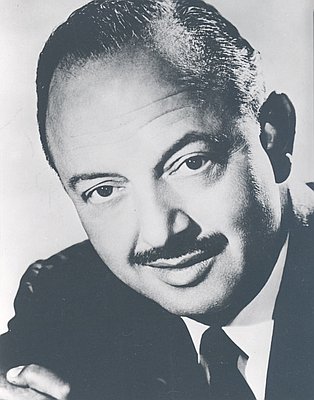
Mel Blanc, who acted the voice of Bugs Bunny and over four hundred other characters, appeared in three thousand cartoons and animated film shorts. From Yosemite Sam and Daffy Duck to Mister Magoo and George Jetson, he made an enduring contribution to the art of voice animation. Blanc grew up in Portland, Oregon, where early in his career he was an entertainer and writer for KGW’s Hoot Owls radio program. During his years in Hollywood, he had hit recordings on Capitol Records, performed on radio and television network programs, and had his own radio show.
Melvin Jerome Blank was born to Frederick Harvey and Eva H. Katz Blank on May 30, 1908, in the Mission District of San Francisco. When he was six years old, the family moved to southwest Portland, where he attended Shattuck and Commerce grammar schools and Lincoln High School. In June 1923, at the age of fifteen, he got his first job as a radio performer, singing on KGW’s Stories by Aunt Nell, a weekday program for children. When he was sixteen, he changed the spelling of his last name to Blanc when a high school teacher told him he would amount to nothing—a blank, like his name.
|
Bigfoot (Sasquatch) legend
Bigfoot is a large and mysterious humanoid creature purported to inhabit the wild and forested areas of Oregon and the West Coast of North America. Bigfoot is also known as Sasquatch, an Anglicization of the name Sasq’ets, from the Halq’emeylem language spoken by First Nations peoples in southwestern British Columbia.
Most people who believe in Bigfoot’s existence, or claim to have seen one, assert that they are hair-covered bipeds with apelike features up to eight feet tall that leave correspondingly large footprints. They are generally characterized as nonaggressive animals, whose shyness and humanlike intelligence make them elusive and thus rarely seen, though some wilderness travelers claim to have smelled their stench or heard their screams and whistles.
Two-Bits, the World War II lookout dog
A persistent fox terrier named Two-Bits earned a brief measure of national fame while spending the winter of 1942-1943 at the Siskiyou Mountains' isolated Whisky Peak Lookout. Called a "war hero" by the press, Two-Bits became the subject of front-page newspaper articles across the country, and his story was told in a children's book about famous animals.
 |
|
|
| |
|
|
|
Florence Merriam Bailey
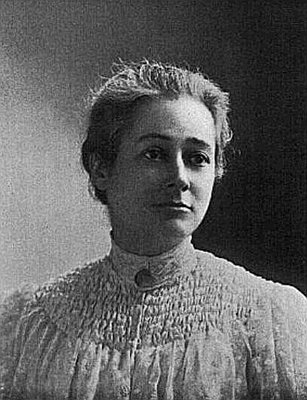
Florence Augusta Merriam Bailey was an ornithologist and nature writer whose fieldwork contributed significantly to the knowledge of the birds of Oregon. Best known for Handbook of Birds of the Western United States and Birds of New Mexico, she was called the First Lady of American ornithology. She was the first woman elected as a fellow of the American Ornithologists’ Union (1929); and in 1931, she won that society’s highest award, the William Brewster Memorial Award.
Born in Locust Grove, New York, in 1863, Florence Merriam attended Smith College. Her brother, zoologist C. Hart Merriam, worked for and eventually was director of the U.S. Biological Survey. Florence Merriam met and married one of the survey’s field workers, mammalogist Vernon Bailey, and they spent decades as the only well-known husband-and-wife wildlife collection and survey team in the country.
|
|
Vernon Bailey
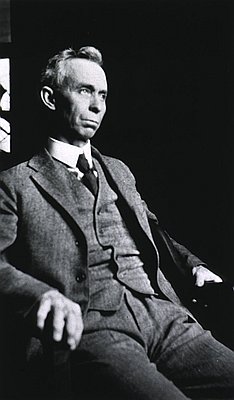
Vernon Bailey, chief field naturalist for the U.S. Bureau of Biological Survey from 1890 to 1933, is best known in Oregon as the author of Mammals and Life Zones of Oregon (1936), a remarkably interesting and informative study of the state’s wildlife and ecological regions.
Born on June 21, 1864, in Manchester, Michigan, Bailey grew up mainly in Minnesota. His youthful abilities as a trapper of small animals led to his employment in 1887 as a special field agent for the Division of Economic Ornithology and Mammalogy (renamed the Bureau of Biological Survey in 1905) in the U.S. Department of Agriculture. Because of his exceptional abilities, he was promoted in 1890 to the position of chief field naturalist, a title that he held for forty-three years and that no one else has held since.
|
Turkey Rama
In 2015, McMinnville’s annual Turkey Rama marked its fifty-fourth anniversary. Unique in the nation, the event celebrates Yamhill County’s turkey industry, which in 1986 accounted for more than 90 percent of Oregon’s turkey production. McMinnville hosted the first Pacific Coast Turkey Exhibit in 1938, a one-day affair with activities and prizes. Each year, the top turkey breeders were recognized, and there was a competition for who had raised the biggest and best turkeys. By the late 1940s, the Turkey Exhibit was one of the largest industry celebrations in the nation.
Keiko
The orca whale known as Keiko was captured from a pod in Iceland in 1979. He was exhibited there for three years and then sold to Marineland in Ontario, Canada, where he performed for audiences. Although some believed that Keiko appeared to enjoy contact with humans, his dorsal fin began to droop and he developed skin lesions. In 1985, he was sold to Reino Aventura, an amusement park in Mexico City. Warmer temperatures and chlorinated water aggravated Keiko’s lesions and his health deteriorated.
 |
|
William L. Finley
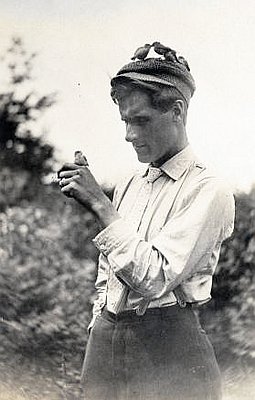
Oregon's birds have had few better friends than William Lovell Finley. As a biologist, photographer, writer, filmmaker, and public official, Finley spent his life tirelessly advocating for the protection of wildlife, especially birds. His efforts led to the creation of three National Wildlife Refuges in Oregon, and a fourth was named in his honor.
Finley was a native Californian, born in Santa Clara on August 9, 1876. His family moved to Portland when he was ten years old, where his father founded a mortuary. Finley collected bird skins and eggs from an early age, and at eighteen he and several friends formed the North-Western Ornithological Association. He returned to California to attend the state university at Berkeley, but his summer breaks were spent in Oregon photographing birds with his friend and partner, Herman Bohlman.
Finley's foray into the developing field of wildlife photography coincided with the rise of the wildlife conservation movement, and he soon found himself swept up in the tide. He helped organize the state chapter of the Audubon Society and lobbied the Oregon legislature to pass a Model Bird Law, which it did the following year. The act criminalized the killing of nongame birds, but enforcement remained lax until Finley helped secure private funds to hire additional wardens.
|
Oregon State Symbols
Oregon Junco
A hundred years ago, many birds carried the name of “Oregon,” including Oregon Jays, Oregon Chickadees, Oregon Titmice, and Oregon Towhees. One by one, those names fell into disuse or were discarded. The last bird bearing the state's name is the Oregon Junco.
Klamath midge
Klamath Lake's nutrient-rich waters support an array of aquatic and terrestrial organisms, ranging from bacteria and algae to fish and other vertebrates, including birds. The many invertebrates include the Chironomidae, an insect family of nonbiting midges, in the fly Order Diptera. In spring and early summer enormous numbers of adult Klamath midges—known locally as "little green bugs"—appear near evening on their nuptial flight.
The "Klamath" midge was first described by Malloch in 1915 from its type locality, Kaysville, Utah. Hence its scientific name, Chironomus utahensis(meaning "citizen of Utah"). Its common name Klamath midge (or little green bug, for that matter) has no legal scientific standing, and likely comes from its pestiferous nature near the relatively large human population of Klamath Falls, Oregon.
Florence Whale Explosion
On November 9, 1970, a forty-five-foot, eight-ton sperm whale washed ashore near Florence, Oregon. In addition to the stench and the possibility that the body would burst, local officials were concerned that people curious about the carcass might climb on it and fall in. The agency responsible for Oregon beaches, the Oregon State Highway Division (now the Oregon Department of Transportation), was called in to remove the whale. After consulting with U.S. Navy and munitions experts, Assistant District Highway Engineer George Thornton decided to treat the carcass as a boulder and to use dynamite to dislodge it.
Guide Dogs for the Blind
Guide Dogs for the Blind is a nonprofit organization that provides service dogs to the blind, with schools in Boring, Oregon, and San Rafael, California. It is the largest organization of its kind in the United States, having provided more than 11,000 trained guide dogs to blind people throughout North America for 60 years. Guide dog trainers Lois Merrihew and Don Donaldson founded Guide Dogs for the Blind in 1942 in the San Francisco Bay area. Merrihew’s lifelong dream was to train guide dogs, but she had been told that women were not physically or emotionally fit for such work. That solidified her resolve to become a guide dog trainer.
Appaloosa Horse Breed
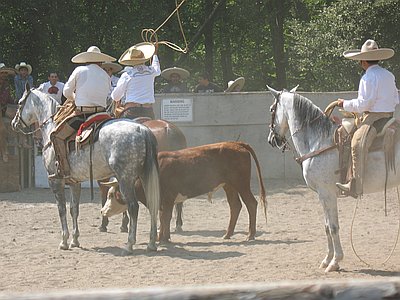
The Appaloosa is a horse breed associated historically with the Nez Perce (Niimipu) Tribe. The name may originate from “a Palouse,” which referred to the region where the horses were bred. It is likely that these horses originally came from a variety of Spanish horses—so-called spotted horses—that were traded into the Northwest by the mid to late eighteenth century. The horses were then bred by the Nez Perce.
Bobbie the Wonder Dog
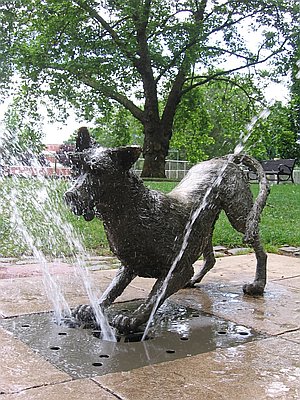
"Bobbie the Wonder Dog" of Silverton, Oregon, was the canine hero in a story that, in the 1920s, became a national sensation. On a February day in 1924, the 2-year-old scotch collie-mix dog appeared on the door step of his owners, Mr. and Mrs. Frank Brazier. What amazed them was that they had not seen their dog since he disappeared six months earlier from a car trip in Indiana. Bobbie—mangy, scrawny, feet worn to the bone—appeared to have walked back the entire way by himself.
 |
|
 |
| |
|
|
|
June Hogs (salmon)
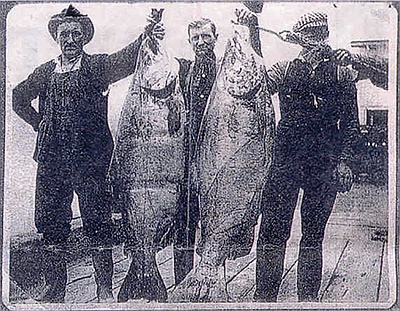
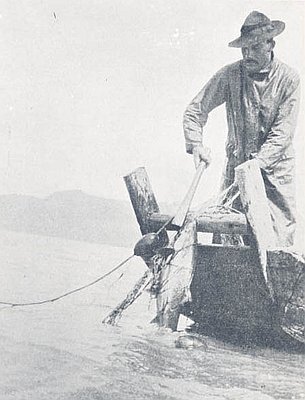
Imagine a single salmon weighing eight-five pounds or more. These summer-run Chinook salmon, named "June hogs" for their hog-like fatness from back to belly, once plowed the waters of the Columbia from the estuary to the upper reaches of the river in British Columbia. They were prized by lower-river gillnetters, native peoples, and sport fishers. One of the many summer Chinook populations was in the Spokane River, where the fish were a staple in the diets of the Spokane and Coeur d'Alene tribes. Grand Coulee Dam, completed in 1941, wiped out those fish populations and all other upper-Columbia salmon and steelhead, as the dam blocked access to more than 1,100 miles of spawning habitat. June hogs had economic and cultural importance in Oregon. For millennia, mid-Columbia tribes who caught the fish at Celilo Falls used them for food but also for spiritual, ceremonial, and trade purposes. The fish were also prized by canning companies on the river. Francis Seufert, a fish canner at The Dalles, wrote: "Because of their size, when you packed them into cans, only one slice...was necessary to fill the can."
|
|
Salmon
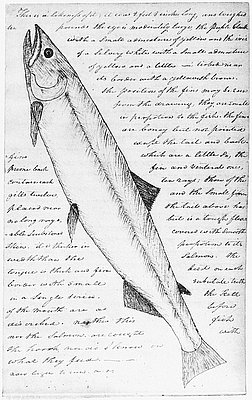
“Salmon” originally meant Atlantic salmon (Salmo salar), a species native to the North Atlantic rim and Arctic Ocean above Western Europe. In 1792, however, the taxonomist Johann Julius Walbaum applied the name to a group of fishes native to the watersheds of the North Pacific and Arctic in eastern Asia and western North America. In Oregon, “salmon” has mostly referred to six species of the genusOncorhynchus, known colloquially as chinook (O. tshawytscha), coho (O. kisutch), sockeye (O. nerka), chum (O. keta), pink (O. gorbuscha), and steelhead (O. mykiss). Since the 1980s, salmon farming has provided S. salarto consumers, and escaped fish have begun to invade the habitats of native species.
|
Oregon Chub
Oregon chub (Oregonichthys crameri) are small minnows that exist only in the Willamette Valley of western Oregon. This species was formerly distributed throughout the Willamette Basin in off-channel habitats, such as beaver ponds, oxbows, backwater sloughs, and flooded marshes.
In the last hundred years, these habitats have disappeared because of changes in seasonal flows resulting from the construction of dams, channelization of the Willamette River and its tributaries, and draining of wetlands. The loss of habitat, combined with the introduction of non-native fish, resulted in a sharp decline in Oregon chub abundance and a 1993 federal listing as an endangered species.