This Month in Oregon History: Black History Month
February: Black History Month
Want to learn about Oregon History every day? Like The OE Facebook and Twitter pages to see our daily history posts.
Blacks in Oregon
Black Exclusion Laws
1852
Holmes v. Ford
On April 16, 1852, a former slave named Robin Holmes filed suit against his white former owner, Nathaniel Ford, in the only slavery case adjudicated in an Oregon court. Holmes was one of about fifty slaves who settlers had brought to Oregon from Missouri. Many of Oregon’s first white settlers were non slave-holding farmers from Missouri and other border states, who had struggled to compete against farmers using slaves. Most were opposed to slavery, but they were also opposed to having African Americans among them, a sentiment reflected in several exclusion laws enacted in Oregon that prohibited free African American settlers. Ford was among a smaller group who did bring slaves to the territory. Although the first provisional government had passed a law in 1843 banning slavery, it had not been enforced. The case, Holmes v. Ford, made it clear that slavery was unlawful in Oregon.
1853
Louis Southworth
 |
|
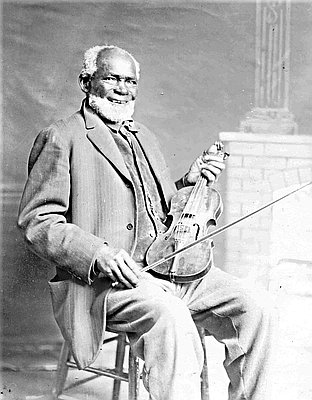
Louis Southworth came to Oregon in 1853, a time that was less than hospitable to African Americans. Most people who traveled the Oregon Trail by wagon were from the nation’s midwestern and border states, and many hoped to avoid the conflicts caused by slavery. Slavery was not legal in Oregon, but African Americans had been prohibited from settling in Oregon since the days of the provisional government. The Oregon State Constitution, passed in 1859, contained an exclusion clause that made it illegal for African Americans to live in Oregon (the clause was not repealed until 1926, and the population of African Americans in Oregon did not surpass one percent until 1960). Those prejudices and restrictions did not stop Southworth from making a good life in the state. The Homestead Act of 1862 did not restrict by race, and in 1879, Southworth and his family took up a homestead in the Alsea Valley. An active member of the community, he built a sawmill and ferried people up the Alsea River. Louis Southworth died on June 28, 1917, at almost eighty-eight years old. |
1866
Fourteenth Amendment
The Fourteenth Amendment to the U.S. Constitution declared that the federal government would guarantee the rights of citizenship to "all persons born or naturalized in the United States." No state could "deprive any person of life, liberty, or property, without due process of law; nor deny to any person within its jurisdiction the equal protection of the law." Passed by Congress in 1866, the law was intended to safeguard the rights of recently freed slaves in the South, where whites were working hard to subjugate them. Most white Oregonians had opposed both slavery and the presence of blacks in Oregon since the early 1840s, and the Oregon legislature ratified the Fourteenth Amendment in 1866 by a narrow margin. Two legislators protested that the amendment would "change, if not entirely destroy, the republican form of government under which we live, and crush American liberty." The same legislature passed a law prohibiting racial intermarriage.
1867
Salem’s Colored School and Little Central
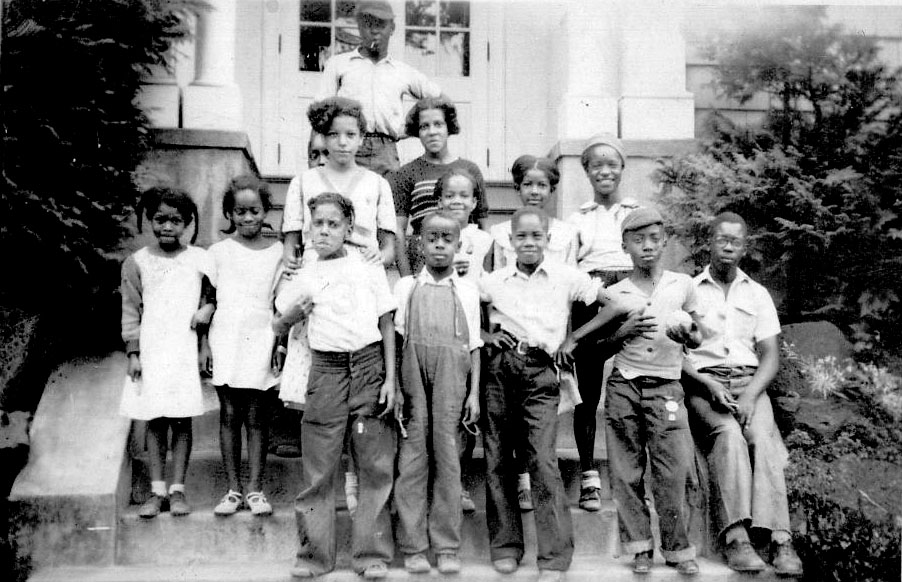
The first school open to African American students in Oregon—referred to as the Colored School—was founded in March 1867 by African American residents in Salem. In 1868, the original school closed when the city opened a segregated public school called Little Central, which was also called the “Colored School.” Oregon did not have a state superintendent of schools to institute and manage free and uniform schools in every district until 1872, so people often organized their own schools and determined enrollment requirements and school fees. In a state where African Americans were legally, economically, and socially marginalized by the white population, the children of black families were routinely barred from school attendance.
1899
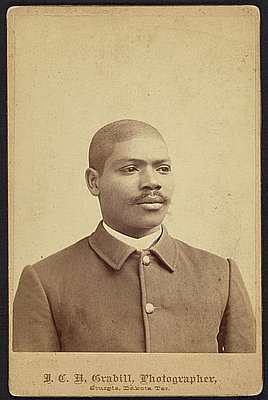
Buffalo Soldiers at Fort Vancouver
1899
DeNorval Unthank
1906
Kathryn Hall Bogle
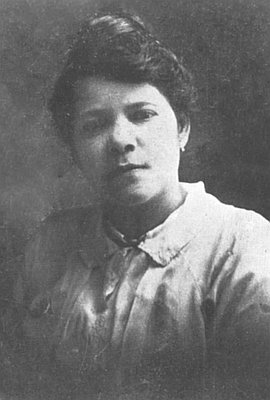
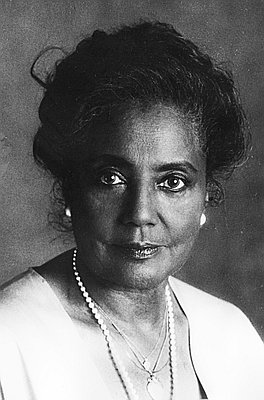
| Kathryn Hall Bogle, a freelance journalist, social worker, and community activist, was born on December 24, 1906. She is remembered as “one of Portland’s earliest and most passionate advocates of racial diversity.” She wrote articles for many African American newspapers, including the Pittsburgh Courier, the Seattle-based Northwest Enterprise, the Portland Observer, and The Skanner, and was presented a Lifetime Achievement Award by the Portland Association of Black Journalists in 1993. Bogle may be best known for “An American Negro Speaks of Color,” a 2,000-word article she sold to the Oregonian in 1937, which described the realities of being black in Portland. It was the first time the newspaper paid an African American for a story, and Bogle would contribute many more articles to the Oregonian over the years. |
|
 |
1906
Golden West Hotel
 |
|
|
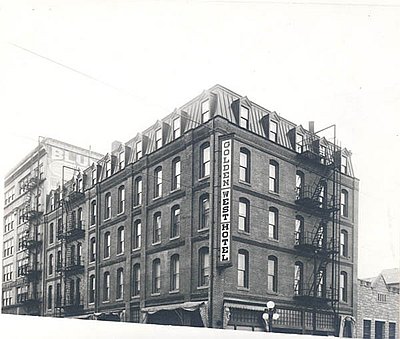
The Golden West Hotel, located at Northwest Broadway and Everett Streets in Portland, was the first hotel in the city to accommodate African American patrons. For twenty-five years, from 1906 through 1931, it was a social center and a focal point of the black community, a place for African Americans of all ages to gather and socialize in a segregated and largely unfriendly city. On the lower floors of the hotel, there were several black-owned businesses, including a bar, a barbershop, an ice cream parlor, and an athletic club. In the twenty-first century, the Golden West still functions as low-income housing, now under its original name. The quarter-century of the original Golden West stands as a reminder of a time in Portland when a black middle class and a vibrant, tightly knit culture thrived in a city weighed down by racism. |
1910
Black Cowboys
| |
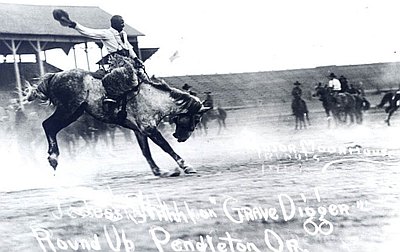
Oregon’s most celebrated rodeo, the Pendleton Round-Up, began in 1910 and included African American competitors from the beginning. The Round-Up’s most famous black rider, George Fletcher, was born in the Midwest, but he moved to Pendleton as a young man, learning from horsemen on the nearby Umatilla Indian Reservation. Throughout the 1910s, he enthralled audiences with his flamboyant style, which included wearing bright orange chaps, and his loose, relaxed way of riding that made every movement look as though it would fling him off. In 1911, Fletcher competed against John Spain, who was white, and Jackson Sundown, who was Nez Perce, in the bucking finals. Spain was awarded first prize, but the crowd disagreed with the judge’s decision and cheered loudest for Fletcher. Most spectators agreed that Fletcher had ridden better and that the decision derived from the judge’s reluctance to award the first prize to a nonwhite man. Fletcher would later serve in the military during World War I, where he sustained injuries that ended his rodeo career. |
|
 |
1912
Beatrice Morrow Cannady
1912
Thelma Johnson Streat
 |
|
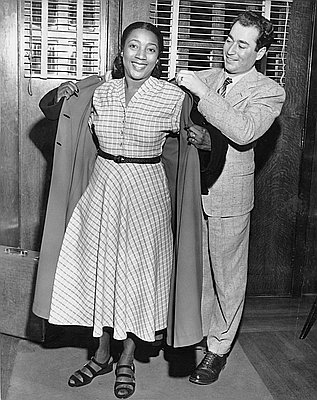
Thelma Johnson Streat was an African American artist who focused on ethnic themes in her work. Born on August 29, 1912, in Yakima, Washington, she moved with her family to Portland where she graduated from Washington High School. Streat began painting at the age of seven and received art training at the Museum Art School in the mid-1930s. Her work is powerful, both in line and color, as exemplified by the piece Black Virgin, now in the collection of Reed College. Her art is also included in the collections of the Museum of Modern Art, Mills College in Oakland, California, the San Francisco Museum of Art, and the Honolulu Academy of the Arts. |
1914
Lizzie Weeks
1915
William McClendon
1916
Willie Mae Young Hart
Willie Mae Young was born on April 4, 1916, in Vicksburg, Mississippi, where she trained informally as a nurse. She relocated to Oregon in 1939, first to Coos Bay and then to Portland, where she worked in the shipyards on Swan Island. In addition to the community organizing that characterized so many of her contemporaries, Willie Mae Young Hart has made a habit of breaking the color line. She helped operate Portland’s first black-owned cab company and was the first African American nurse to work at Portland's Physicians and Surgeons Hospital. As a founding member of the Portland Chapter of the National Council of Negro Women and Women In Community Service, Hart inspired others to serve as agents of change.
1920
Arthur Lee “Artie” Wilson
Artie Wilson was a professional baseball player who was A longtime Portland resident, Artie Wilson played for the Pacific Coast League for most of his professional baseball career. Born in Springfield, Alabama, on October 28, 1920, he was the first African American player hired on an integrated team, the Oakland Oaks. Wilson played shortstop for the Birmingham Black Barons, a Negro League team, from 1942 to 1948. During his last year with the Barons, the team competed in the Negro League World Series, and Wilson became the last professional baseball player to bat over 400 (.402). That year, he mentored the young Willie Mays, who played for the team. In 1949, the New York Yankees signed Wilson and then sold his contract to the Oakland Oaks of the Pacific Coast League. In 1950, the Oaks won the PCL championship, and Wilson won the PCL batting title with a .348 average; he led the league with 47 stolen bases. For the next sixteen years, he played for PCL teams, including the Portland Beavers (1955-1956; 1961).
1923
Maxville
1926
Billy Webb Elks Lodge
The Billy Webb Elks Lodge, a modest, shingle-sided building located at 6 North Tillamook Street in Portland, is a reminder of the city's history of segregation history and is a key historical landmark for the African American community. Designed by DeYoung and Roald, the structure was completed in 1926 as a project of the Portland YWCA. The building replaced a temporary structure that since 1921 had housed the YWCA’s first effort to reach out to Portland’s small African American community. During the 1920s, “membership reflected segregated housing in the city, with separate clubs for African-American, Japanese, Chinese, and native/foreign-born white girls.” People referred to it as the “Williams Avenue branch” or the “Colored YWCA.”
1936
Obo Addy
1945
Triple Nickles
1945
The Dude Ranch
On December 5, 1945, impresario Norman Granz brought his touring jam session, Jazz at the Philharmonic, to the Dude Ranch, Portland’s premier jazz venue on North Williams Avenue, the center of the city’s African American community. That night, legendary saxophonist Coleman Hawkins led a group that included trumpeter Roy “Little Jazz” Eldridge, bassist Al McKibbon, and a twenty-five-year-old pianist with a “lightning-like right hand” who was soon to usher in the bebop age, Thelonious Monk. “Never before in the history of the northwest has there been as much jazz music played per square minute by any group,” Bill McClendon proclaimed in The Observer, Portland’s African American newspaper.
1948
Vanport
1954
Clarence Pruitt
1959
15th Amendment
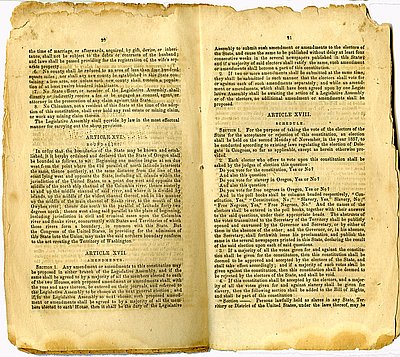
Oregon joined California as two of the five western states that considered and rejected the Fifteenth Amendment, which stated that voting rights "shall not be denied or abridged by the United States or by any State on account of race, color, or previous condition of servitude." Oregon did not formally ratify the amendment until 1959. This refusal was largely symbolic, since Oregon could not overturn the rule of the land. Hence, Oregon's Supreme Court in 1870 upheld the rights of two African American men in Wasco County to vote for county commissioner, explaining: "To hold otherwise would be to unwarrantably overthrow certain well established principles of law. . . ."
1969
Black Panthers in Portland
1969
Fred Milton
1982
William A. Hilliard
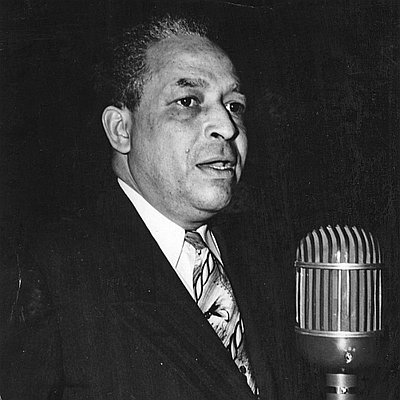
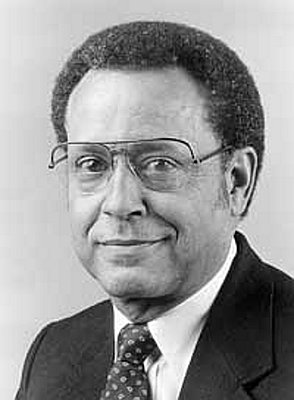
| William A. Hilliard was named the first African American editor of the Oregonian in 1982, and one of the few blacks to serve as the editor of a major newspaper. Growing up in Portland, he was refused a paper route for the Oregonian when he was a boy for fear that white subscribers would resent it, and he transferred from the University of Oregon after a professor told him there was no place for blacks on newspapers. In 1993, Hilliard was named president of the American Society of Newspaper Editors, the first African American to hold that position. At the end of his one-year term, he retired as editor of the Oregonian. "I want to believe," Hilliard said at his retirement, "that over the years, scores of young people of color have looked at me and said, ‘It can happen.'" |
|
 |
Jazz Musicians in Oregon
| Nancy King |
|
Mel Brown |
|
Leroy Vinnegar |
| For most of her career, Nancy King has been considered the Pacific Northwest's pre-eminent jazz singer. National recognition was slower to come, though she always received the praise of her peers. For twenty years, King was known as an underground classic—a supremely talented vocalist whose strict adherence to straightahead jazz and independent attitude at times got in the way of national tours and higher visibility. By the end of the 1990s, however, King had become one of the leading jazz singers in the world. |
|
If one had to choose a single musician to represent the history of jazz in Portland, it would be drummer and bandleader Mel Brown. One of the most active, influential, and respected artists in the area jazz scene since the 1970s, Brown’s roots are in Portland’s historic jazz district that flourished along Williams Avenue in the 1940s and 1950s. Just as he was brought into jazz as a teenager, he helps train and nurture later generations of musicians. |
|
Though he spent only the last thirteen years of a long career in Portland, celebrated bassist Leroy Vinnegar became a central figure in the local jazz scene. In 1995, the Oregon legislature honored his contributions to the cultural life of the state by designating May 1 as Leroy Vinnegar Day. The Leroy Vinnegar Jazz Institute at Portland State University was named in his honor, and in 1998, Vinnegar became the first member of the Jazz Society of Oregon’s Hall of Fame. |
| |
|
|
|
|
| Esperanza Spalding |
|
Marianne Mayfield |
|
Janice Scroggins |
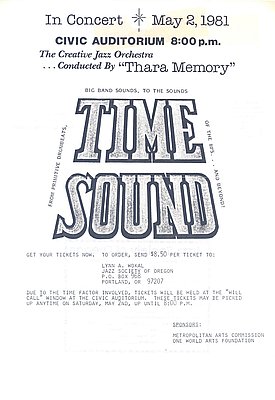
| Esperanza Spalding’s fierce talent in double bass and vocal work earned her a Grammy in 2011 for Best New Artist, making her the first jazz musician and one of only four Oregonians to ever win that award. She won three more Grammys in 2013 and 2014, one of them shared with her mentor, Portland jazz trumpeter Thara Memory. Not only did Spalding master singing while playing bass, but she also distinguished herself as a woman in the male-dominated jazz genre within the even narrower pool of female double bass players. |
|
During more than thirty years on the Portland jazz scene, singer and bassist Marianne Mayfield was a rare female instrumentalist in a male-dominated jazz world and was proud of her place in it. “I’m grateful for…the fact that I have enjoyed the respect of my contemporaries, the musicians, the guys. Not as a woman but as a musician and as a person,” she said in a 1985 interview. |
|
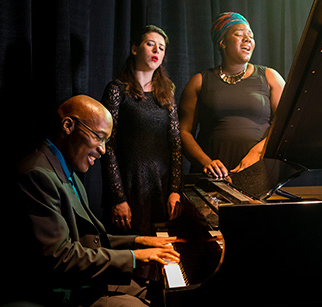
It is unusual for musicians to achieve the respect of peers and professional success in more than one field. Pianist, music director, educator, and composer Janice Scroggins did. Between her arrival in Portland in 1979 and her death at age fifty-eight in 2014, she played a central role in the blues, gospel, and jazz communities. Such a wide scope was possible for the Oklahoma native due to her command of the common elements underlying those styles. |