


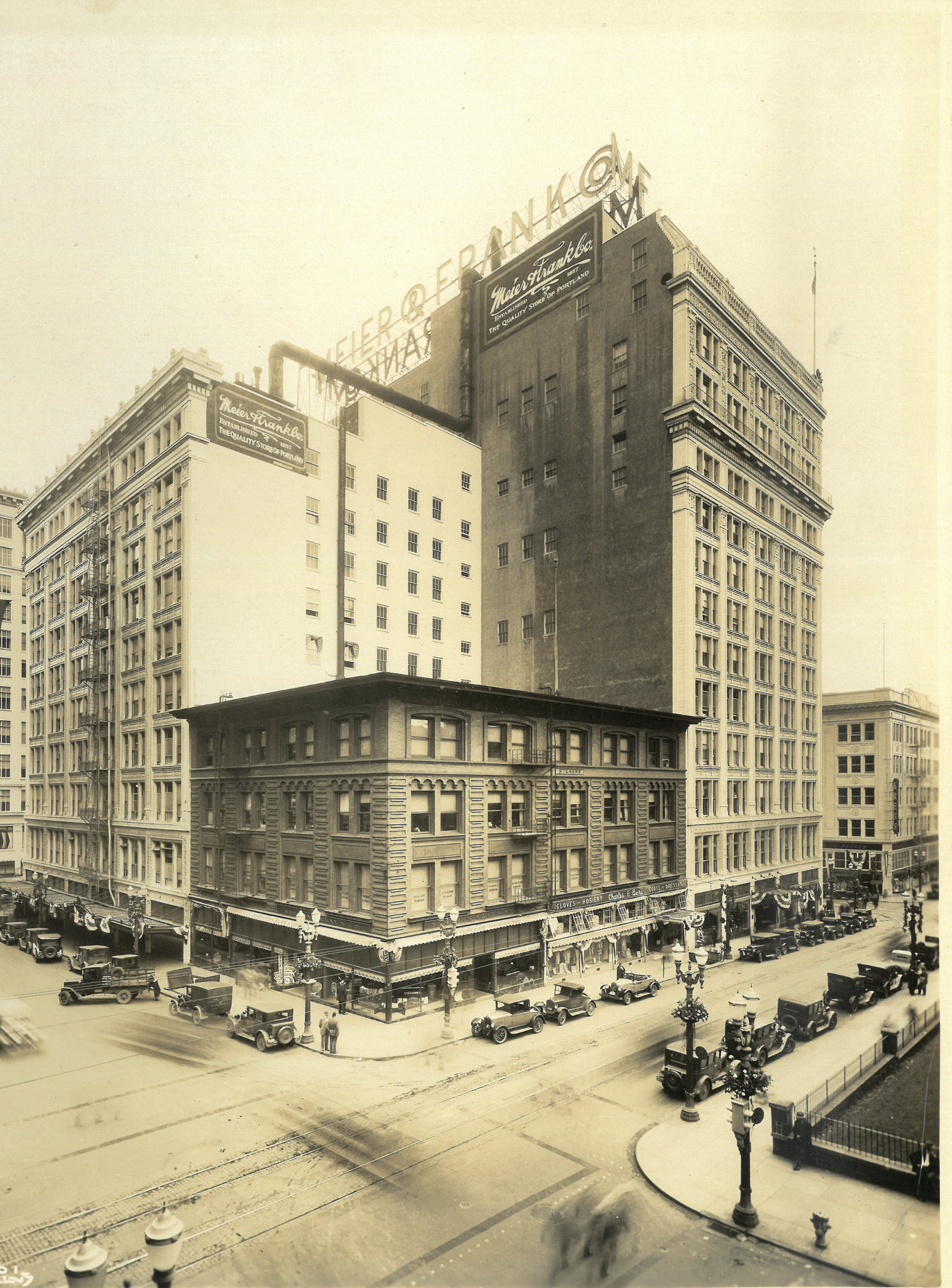
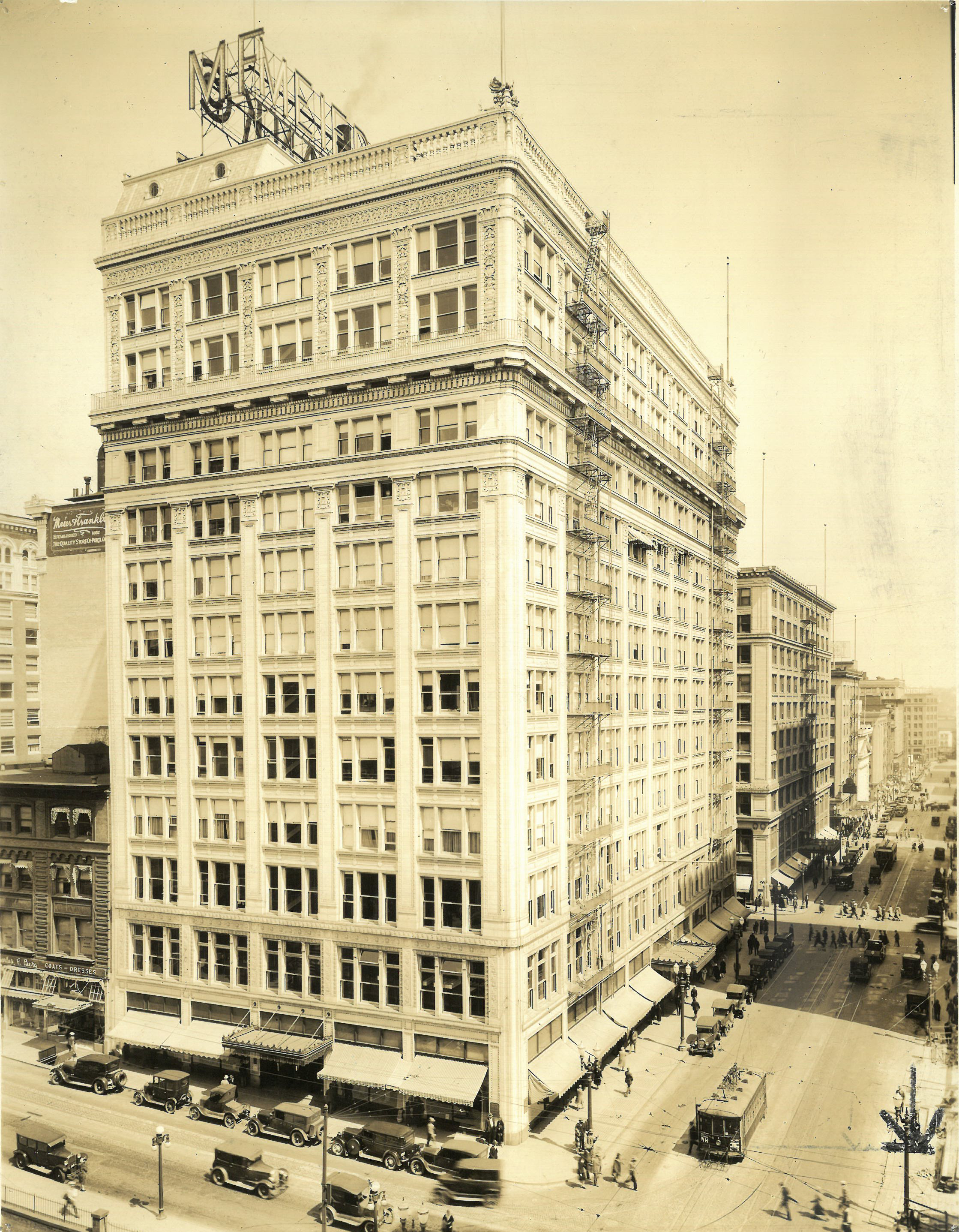
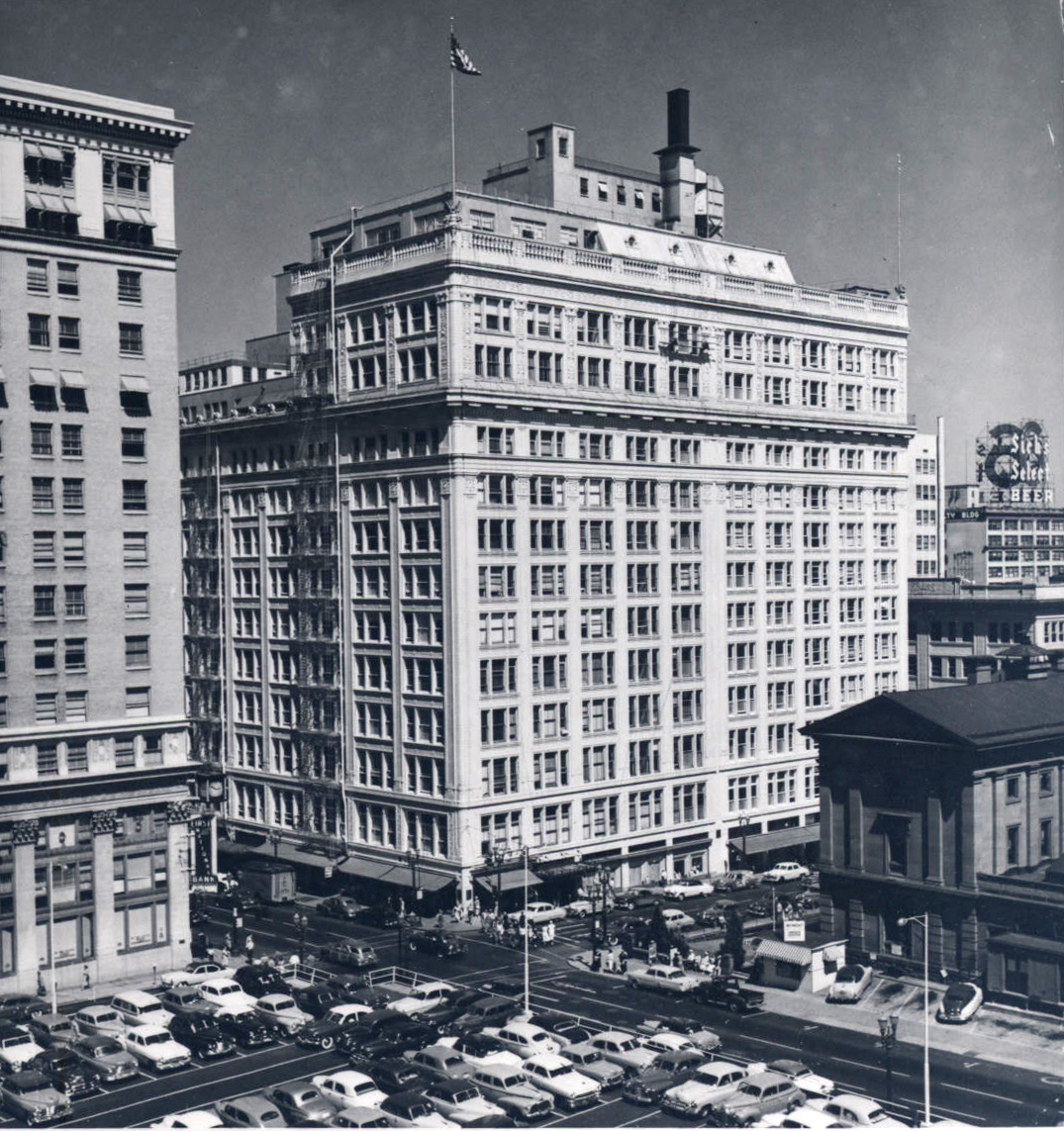
The heart of downtown Portland’s commercial district in the twentieth century was the neo-classical Meier & Frank Building, which occupies an entire city block between Southwest Fifth and Sixth Avenues and Morrison and Alder Streets. The building served as the Meier & Frank Co.'s flagship store from 1898-2017 and was placed on the National Register of Historic Places in 1982. Patterned after department stores in nineteenth-century Chicago, the white terra cotta building that stands today is fifteen stories at its highest point with a steel frame. In 2026, it houses retail, offices (including Oregon State University and Google), restaurants, and a hotel.
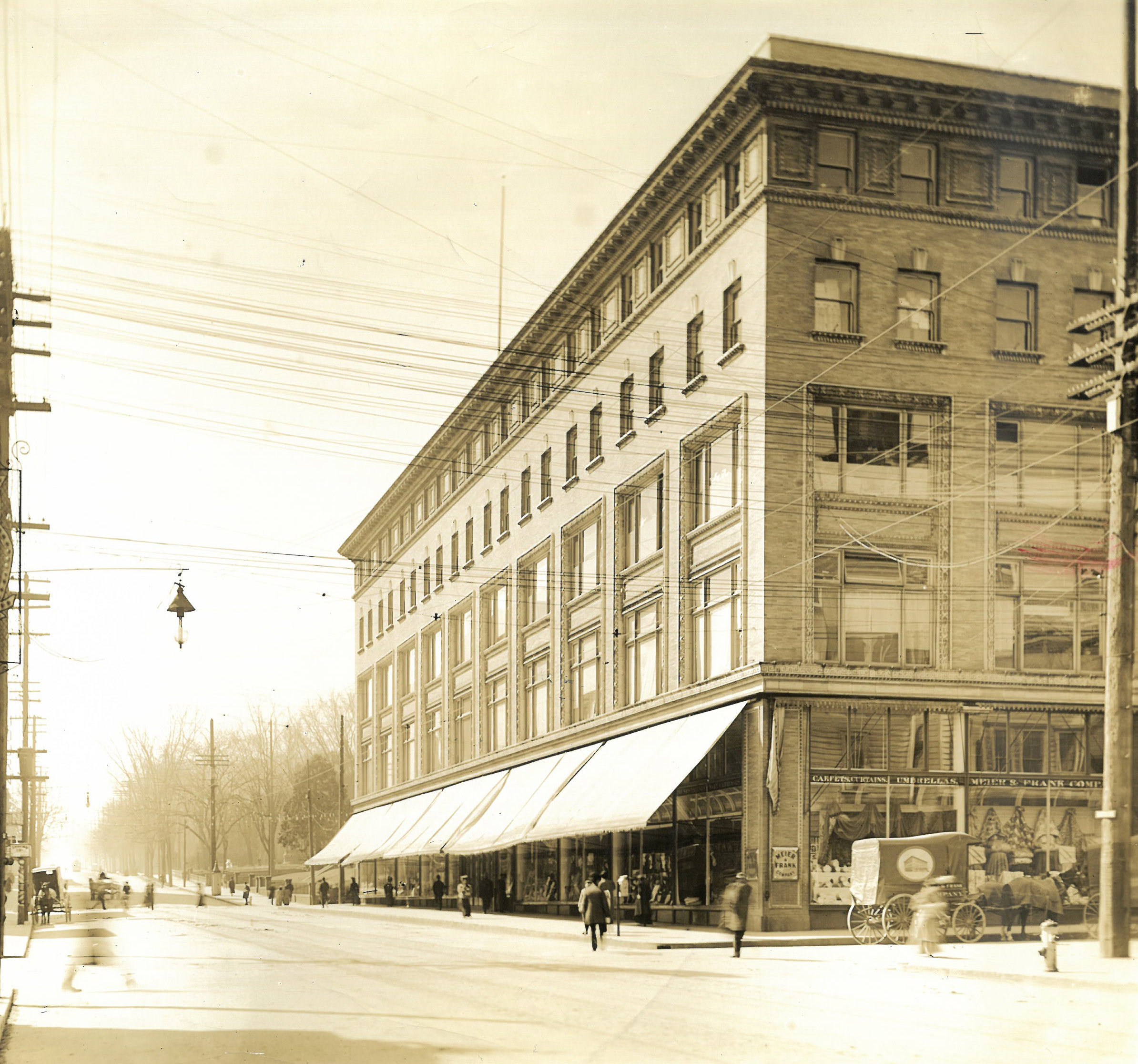
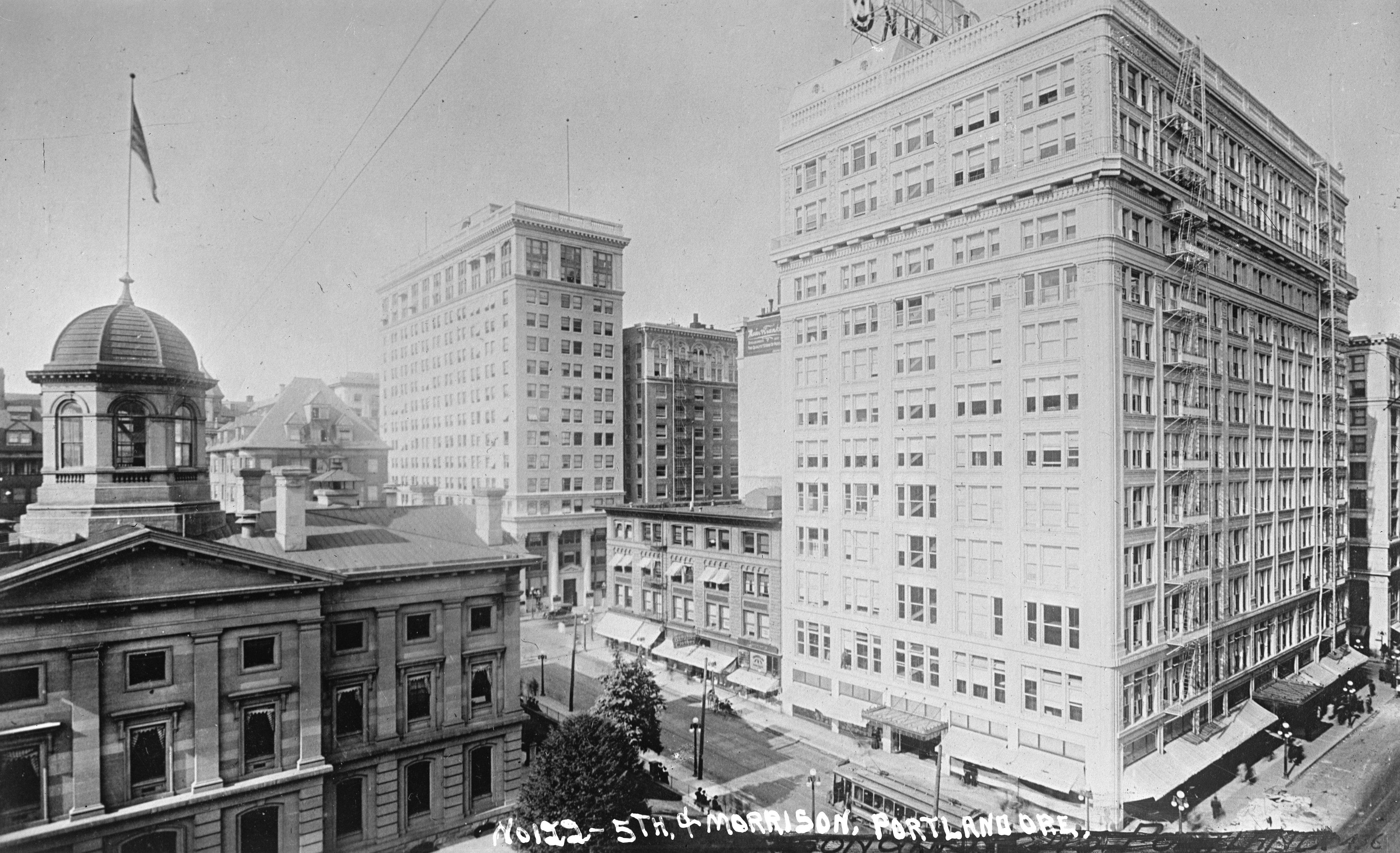
Aaron Meier had been operating a general store on Portland’s Front Street since 1857 when he partnered with Emil and Sigmund Frank in 1873 to create Meier & Frank Co. After a massive fire (1873) and flooding (1894) in the city, Sigmund Frank foresaw Portland’s retail core moving west from the waterfront to what was considered a “mercantile wilderness.” Against the advice of naysayers, Frank invested over $500,000 in land and construction costs in 1897 for a modern five-story department store on Fifth and Morrison, located across from the Pioneer Courthouse and the Portland Hotel.
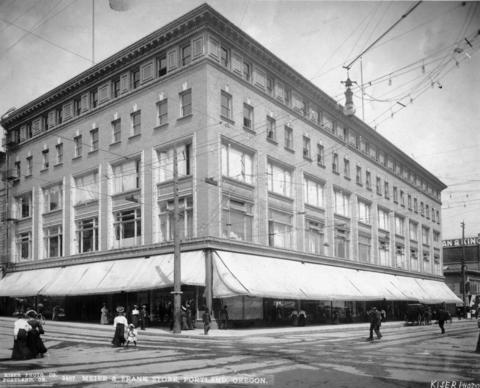
Designed by Whidden & Lewis, the new store opened in 1898 with 120,000 square feet of floor space, taking up the east half of the block and employing 250 people. The building was mechanically modern, with excellent lighting and ventilation, two passenger and two freight elevators, a telephone service that connected departments, and a mail-order operation. The elevator cages were designed and installed by Portland Wire & Iron Works, making the cages among the first built by an Oregon company. The store was immediately successful, with three floors devoted to retail and other floors dedicated to wholesale operations, manufacturing and receiving, and stock, crockery, and grocery departments.
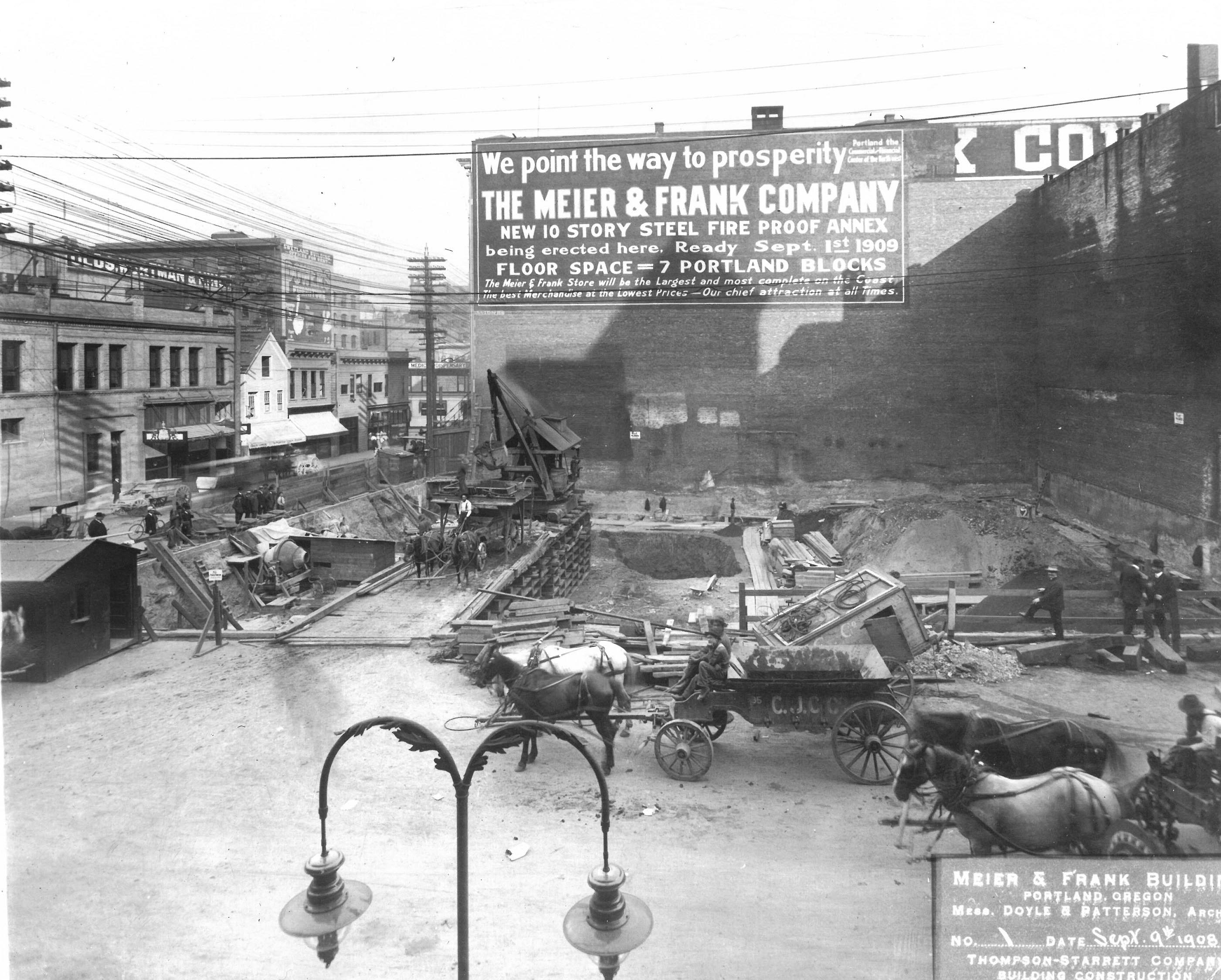
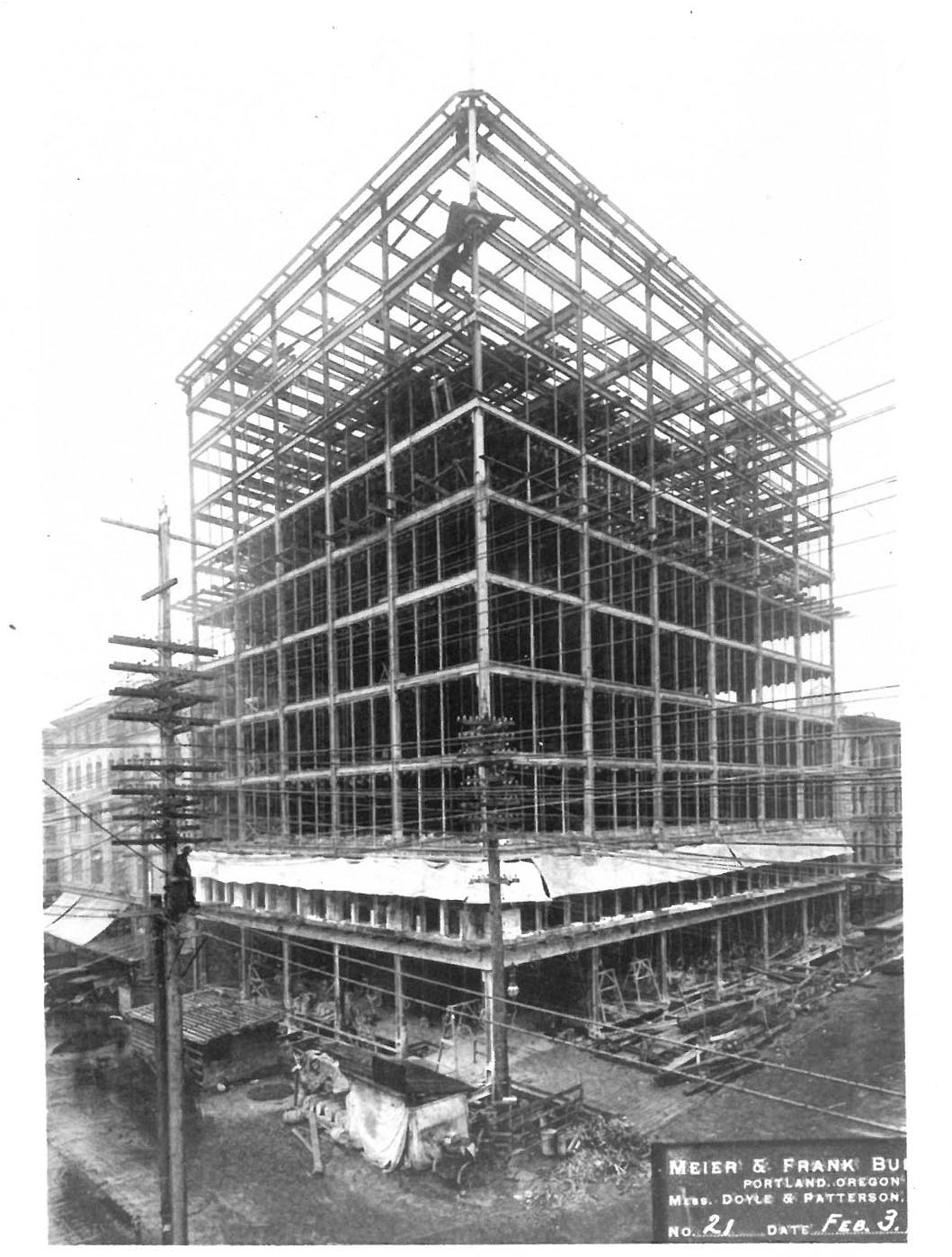
In 1908, Sigmund Frank travelled to Chicago and was impressed by architect Louis Sullivan’s Carson Pirie Scott Store, which featured facades of white terra cotta. Frank returned to Portland with plans to expand to a full-block store, similar to those he’d seen in Chicago, and hired architect A. E. Doyle to design it. It took two decades to complete the expansion, which was implemented in three stages.
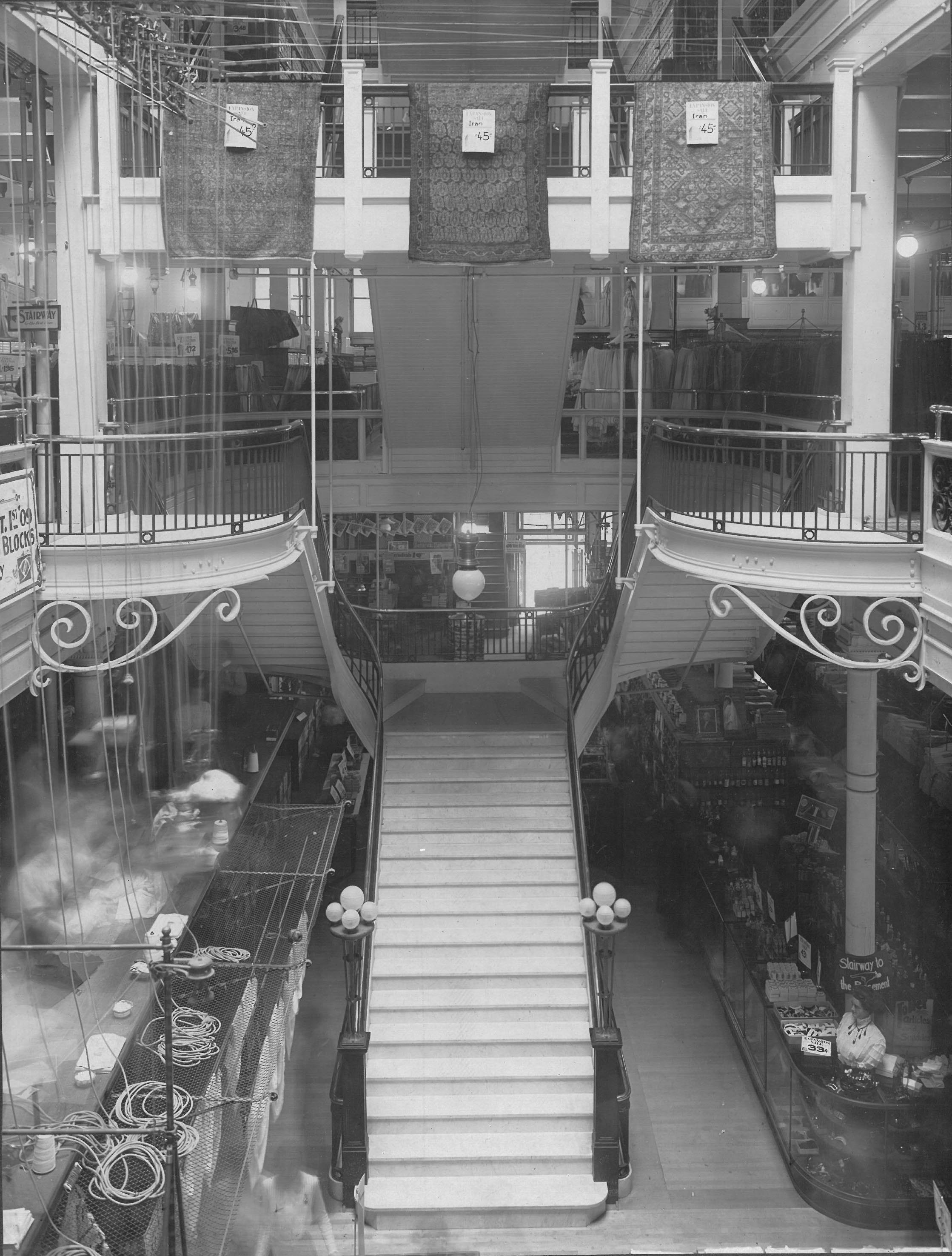
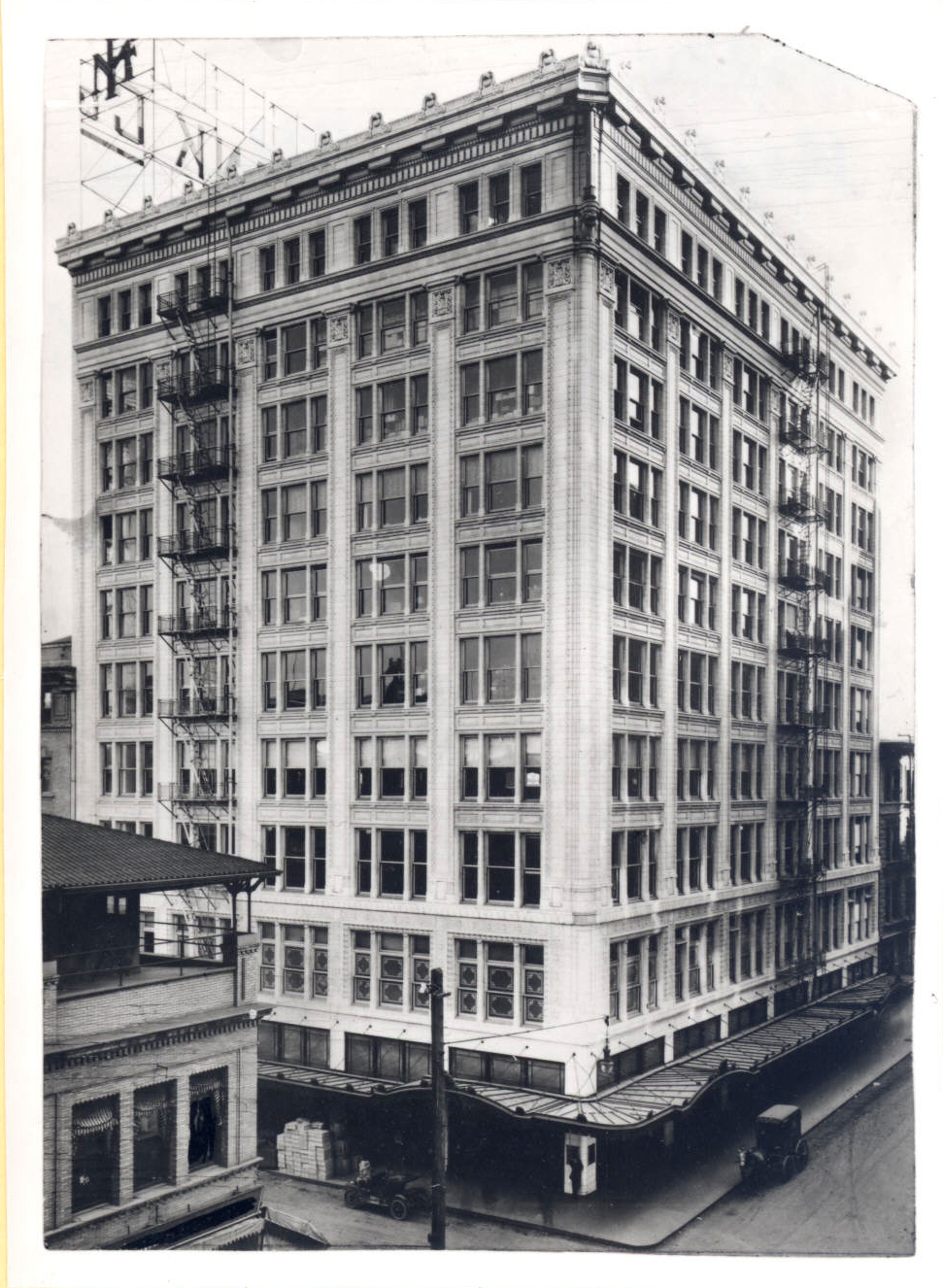
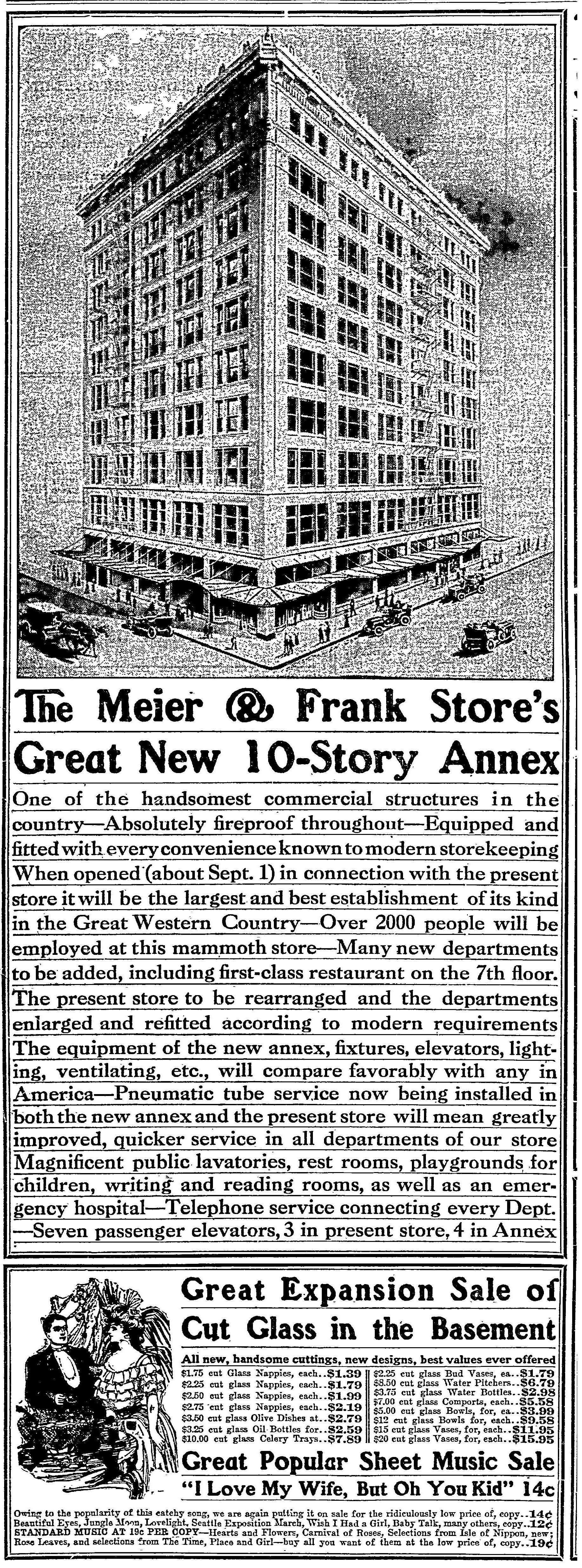
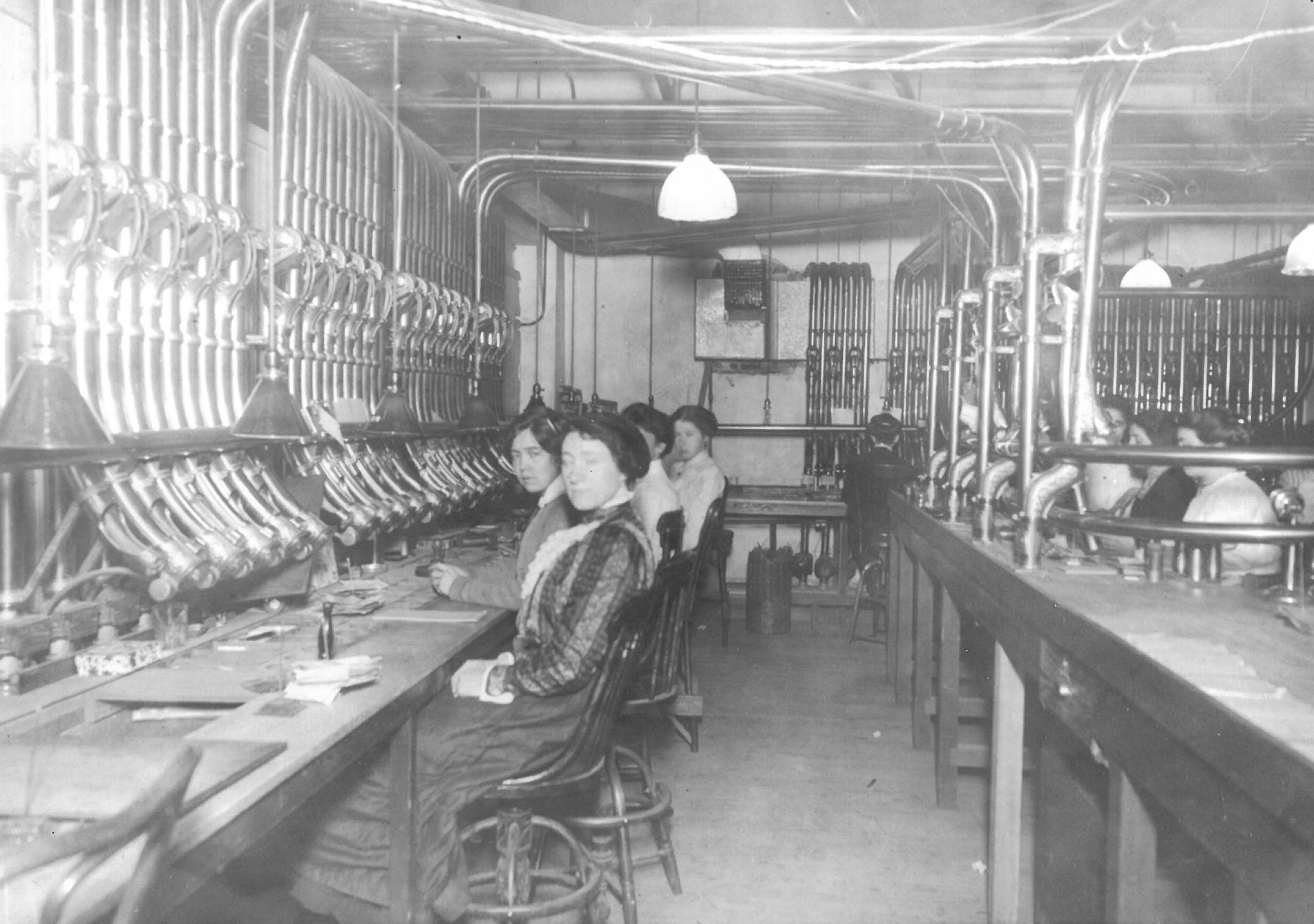
The first stage was the construction of a ten-story structure on the northwest corner of the block (Sixth and Alder) called “The Annex,” which opened in 1909 with two basement levels, including a water well, a steam plant, and an electrical generating plant. To support its 2,000 employees and shopping customers, the Annex had playgrounds for children, a pneumatic tube system used to move receipts and paperwork between departments, and an emergency hospital. The glazed white terra cotta on the exterior was fireproof and reflected the light—a contrast to the dark red brick and stone buildings nearby. Doyle used the material on several downtown buildings during that period, including the Lipman & Wolfe Department Store and the National Bank. Other architects followed suit, creating an architecturally distinctive district in downtown Portland that remains mostly intact in 2026.
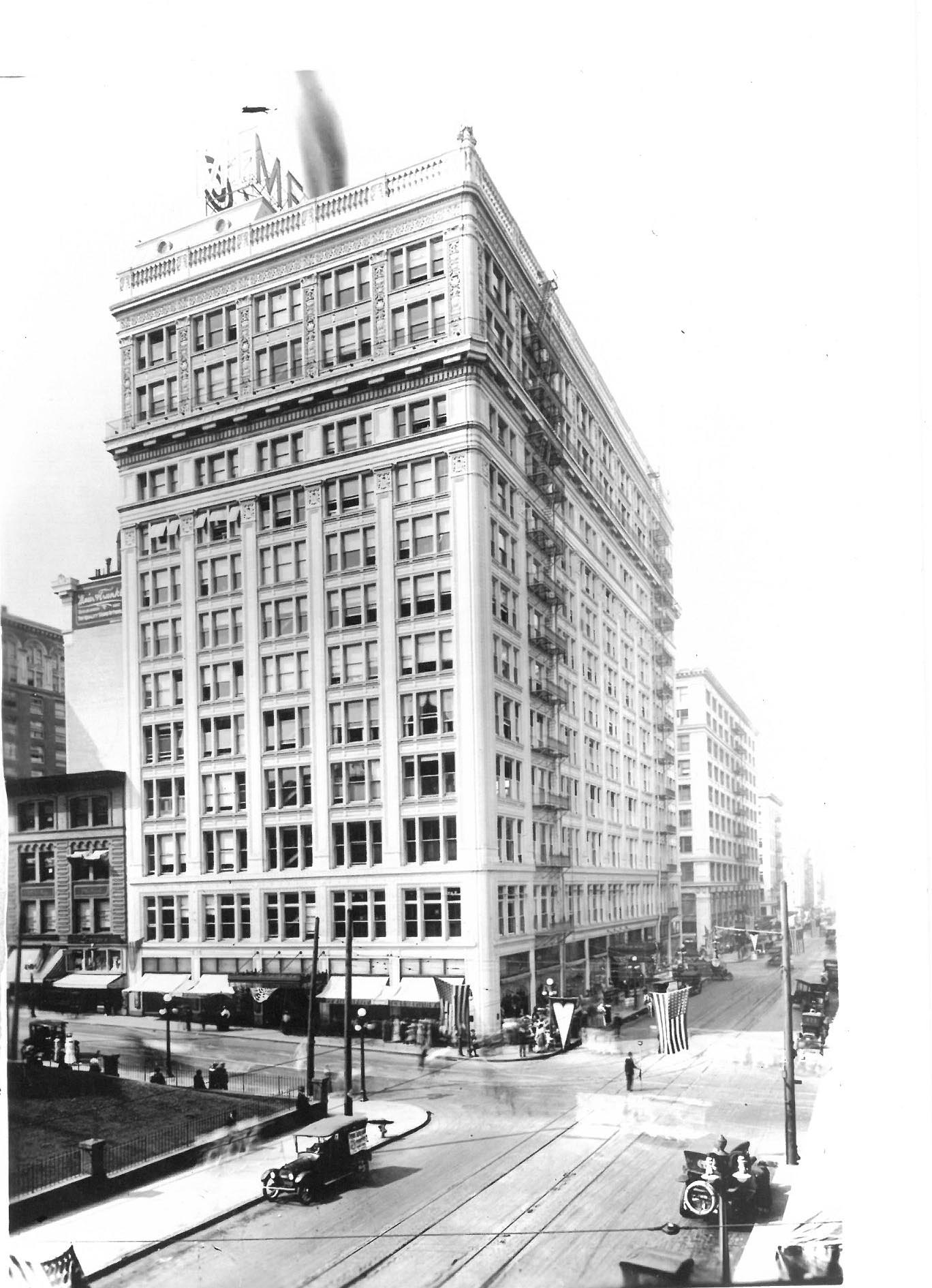
In 1915, the 1898 half-block store was demolished during the second expansion stage and replaced with a new building. Completed at a cost of $1.5 million, the section featured thirteen stories, with partial fourteenth and fifteenth floors, ten passenger elevators, operated by a team of “elevator girls,” and three freight elevators, a basement, and a subbasement for retail sales. The ninth floor had a new tea room and the Pine Room Men's Grille, grocery, delicatessen, bakery, and creamery; the tenth featured a mezzanine with an art gallery and restaurant; and the twelfth floor had a cork-lined fur vault. A kitchen, cafeteria, and other employee services dominated the thirteenth floor. The building was technologically innovative, as well, with a central vacuum cleaning system, an automatic fire sprinkler, and Portland’s first escalators.
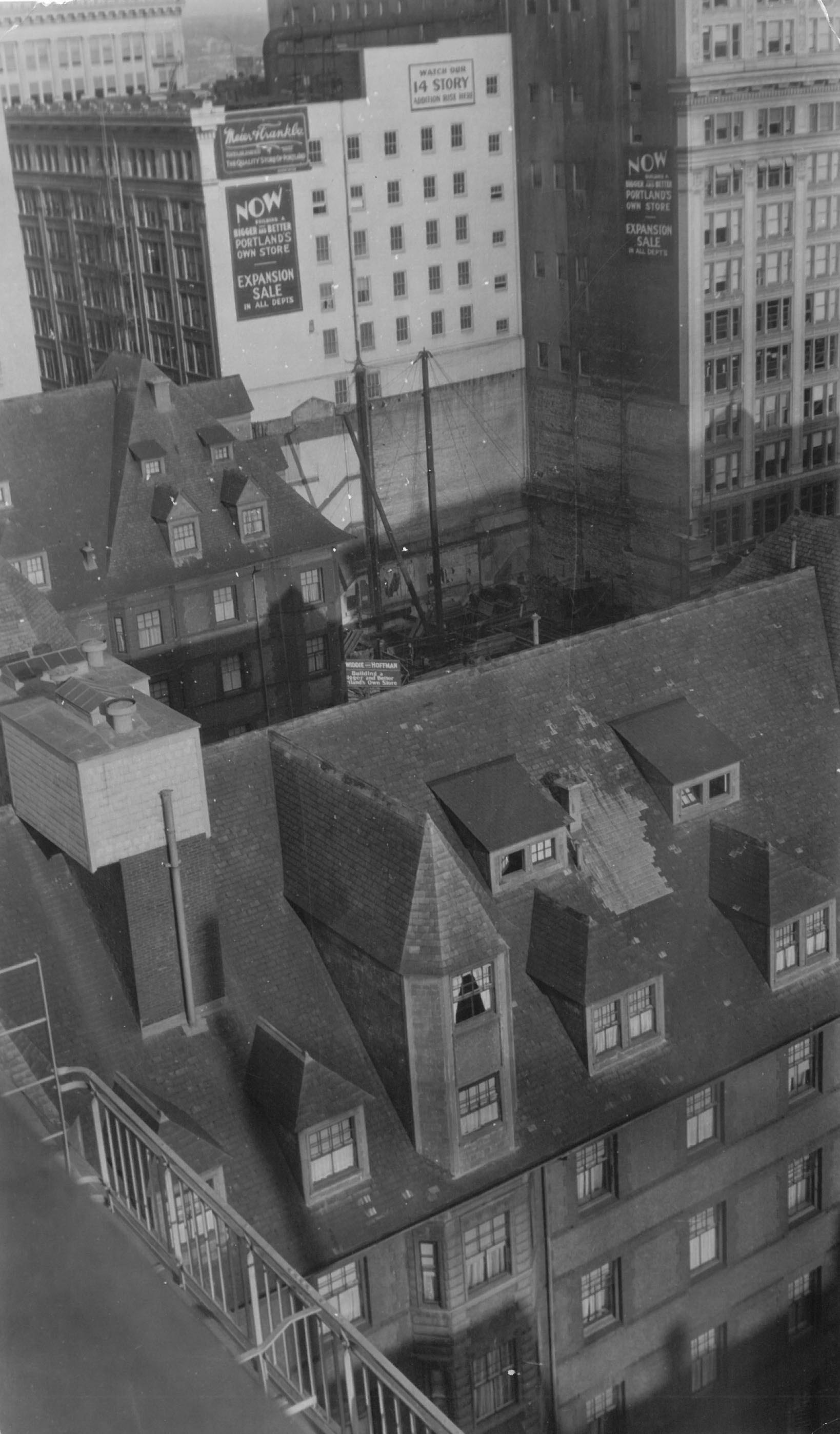
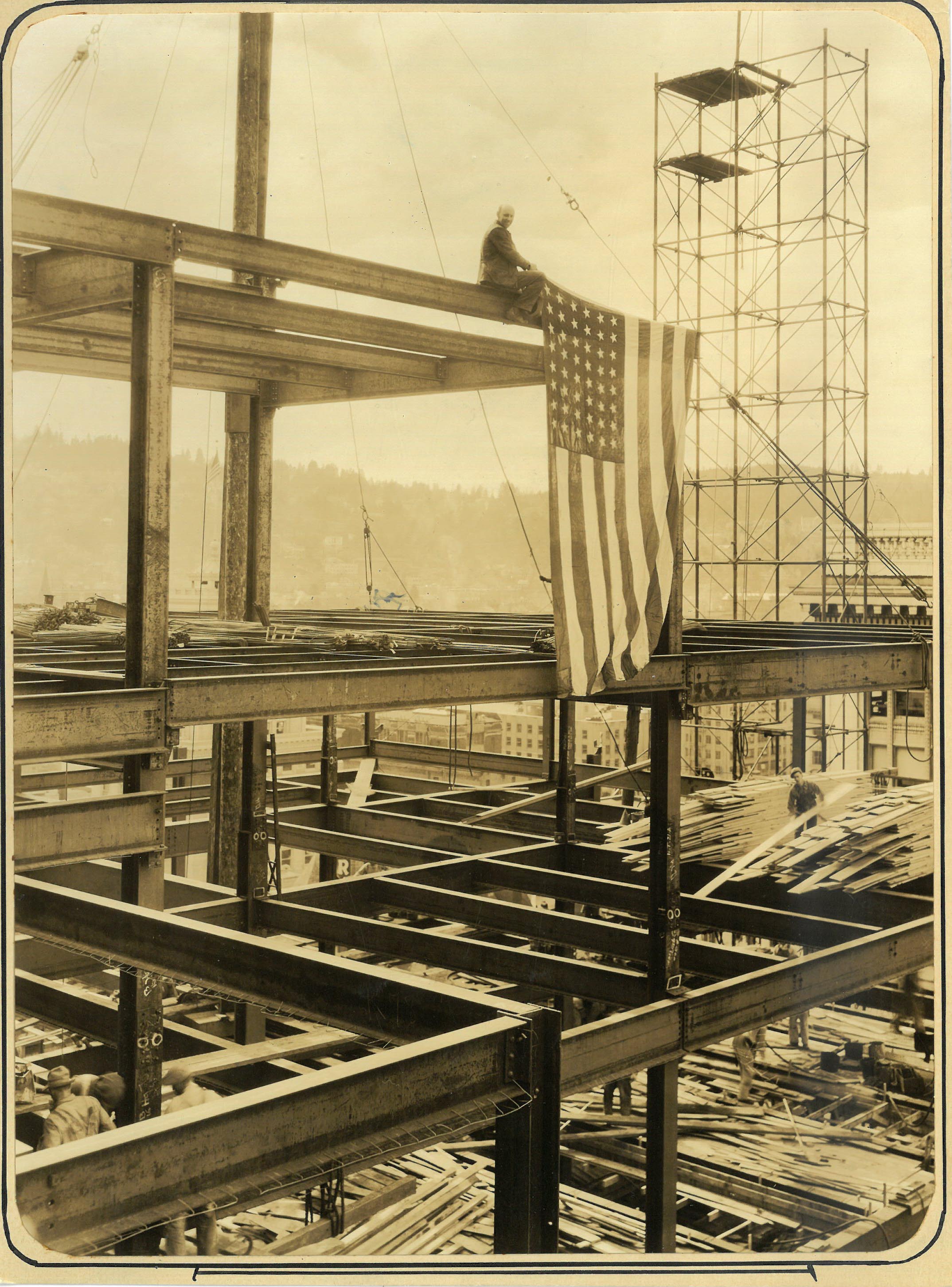
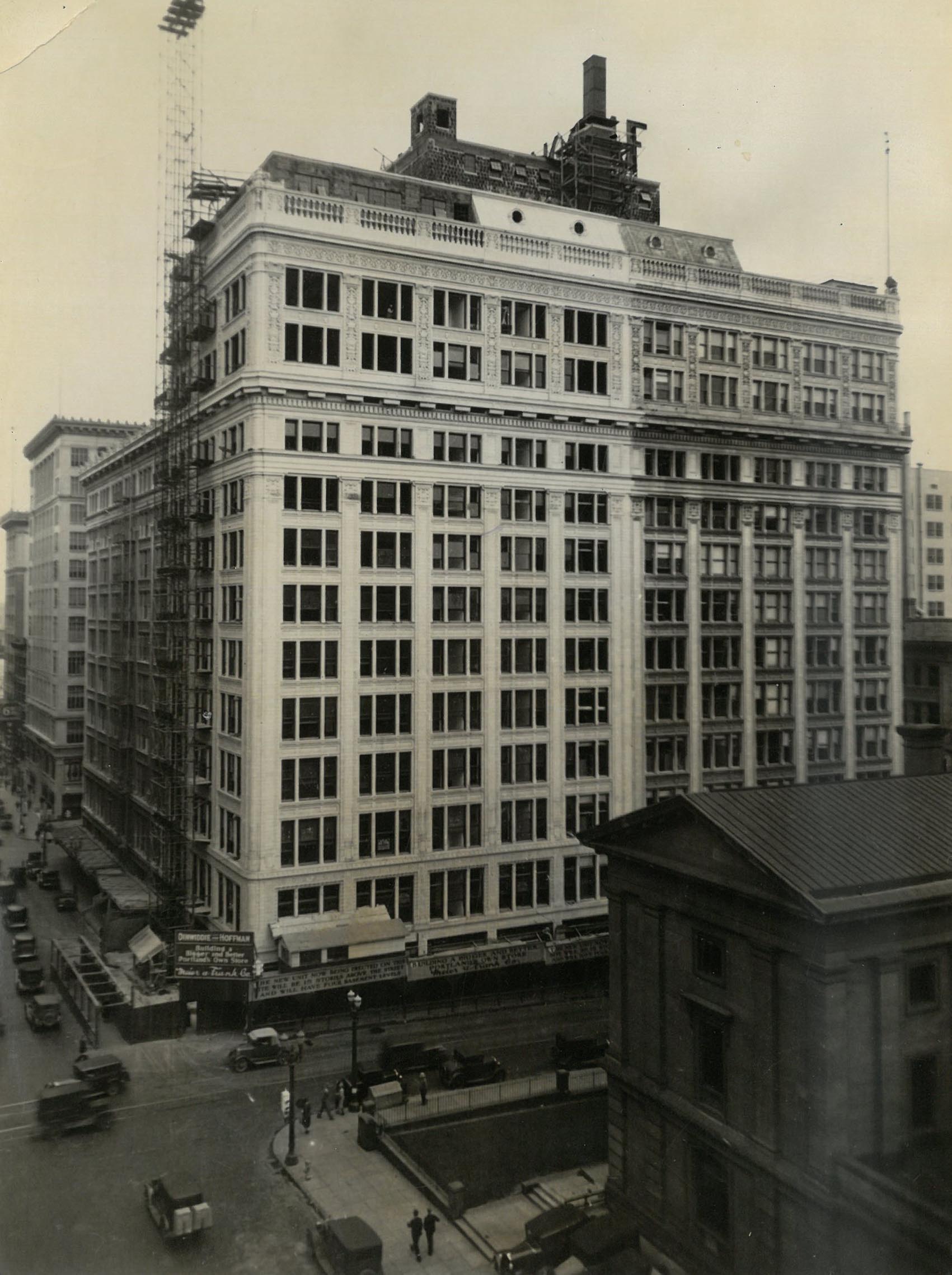
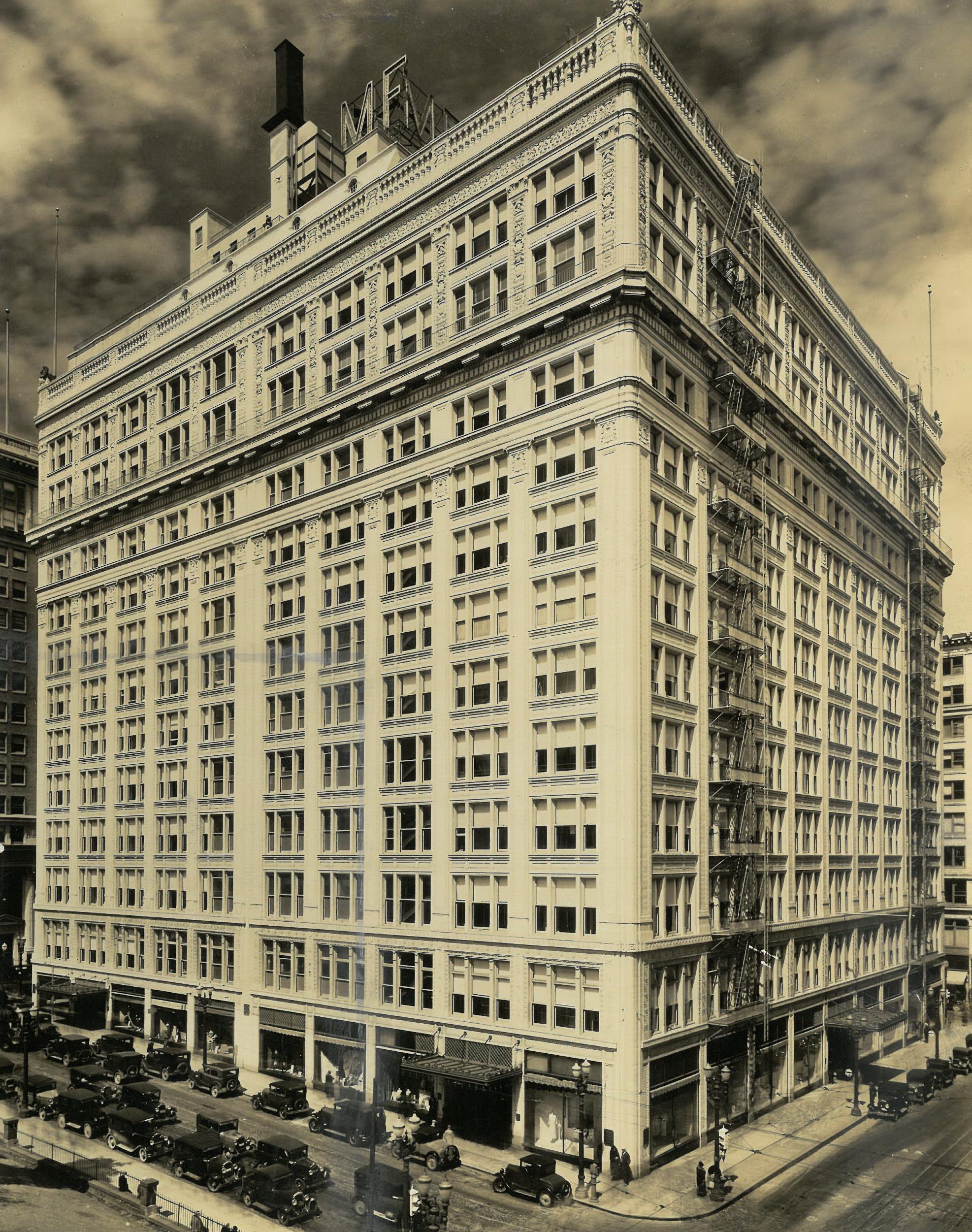
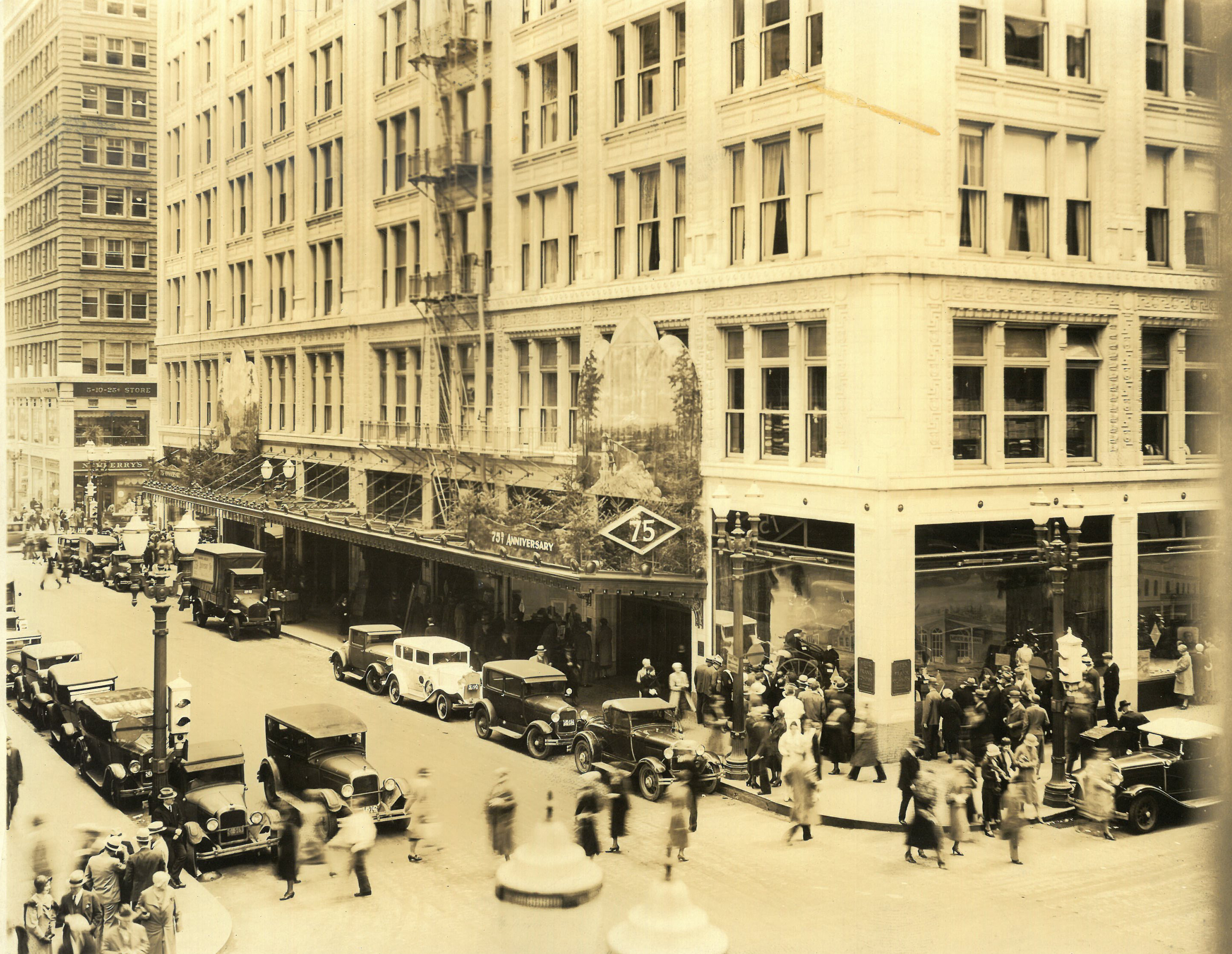
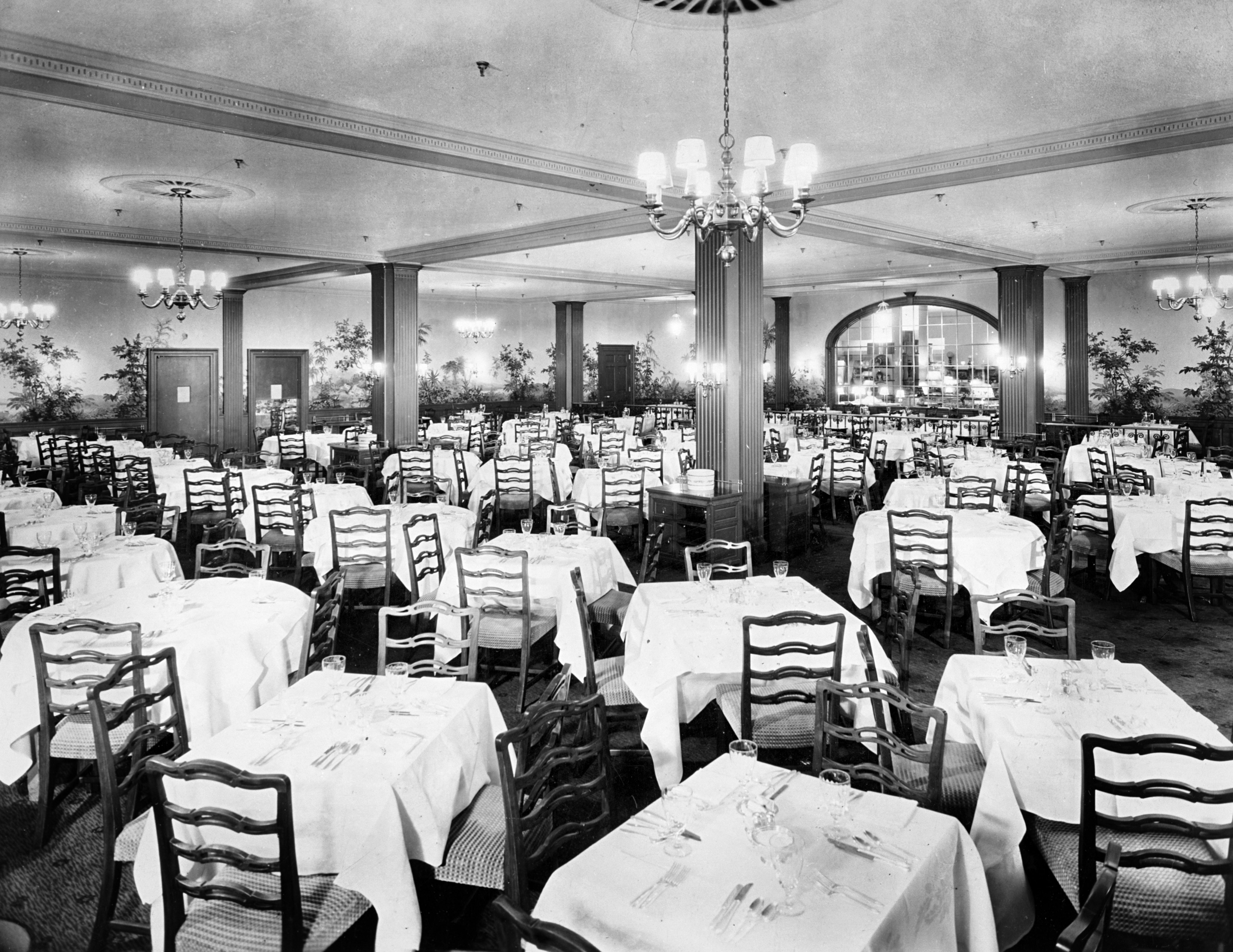
The third stage—a fifteen-story building on the southwest corner of the block—was connected to the existing structures in 1932, completing the full-block design. The 650,000 square feet of added floor space cost $3.5 million. Doyle had died in 1928, so his work was taken up by DeYoung, Moscowitz & Rosenberg (New York) and local architect Herman Brookman. The addition included an auditorium for events and fashion shows, an art gallery, a hair salon, a fur vault, a photo department, a grocery, and confectionery departments. A Women’s Meeting and Writing Room was on the fifth floor. Restaurants included the existing tea room and Men’s Grill, the white-tablecloth Georgian Room, and a coffee shop. Meier & Frank had over 100 departments selling everything from candy to clothing, buttons to parakeets, furnishings to fine china. The final addition made the store the largest commercial structure in the state and the city’s second tallest skyscraper (the Public Service Building was the tallest) until the Portland Hilton Tower topped them both in 1962.
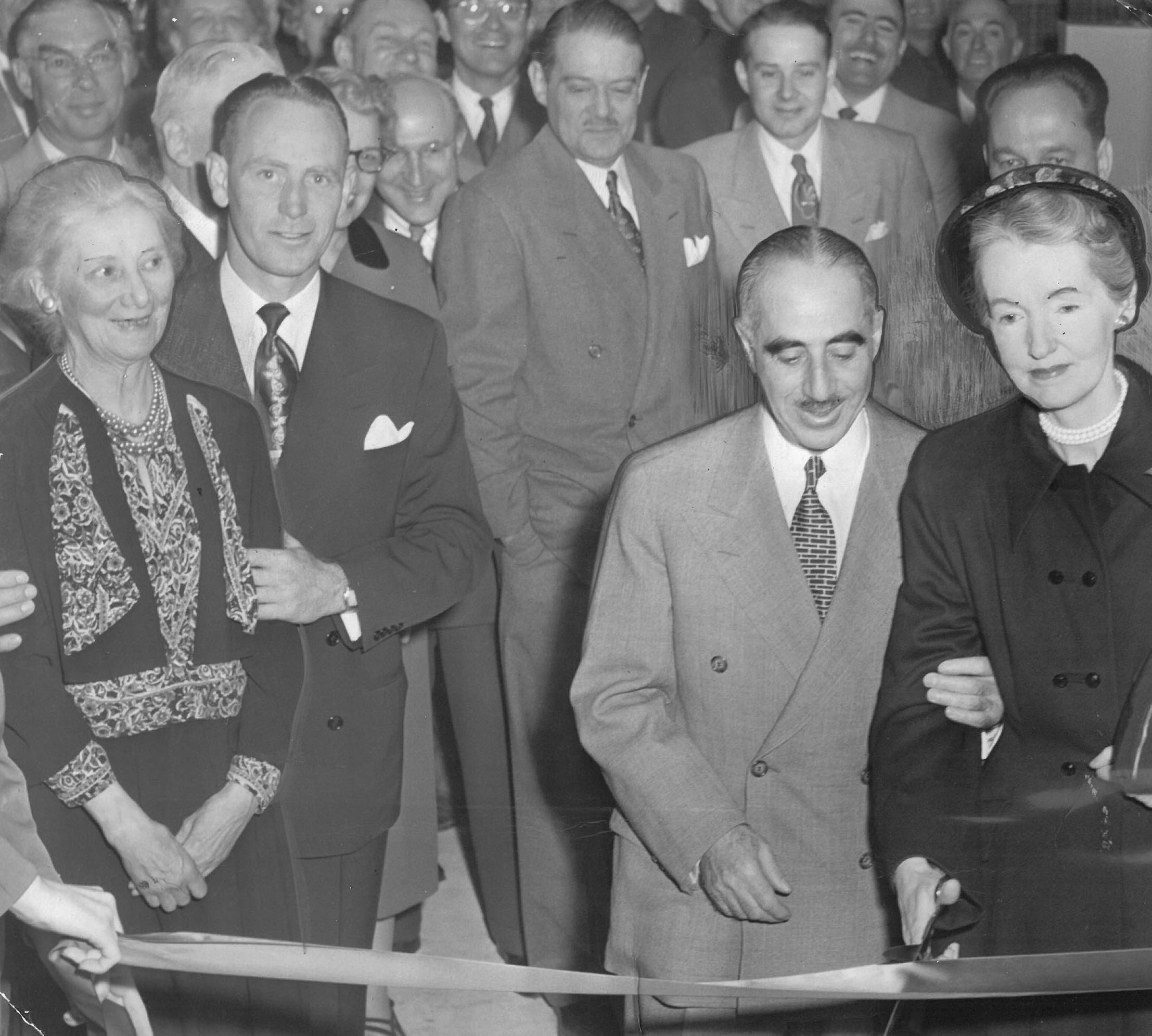
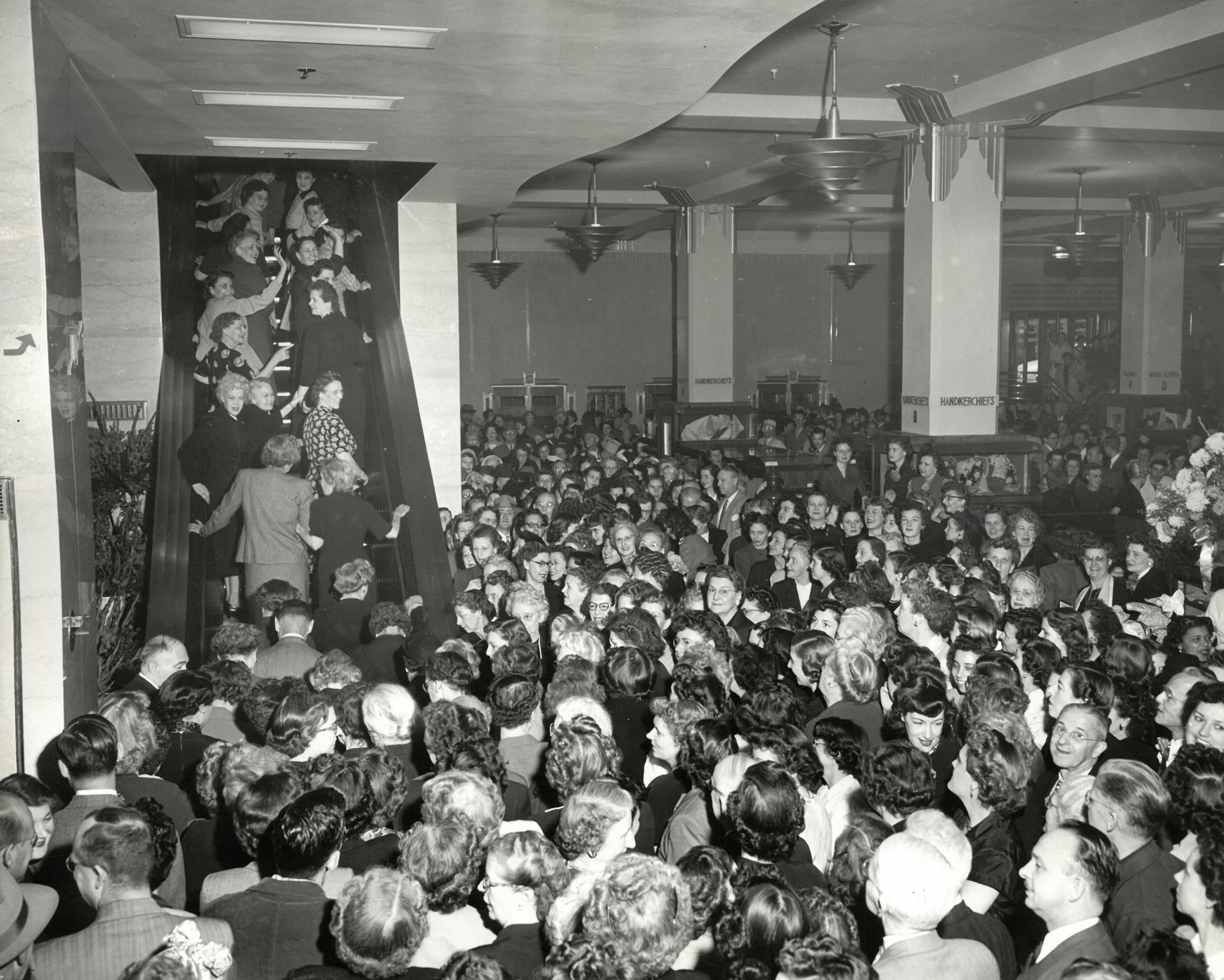
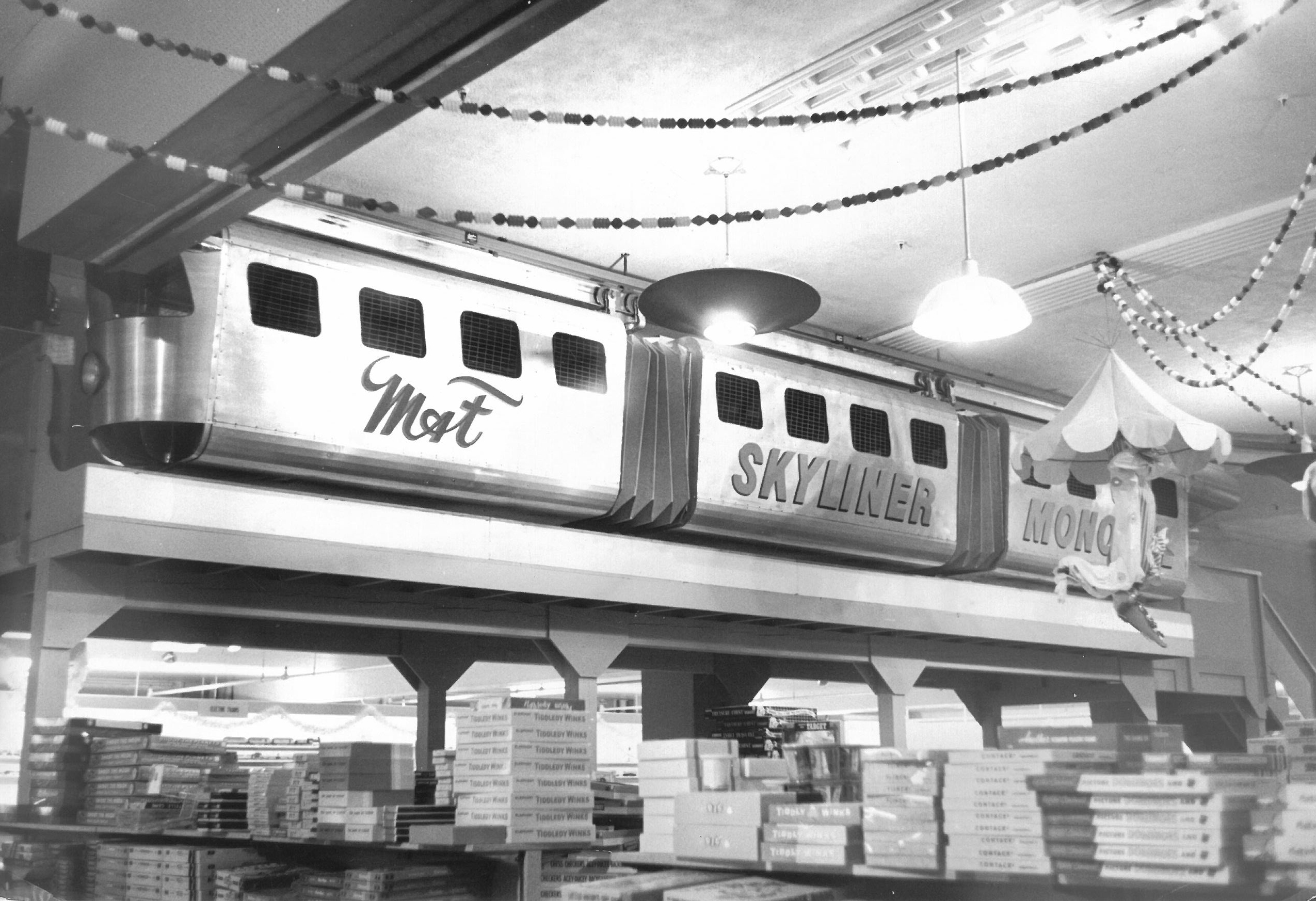
In 1944, Meier & Frank purchased the struggling Portland Hotel, which it operated until the building was torn down in 1951 and replaced it with a two-story parking structure (now Pioneer Courthouse Square). In 1950, Mayor Dorothy McCullough Lee was the first passenger on the new escalator, one of the longest in America, which replaced ten elevators from the 1915 expansion. The $1.5 million dual escalator system extended fourteen floors and could handle 8,000 customers hourly. In 1957, the tenth floor of the building was transformed into Circus Land (later Toyland), with Santa’s Headquarters on the seventh floor. The company installed a working monorail in 1959 in the renamed Santaland. May Department Stores Co. acquired Meier & Frank in 1966, leaving the original name intact.
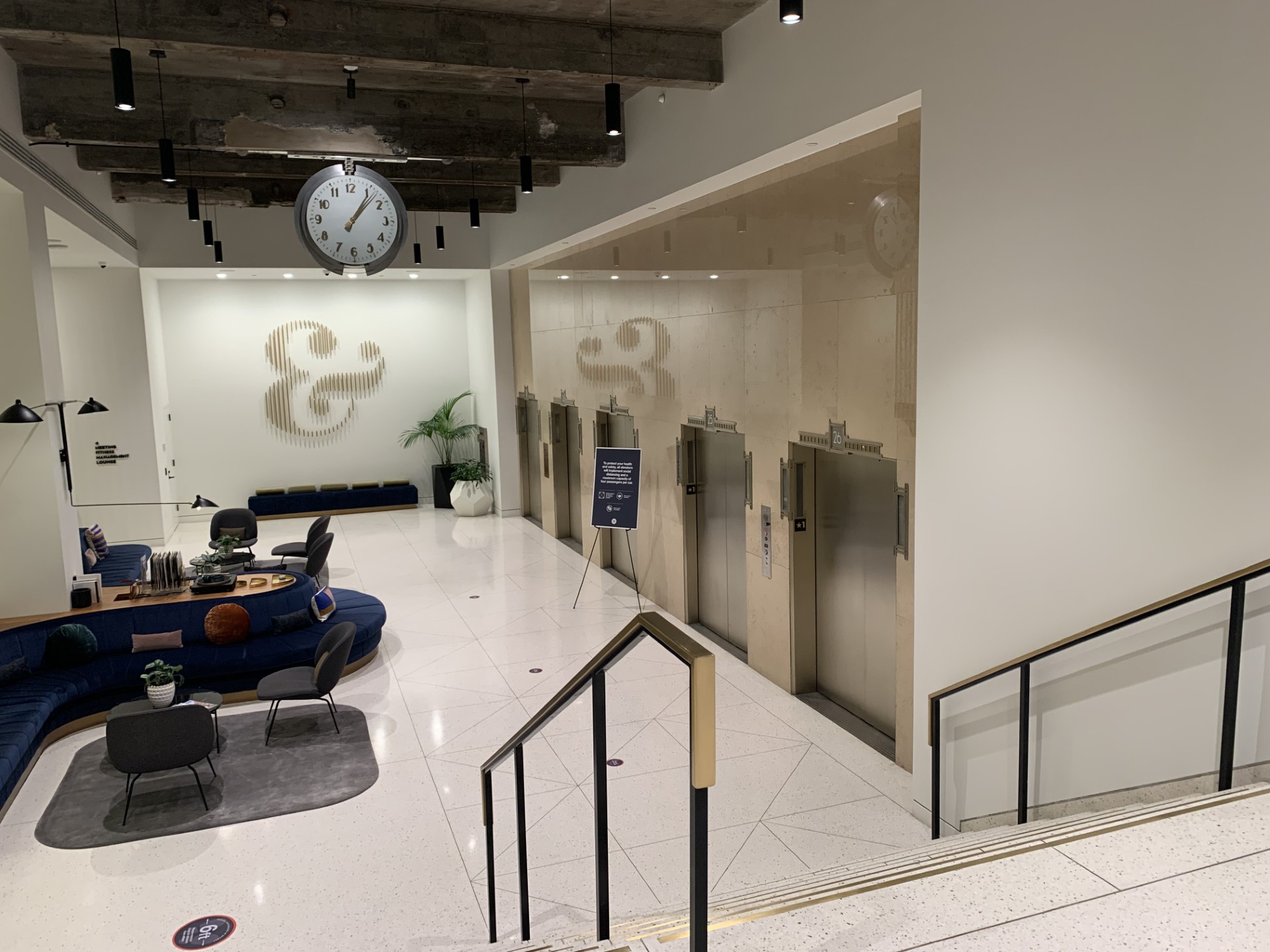
Macy’s purchased Meier & Frank in 2005 and retired the name in 2006. The downtown Portland store was remodeled and reopened with a fraction of its selling space. Upon its closure, Gerry Frank, the founder’s great-grandson, commented, “It was a great institution. It was the heartbeat of Portland.” The flagship store was designated a historic place by the National Register in 1982, and much of the company and family records and artifacts are maintained by the Oregon Historical Society, including sections of Santaland. The famed double-faced clock referred to in the phrase “Meet me under the clock”—coined by Meier & Frank shoppers in the 1960s—still hangs from the ceiling on the building’s first floor near the Morrison Street entrance.
-
![]()
Meier & Frank, c.1920s.
Oregon Historical Society Research Library, Meier & Frank Store photograph collection, 1885-1960, Org. Lot 695, box 1, folder 1, OrHi 106033
-
![]()
Meier & Frank at SW 5th between Alder and Morrison.
Oregon Historical Society Research Library, Photo File #1806 A
-
![]()
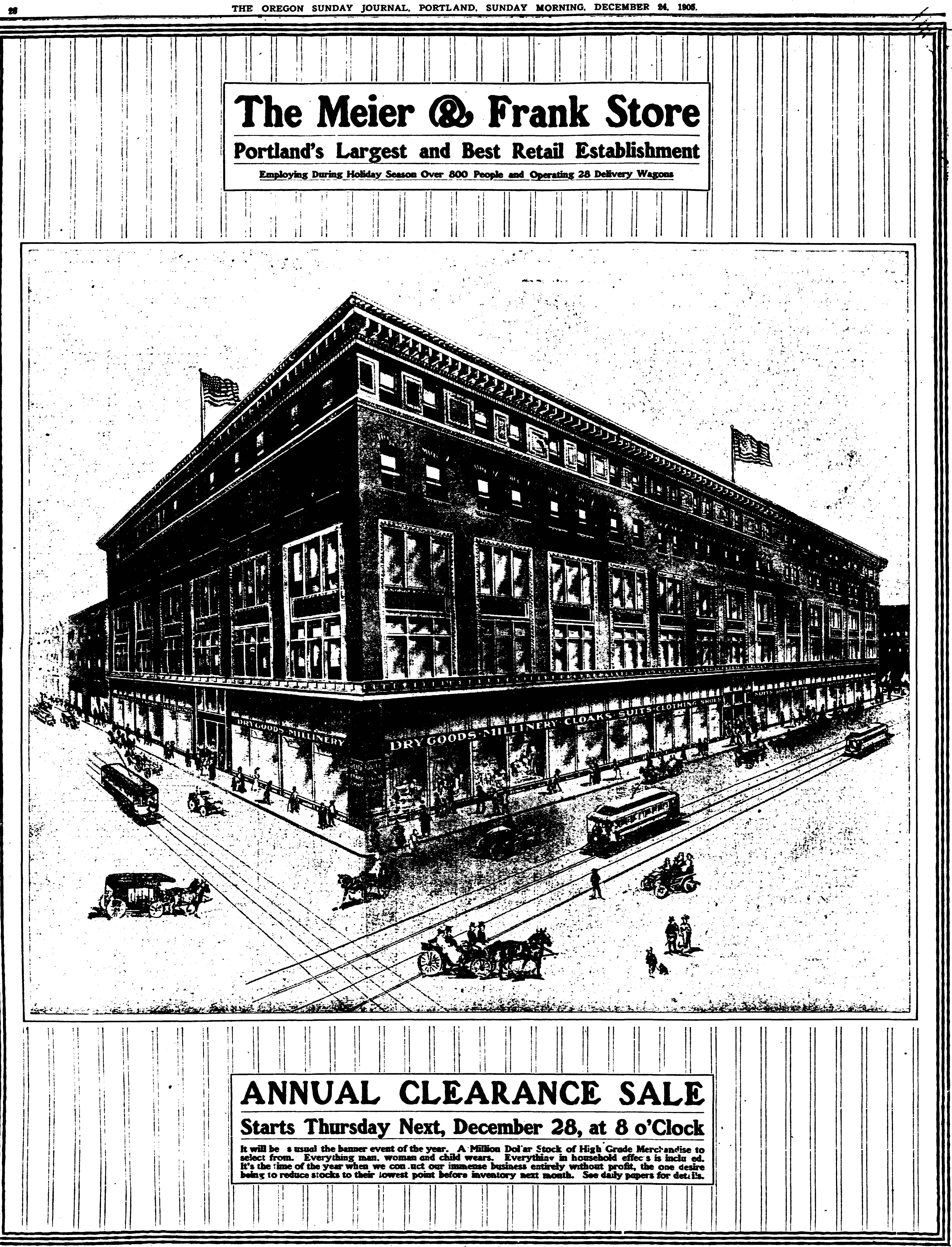
The Meier & Frank Store advertisement in the Oregon Journal, December 24, 1905, p.68.
Courtesy The Oregon Journal
-
![Kiser Photo Co. (Portland, Or.).]()
-
![]()
Meier & Frank, 1909.
Oregon Historical Society Research Library, Photo File #1806-A
-
![]()
Construction of Meier & Frank 1909 Annex addition.
Oregon Historical Society Research Library, Neg. No. 12967, Photo File #1806-A
-
![]()
Construction on the 1909 Meier & Frank building addition.
Oregon Historical Society Research Library, OrHi 12968, Photo File #1806-A
-
![]()
Meier & Frank building, 1909.
Courtesy Oreg. Hist. Soc. Research Library, 023532
-
![]()
"The Meier & Frank Store's Great New 10-Story Annex," Morning Oregonian, July 6, 1909, p.10.
Courtesy The Oregonian
-
![]()
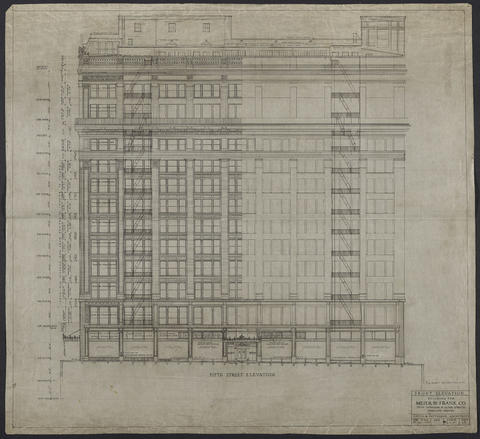
Building for Meier & Frank Front Elevation, 1914.
Oregon Historical Society Research Library, Digital Collections, Doyle and Patterson architectural papers, Mss3075-6, Item 19 -
![]()
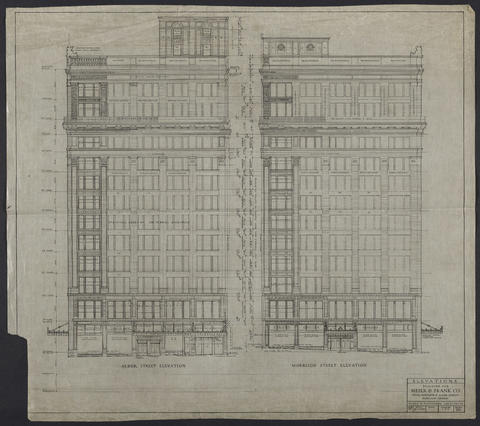
Building for Meier & Frank Elevations, 1914.
Oregon Historical Society Research Library, Digital Collections, Doyle and Patterson architectural papers, Mss3075-6, Item 20 -
![]()
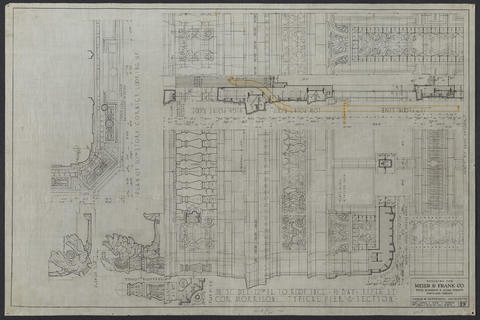
Building for Meier & Frank Exterior Details, 1914.
Oregon Historical Society Research Library, Digital Collections, Doyle and Patterson architectural papers, Mss3075-6, Item 25 -
![]()
Meier & Frank after 1915 construction, OrHi 76695, Photo File #1806-A.
-
![]()
Meier & Frank building at SW 5th and Alder, 1915.
Oregon Historical Society Research Library, Meier & Frank Store photograph collection, 1885-1960, Org. Lot 695, box 1, folder 1, OrHi 95981
-
![]()
Meier & Frank Tube room, c.1915.
Oregon Historical Society Research Library, Photo File #1806-A, Neg #72537
-
![]()
The main block of the Meier & Frank store was built in 1915. The 1932 addition replaced the four-story structure at SW Sixth and Morrison.
Oregon Historical Society Research Library, OrHi_17526
-
![]()
View of 1932 Meier & Frank construction at SW 6th & Morrison taken from the Oregon Journal building, Portland Hotel in foreground.
Oregon Historical Society Research Library, Neg #84108, Photo File #1806-A
-
![]()
Harry Nielsen, superintendent of steel construction on the new Meier & Frank addition, April 1931.
Oregon Historical Society Research Library, Oregon Journal Photo, BB009113, Photo File #1806-A
-
![]()
Meier & Frank final building addition, 1932.
Oregon Historical Society Research Library, OrHi 105752, Photo File #1806-A
-
![]()
Meier & Frank Company from the Fifth and Morrison street corner, 1932.
Oregon Historical Society Research Library, Oregon Journal Photo, OrHi 95295, Photo File #1806-A
-
![]()
Meier & Frank store celebrating its 75th anniversary, 1932.
Oregon Historical Society Research Library, Meier & Frank Store photograph collection, 1885-1960, Org. Lot 695, box 1, folder 1, CN 023526
-
![]()
The Georgian Room's main dining room in about 1933.
Oregon Historical Society Research Library, bb003632
-
![]()
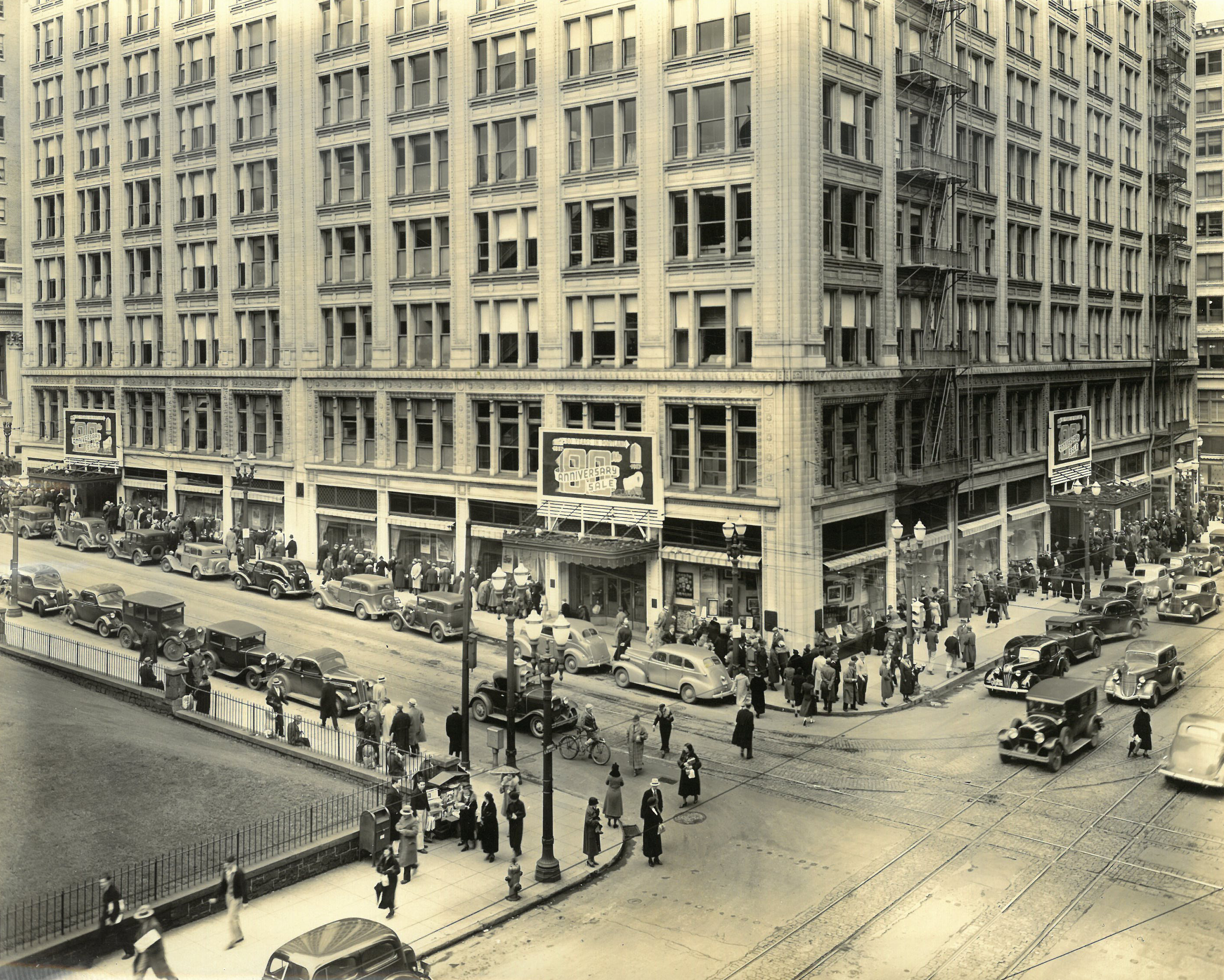
Meier & Frank 80th anniversary celebration, 1937.
Oregon Historical Society Research Library, Meier & Frank Store photograph collection, 1885-1960, Org. Lot 695, box 1, folder 1, OrHi 95982
-
![]()
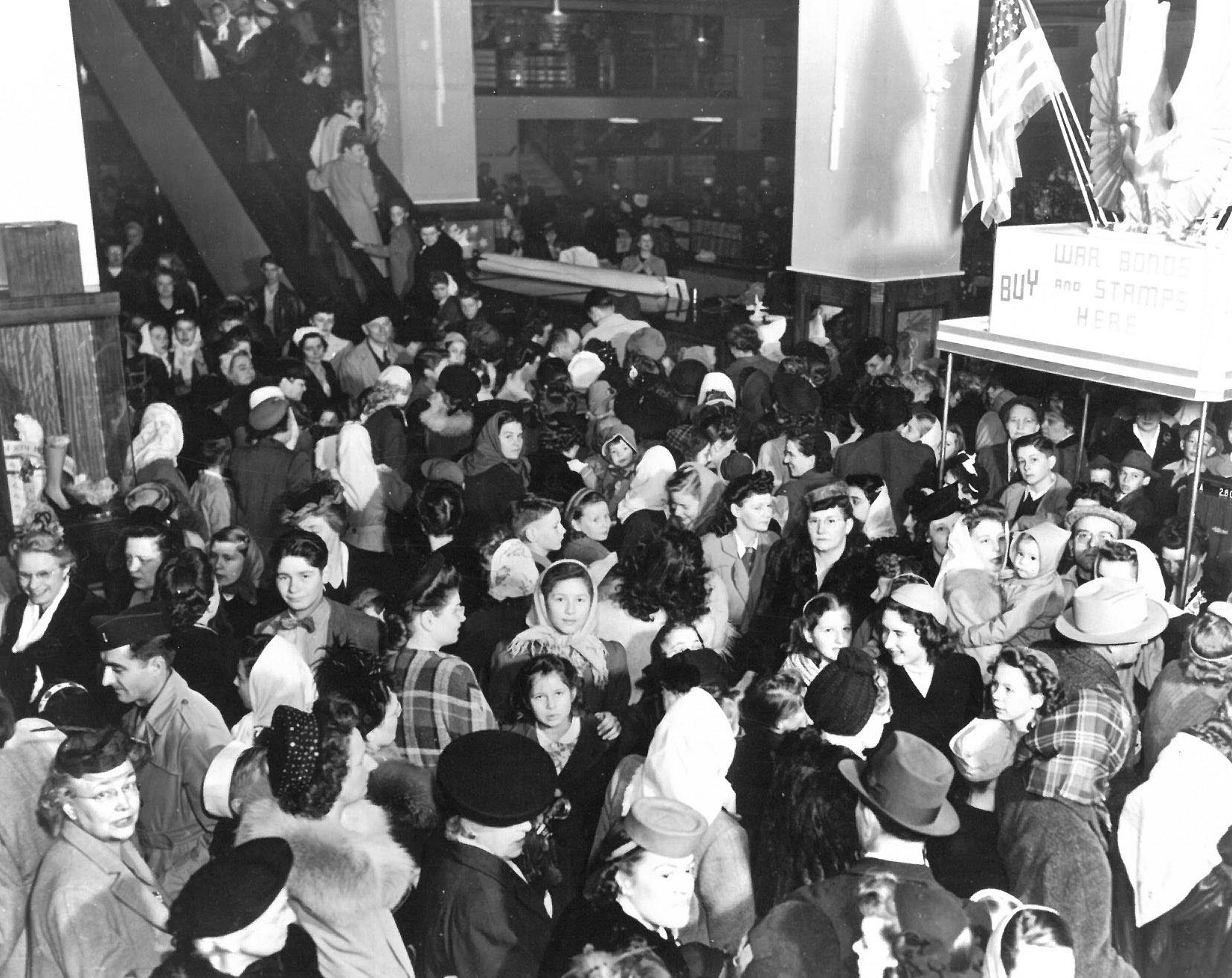
Meier & Frank War Bond Drive.
Oregon Historical Society Research Library, OrHi 76842, Photo File #1806-A
-
![]()
Mayor Dorothy McCullough Lee at the ribbon cutting ceremony for Meier & Frank's new escalator system, October 1950.
Oregon Historical Society Research Library, Photo File #1806-A
-
![]()
Meier & Frank shoppers on the longest continual moving stairway in the U.S., October 2, 1950.
Oregon Historical Society Research Library, Meier & Frank Store photograph collection, 1885-1960, Org. Lot 695, box 1, folder 1, CN 023528
-
![This group of employees have been with the company for at least thirty years. Emma Doering, (2nd woman from the right in the first row) has been with the company for 64 years.]()
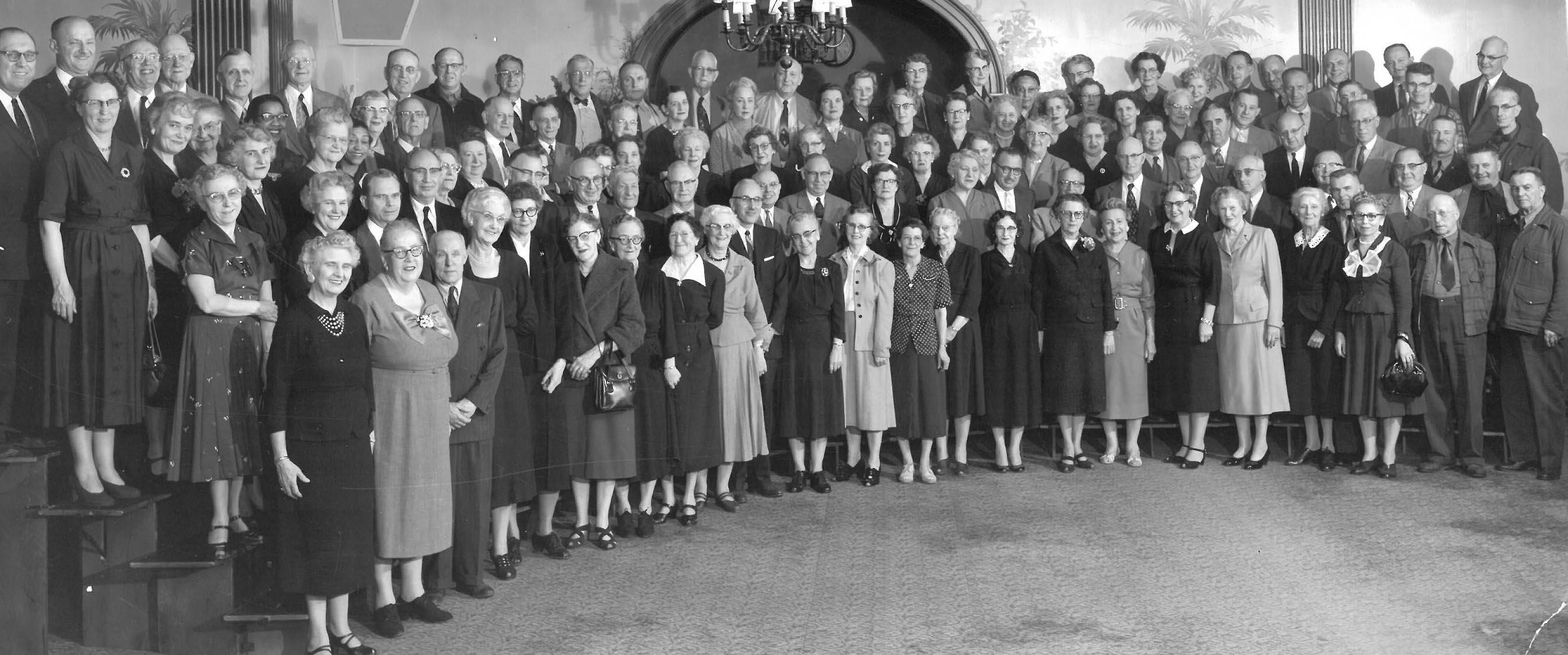
Founders Day event at Meier & Frank, April 1957.
This group of employees have been with the company for at least thirty years. Emma Doering, (2nd woman from the right in the first row) has been with the company for 64 years. Oregon Historical Society Research Library, 235038, Photo File #1806-A
-
![]()
Meier & Frank toyland with skyliner monorail, 1959.
Oregon Historical Society Research Library, Photo File #1806 A, OrHi 106030
-
![]()
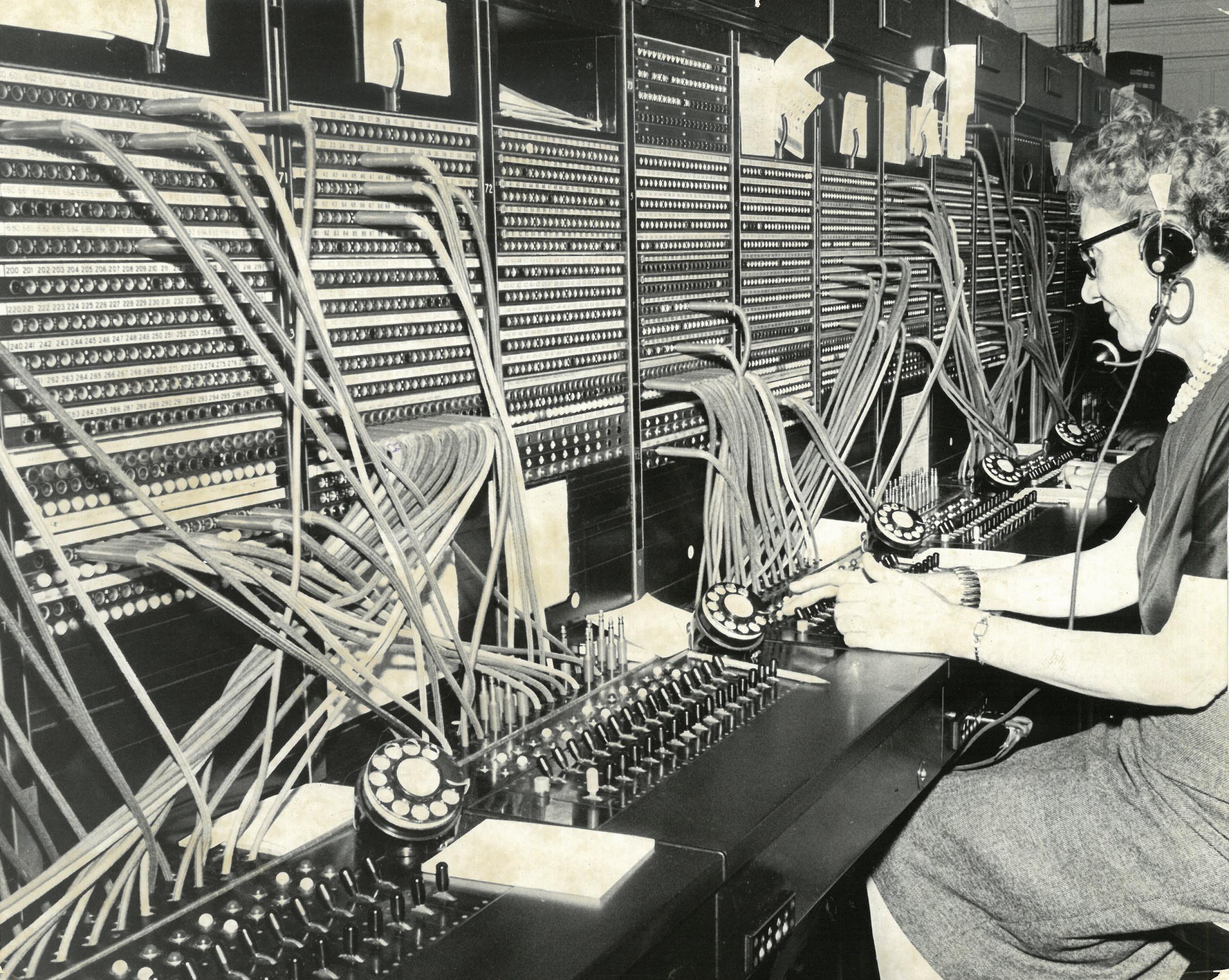
Mrs. Dot Lake manages Meier & Frank switchboard calls, December 1960.
Oregon Historical Society Research Library, OrHi 91003, Photo File #1806-A
-
![]()
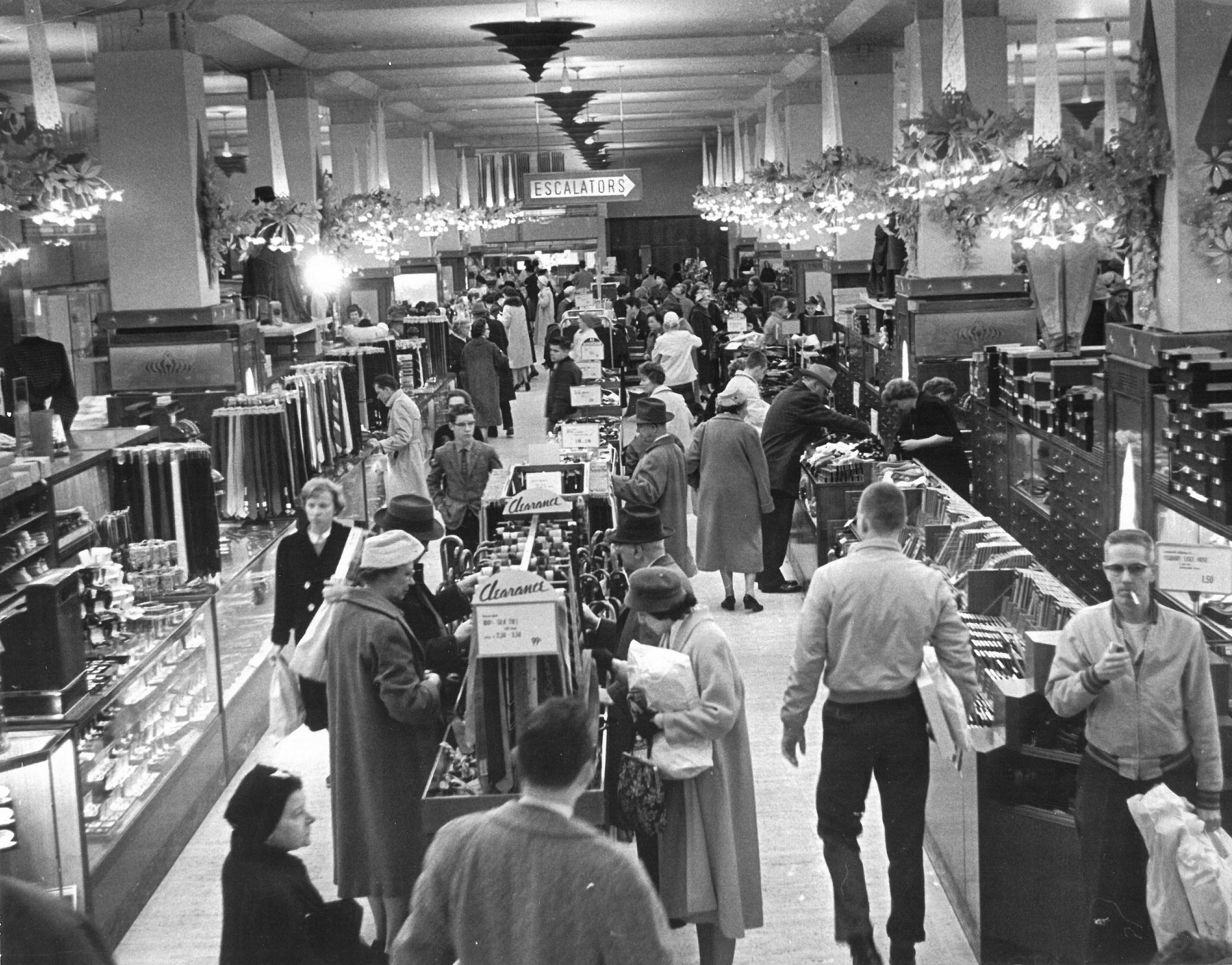
Meier & Frank shoppers, December 26, 1960.
Oregon Historical Society Research Library, OrHi 91262, Photo File #1806-A
-
![]()
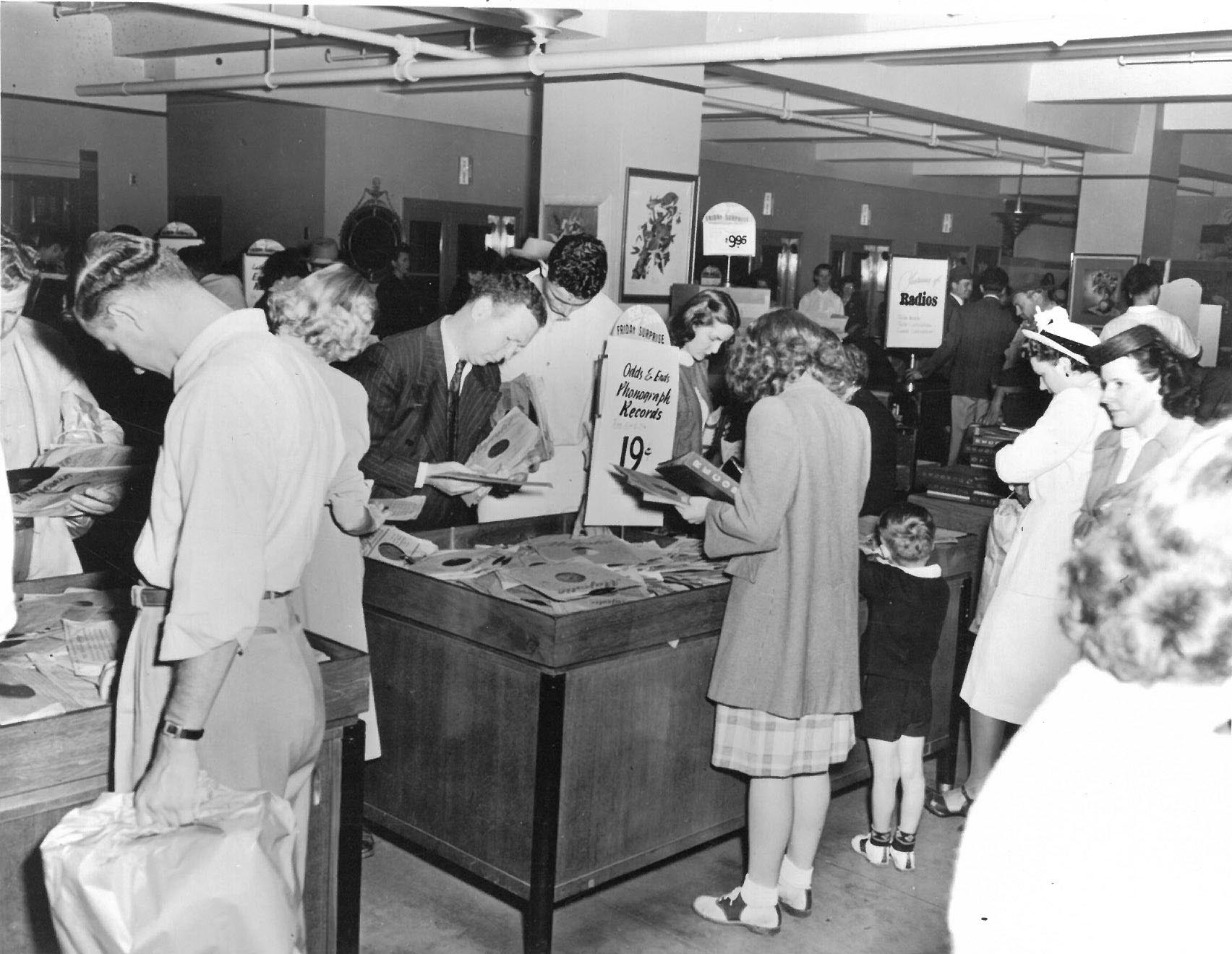
Meier & Frank "Friday Surprise" Record Sale.
Oregon Historical Society Research Library, OrHi 76853, Photo File #1806-A
-
![]()
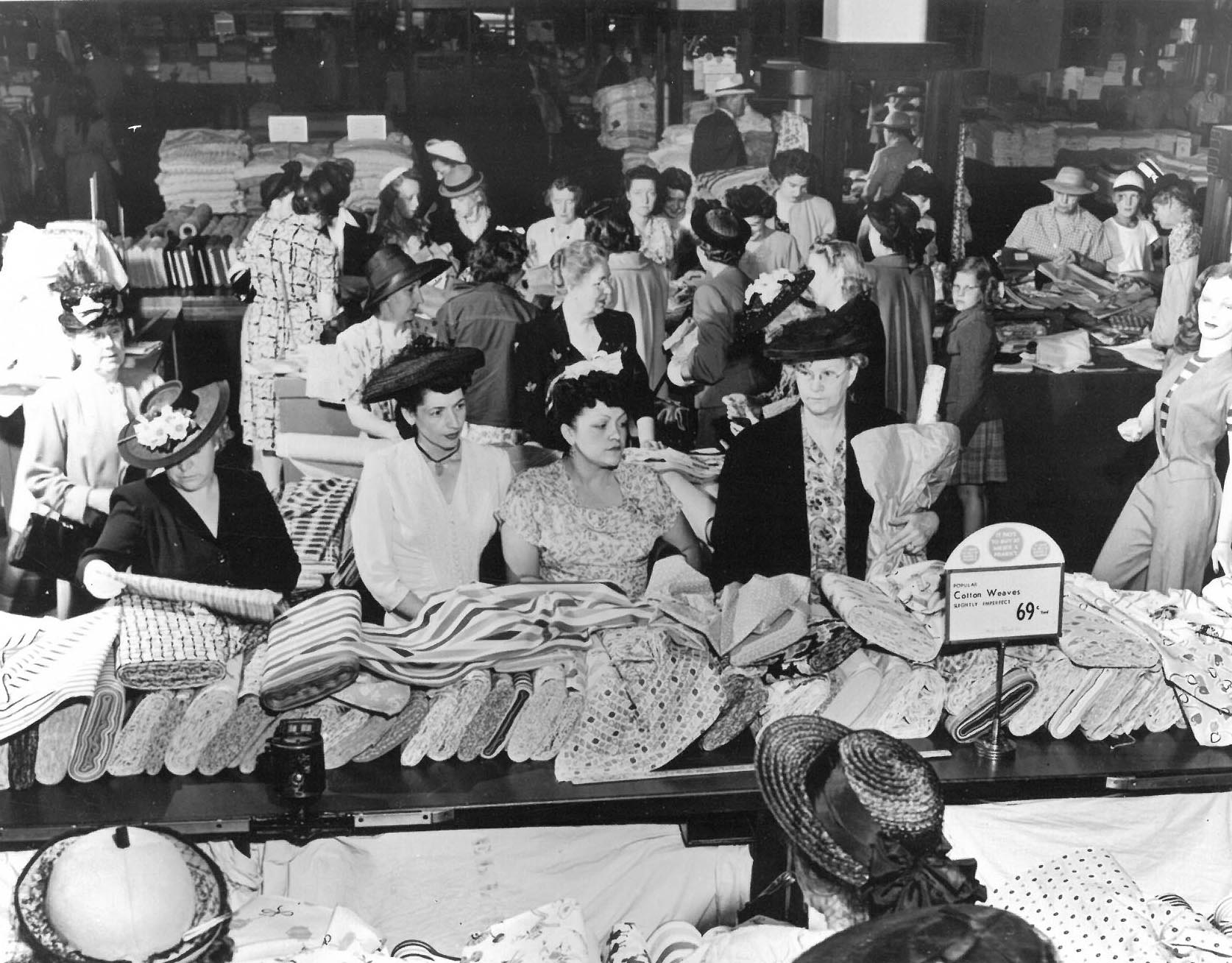
Meier & Frank sale.
Oregon Historical Society Research Library, OrHi 76855, Photo File #1806-A
-
![]()
Meier & Frank building, 1952.
Courtesy Oreg. Hist. Soc. Research Library, 005930
-
![]()
"Meet Me Under the Clock" clock at the former Meier & Frank Building entrance, 2026.
Courtesy Lee Weinstein
Related Entries
-
![Albert E. Doyle (1877-1928)]()
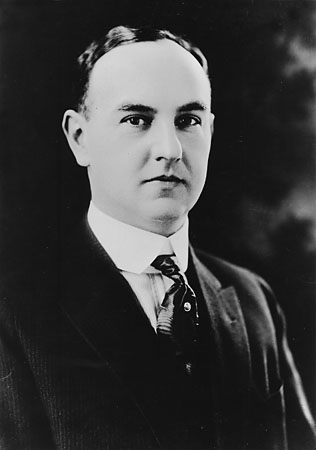
Albert E. Doyle (1877-1928)
Albert Ernest Doyle was one of Portland’s most successful early twentie…
-
![Gerald Wendel “Gerry” Frank (1923–2022)]()
Gerald Wendel “Gerry” Frank (1923–2022)
In 2000, Governor John Kitzhaber named Gerry W. Frank Oregon’s Premier …
-
![Julius L. Meier (1874-1937)]()
Julius L. Meier (1874-1937)
Julius Meier served as Oregon’s governor from 1931 to 1935 during the d…
-
![Meier & Frank Co.]()
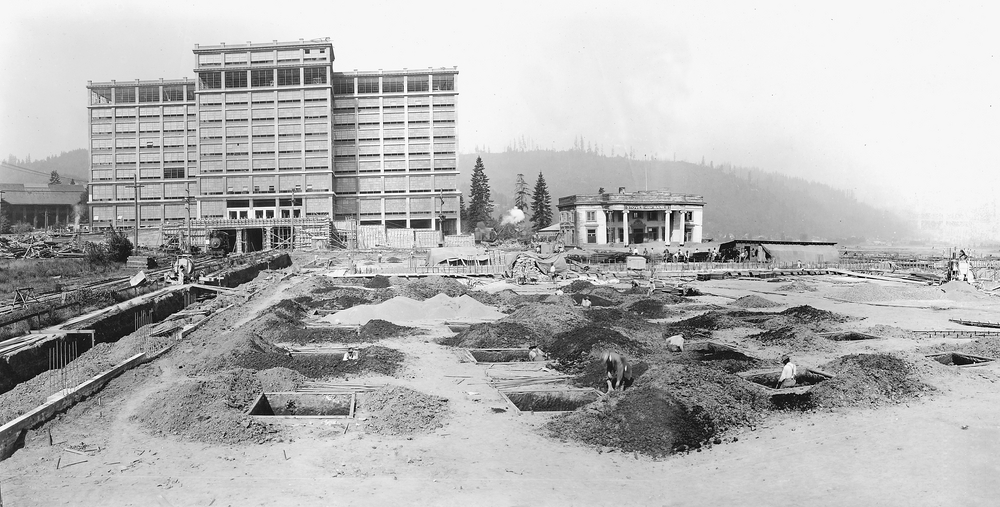
Meier & Frank Co.
Meier & Frank, which advertised itself as “One of America’s Great Store…
-
![Montgomery Ward/Park Building]()
Montgomery Ward/Park Building
The Montgomery Ward building in northwest Portland was a hallmark of mo…
-
![Portland]()
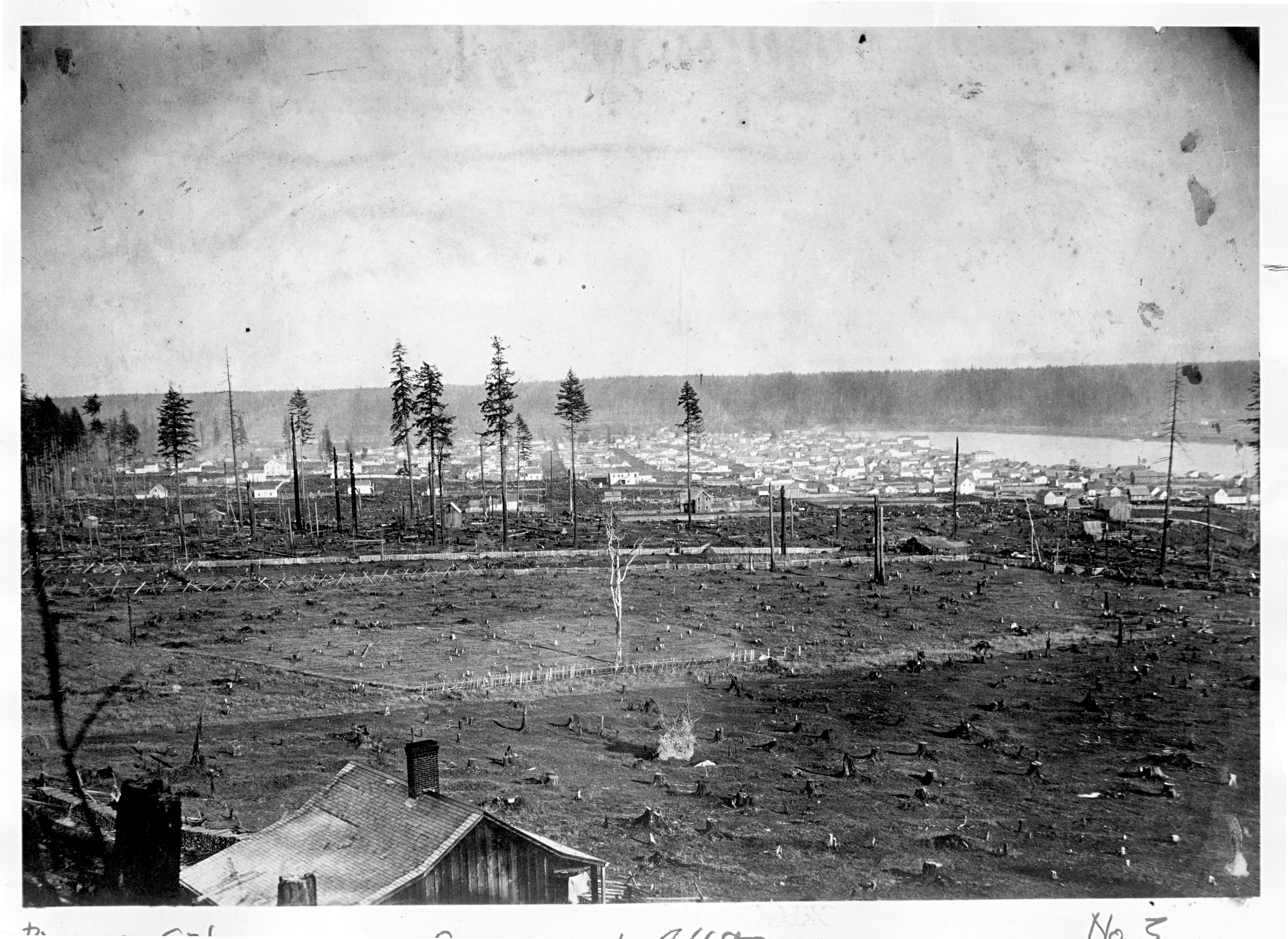
Portland
Portland, with a 2020 population of 652,503 within its city limits and …
-
![Whidden and Lewis, architects]()
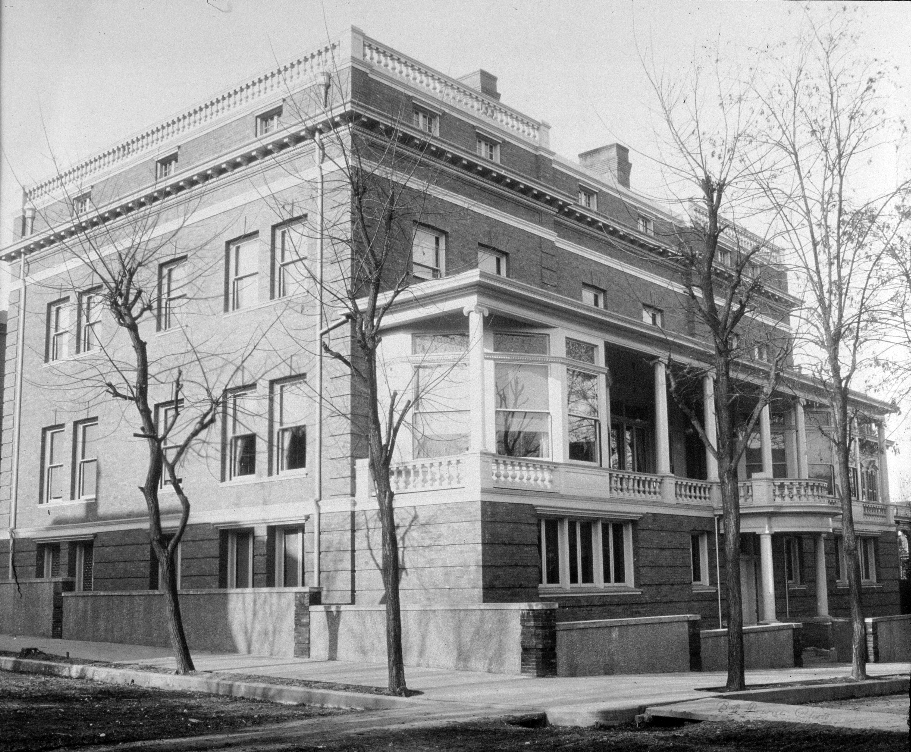
Whidden and Lewis, architects
From 1890 to 1910, the Whidden and Lewis firm dominated architectural d…
Related Historical Records
Map This on the Oregon History WayFinder
The Oregon History Wayfinder is an interactive map that identifies significant places, people, and events in Oregon history.
Further Reading
Acker, Lizzy. "Macy's Portland downtown holiday parade is no more." Portland Oregonian, May 8, 2017.
Whitaker, Jan. The World of Department Stores. London, UK: The Vendrome Press, 2006.
Meier and Frank Company collection, 1855-2006. Mss 2866, OHS Research Library, Portland.
Harris, Leon A. Merchant Princes: An Intimate History of Jewish Families Who Built Great Department Stores. New York: Kodansha USA, 1979.
Lockley, Fred. “Observations and impressions of the Journal Man.” Portland Oregon Journal, July 30, 1919, p. 8.
Lowenstein, Steven. The Jews of Oregon. Portland: Jewish Historical Society of Oregon, 1987.