


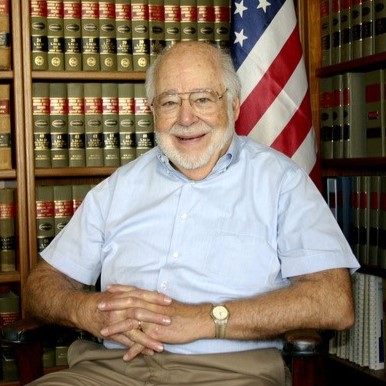
A respected and successful trial lawyer, Elden Rosenthal practiced law in Oregon from 1972 to 2019 with a focus on personal injury law and civil rights advocacy. His work included cases involving wrongful death, automobile accidents, medical and nursing home malpractice, defective products, and sexual misconduct. He also made significant advances in Oregon law regarding government abuses, taking cases where individuals had been caught in a web of government misconduct at every level.
Elden Rosenthal was born in Des Moines, Iowa, on March 15, 1947, to Frank Rosenthal, a rabbi whose family had left Germany in the 1930s, and Ruth Mestelman, whose family had immigrated from Russia. As a child, Elden lived in Seattle and in the Los Angeles area, where he attended school in Long Beach and Bellflower. He earned a BA in speech and rhetoric from UCLA in 1968 and a JD from Stanford University in 1972.
In 1969, Rosenthal married Marjorie "Margie" Kieffer, a special education teacher who taught music at Jewish religious schools and sang and recorded Jewish music. They would have two children. After Elden completed law school, the couple moved to Portland, where he practiced law with the firm Pozzi, Wilson and Atchison before beginning his own practice in 1973. That year the Rosenthals attended the first meeting of the newly forming congregation Havurah Shalom, where each served as president of the congregation. Elden formed a partnership with Michael Greene in 1980, and they practiced together until they retired in 2019.
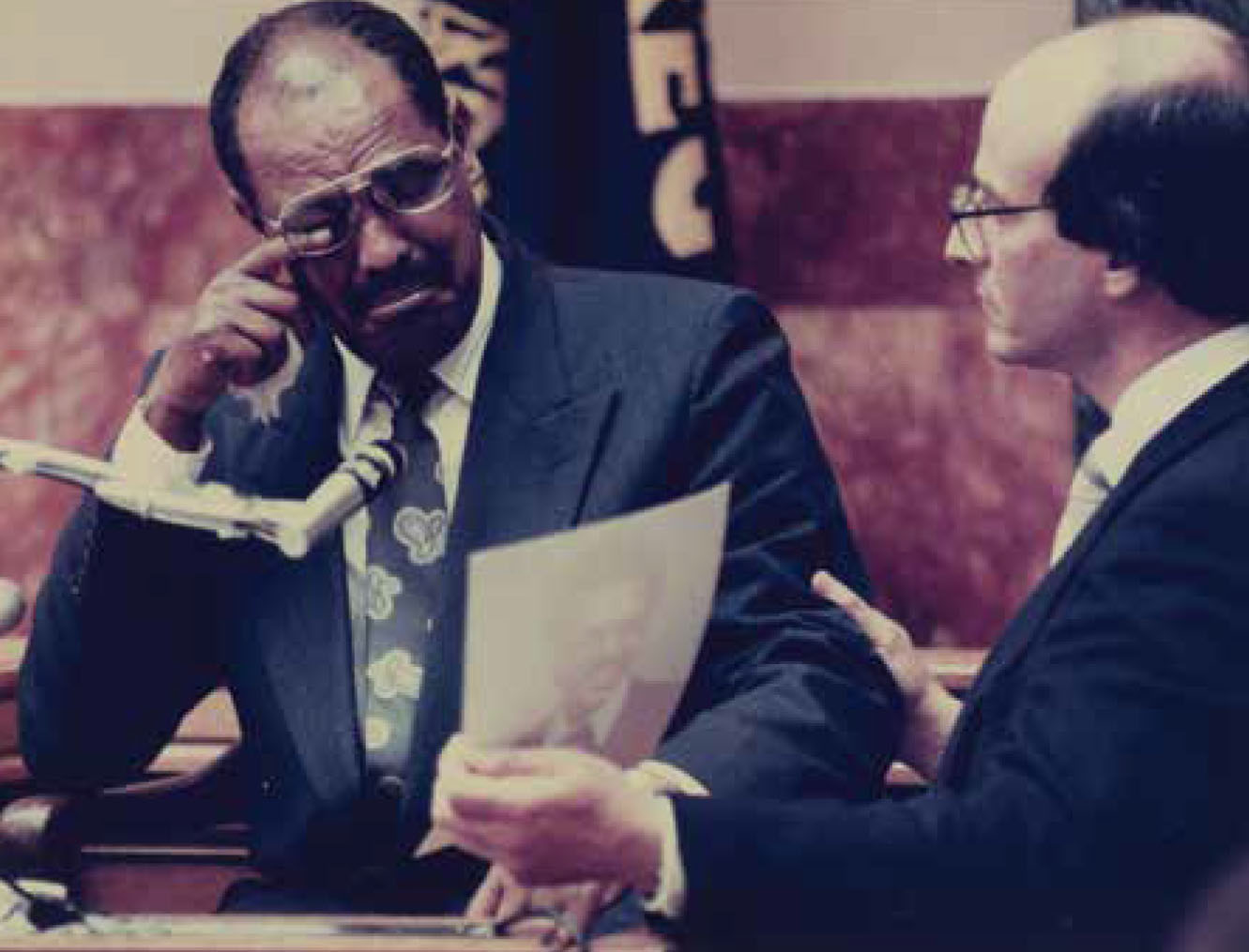
Rosenthal came to national prominence in 1990 when he served as the local pro bono co-counsel for Berhanu v. Metzger, a civil case connected to a racially motivated murder in Portland. On November 13, 1988, three young neo-Nazi skinheads, members of a group that called itself East Side White Pride, attacked Mulugeta Seraw, an Ethiopian student, on a Portland street and beat him to death with a baseball bat. The three men had joined White Aryan Resistance, founded by Californian Tom Metzger and his son John. The Metzgers had sent one of their members, Dave Mazzella, to Portland to recruit skinheads, including members of East Side White Pride, to join their group. The three attackers were convicted of murder.
After the criminal trial, Mazella turned himself in to the Jewish Anti-Defamation League in Santa Ana, California. The ADL contacted the Southern Poverty Law Center, and Morris Dees, its director, persuaded Mazzella to be a witness against the White Aryan Resistance. Dees and SPLC had been pursuing a successful strategy of bringing lawsuits against white supremacist groups and had won large financial judgments that put those groups out of business. He planned a similar suit in Portland against White Aryan Resistance, and he needed a local co-counsel. Paul Meyer, a Portland ACLU lawyer, recruited Rosenthal.
Rosenthal agreed with Dees that civil rights violations are often best vindicated by making the wrongdoers pay, literally, for their misdeeds. Dees had originally wanted to bring a suit against White Aryan Resistance for a civil rights violation under federal law, but Rosenthal persuaded him to bring a wrongful death case under Oregon law because the names of witnesses would not have to be released before trial and they could protect Mazzella from harassment. The subsequent trial in the court of Multnomah County Circuit Judge Ancer Haggerty resulted in an award for damages of $12.5 million, at the time one of the largest verdicts in Oregon history.
Rosenthal was in the national news again in 2006 as co-counsel with Gerry Spence and Michelle Longo Eder, settling the claims of Oregon attorney Brandon Mayfield against the FBI. Based on an incorrect fingerprint match, the Bureau had wrongfully identified Mayfield as a suspect in a March 11, 2004, terrorist bombing in Madrid. Despite doubts expressed by Spanish authorities, the FBI had investigated Mayfield using the powers of the Patriot Act to search his home and office and to tap his phones. He was jailed for two weeks as a material witness before a judge dismissed the case against him. Mayfield sued, and Rosenthal helped settle the claim. The government paid the Mayfield family $2 million and issued a formal public apology. Mayfield, represented by Rosenthal, Spence and Eder, challenged the provisions of the Patriot Act. On September 26, 2007, two provisions of the Patriot Act were found unconstitutional by the United States District Court for the District of Oregon. The government appealed the decision, and the Ninth Circuit overturned the ruling in 2008 on the grounds that Mayfield lacked standing. The U.S. Supreme Court declined to hear Mayfield's appeal of that decision.
In 1991, Rosenthal received the Award of Merit, the highest honor given by the Oregon State Bar, and the Public Justice Award from the Oregon Trial Lawyers. He received the E. B. MacNaughton Award from the Oregon chapter of the American Civil Liberties Union in 2007; the Distinguished Trial Lawyer Award from the Oregon Trial Lawyers in 2008; and the Don H. Marmaduke Access to Justice Award from the Oregon Chapter of the American College of Trial Lawyers in 2013.
From 1988 to 2004, Rosenthal was an adjunct law professor at the Lewis & Clark Law School, teaching tort law and trial practice to night students. He served on the Board of the Southern Poverty Law Center from 2012 to 2022 and wrote The Plaintiff Lawyer’s Playbook in 2019, as well as law journal articles and a blog, “Streamside Reflections.” Rosenthal lives in Lake Oswego, Oregon.
-
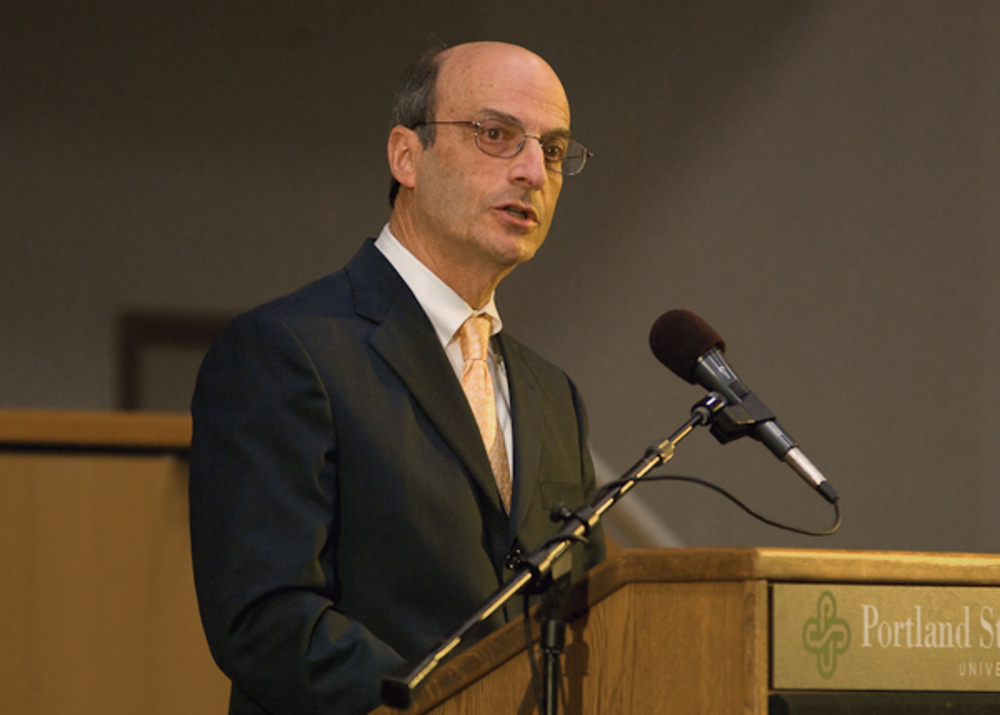
![Civil rights attorney Elden Rosenthal speaks at the 2008 Day of Remembrance event at Portland State University.]()
Day of Remembrance, 2008.
Civil rights attorney Elden Rosenthal speaks at the 2008 Day of Remembrance event at Portland State University. Copyright 2008 Rich Iwasaki
-
![]()
The Plaintiff Lawyer's Playbook, by Elden Rosenthal.
-
![Elden Rosenthal shows Berhanu a photograph of Mulugeta Seraw as Berhanu wipes tears from his eye.]()
Engedaw Berhanu, Seraw's uncle, testifies at the civil trial against the White supremacist Tom Metzger, 1990.
Elden Rosenthal shows Berhanu a photograph of Mulugeta Seraw as Berhanu wipes tears from his eye. Courtesy Portland Oregonian

Related Entries
-
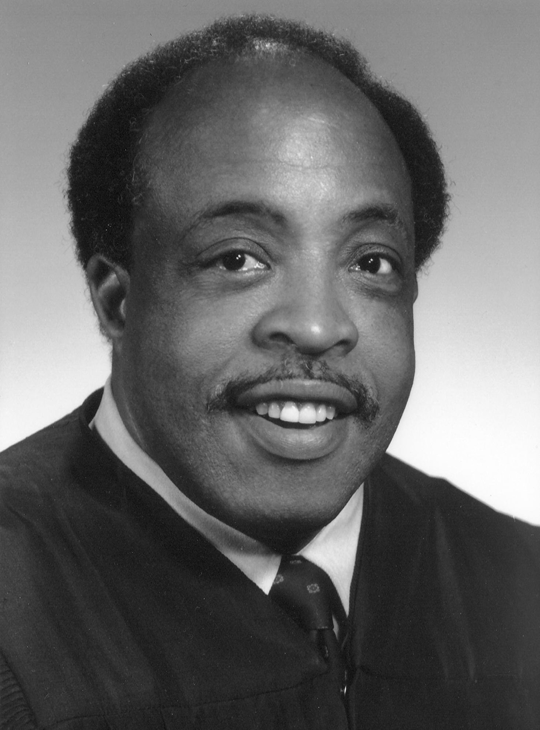
![Ancer L. Haggerty (1944–)]()
Ancer L. Haggerty (1944–)
Ancer L. Haggerty was the first African American to become a partner in…
-
![Lewis & Clark Law School]()
Lewis & Clark Law School
In 1883, British scholar Richard Hopwood Thornton and Matthew Paul Dead…
-
![Mulugeta Seraw (1960–1988)]()
Mulugeta Seraw (1960–1988)
Near Laurelhurst Park in Portland, above the street signs at Southeast …
-
![Paul Richard Meyer (1925–2020)]()
Paul Richard Meyer (1925–2020)
Paul Meyer was a prominent Portland attorney with a lifelong passion fo…
Map This on the Oregon History WayFinder
The Oregon History Wayfinder is an interactive map that identifies significant places, people, and events in Oregon history.
Further Reading
Mayfield v. United States of America. ACLU, Oregon.
Christ, Tom. "Elden Rosenthal." Multnomah Lawyer 53.4 (April 2007).
Rosenthal, Elden. “White Supremacy and Hatred in the Streets of Portland: The Murder of Mulugeta Seraw.” Oregon Historical Quarterly. 120.4 (Winter 2019): 588-605.
Rosenthal, Elden. The Plaintiff Lawyer’s Playbook: Insights and Recommendations on How to Prepare for Success in Settling and Trying Cases. Portland, Ore: Trial Guides LLC, 2019.
“E. B. MacNaughton Award Goes to Elden Rosenthal.” ACLU Oregon News 40.1 (Spring 2007).