


David George Foster was a master teacher, an innovative artist, and an independent thinker. For thirty-five years, beginning in 1957, he was a professor of art, architecture, and art education at the University of Oregon. San Francisco architect Rich Storek, a student of Foster, remembered that many of Foster’s students who became successful film directors, art directors, editors, writers, educators, and animators “regarded him as their prime influence in design thinking for the rest of their lives." Foster also produced experimental and documentary films and for many years created commercials for the Oregon Shakespeare Festival.
Foster was born in Multnomah, Oregon, on January 13, 1924. His father, Winfield Foster, was a World War I veteran. He was twelve when his parents divorced, and Foster moved often—to live with his mother in Salem, his father on the Oregon Coast, his uncle in Klamath Falls, and his older sister in Los Angeles.
Foster’s interest in art began at the Polytechnic High School in Los Angeles, where he learned letterpress, photography, and silkscreen printing. He spent his senior year at Salem High School, where his art teacher was Jean Kendall Glazer, who had studied at the Institute of Design in Chicago. She gave him a dedicated space to work in and encouraged him to think about attending the Institute. For a year after graduating, Foster studied at Willamette University, where he took classes with painter Constance Fowler.
Foster joined the U.S. Army in 1942 and was assigned to the map-making division, where he introduced air brush techniques to improve map illustrations. He transferred to the Army Air Corps, became a tail gunner, and was made an instructor—a position that gave him experience teaching groups of enlisted men, officers, and cadets from China. After his discharge at the war's end, he returned to Oregon to raise enough money to go to Chicago and the Institute of Design.
While in the army, Foster had met László Moholy-Nagy, the founder of the Institute of Design in Chicago, the most famous of the Bauhaus schools in the United States. Moholy-Nagy persuaded Foster to enroll at the Institute, where his teachers in architecture included R. Buckminster Fuller, S. I. Hayakawa, and Harry Callahan, Aaron Siskind, and Konrad Wakeman. He learned graphic design from Hans Scheger and filmmaking from George Kolajo.
He took a part-time job with Mort and Millie Goldsholl Associates, a well-known Chicago advertising agency whose clients included Container Corporation of America, 7-UP, Kimberly-Clark, and Martin-Senour Paints. He set up exhibits of the company's design work in New York City and was often asked to experiment with new materials and techniques for possible use in design and film animation.
By 1954, Foster was teaching at Springfield High School, east of Eugene, and in 1957 he joined the Department of Art at the University of Oregon. He introduced filmmaking in his classes in the 1950s and 1960s, video technology in the 1970s, and computer graphic technology in the 1980s. In 1967, he was a visiting scholar at Mt. Angel College and helped establish its photography and film program.
In his classes at the University of Oregon, Foster used his own film equipment and built animation stands, film-processing tanks, and darkrooms for his students. He mortgaged his house in the 1970s so he could buy professional video equipment for his students’ use. During the 1980s, he allowed students to use his microcomputers to develop art and animation, and he donated equipment to the university to help run one of the first computer-driven weaving looms in a major U.S. art department. He served as department head from 1978 to 1983.
Foster's basic design classes were legendary, and some students took the course many times. In his teaching, Foster used a technique that he called “problem posing,” former student and Oregon artist Robert Gamblin recalled. He “knew that understanding the history of a situation or idea was integral to understanding the situation itself,” and he taught students to look at a problem from many angles and to apply what he called "thinking strategies."
Foster also created documentary, experimental, and animated films; designed signage for Papé Caterpillar Tractor Sales; and made films for the Oregon Shakespeare Festival in Ashland. After he retired from the University of Oregon in the late 1980s, he retrofitted a VW van with a desktop computer graphic workstation powered by batteries so he could drive into the woods and onto farmland to make digital paintings. The paintings were exhibited in art galleries in Eugene and Portland.
David Foster died on December 21, 2002, when he was hit by a car on a rainy night in Springfield. As a legacy to Foster's influence on them, his students created the David G. Foster Endowment at the University of Oregon Art Department to support experimental courses.
-
![]()
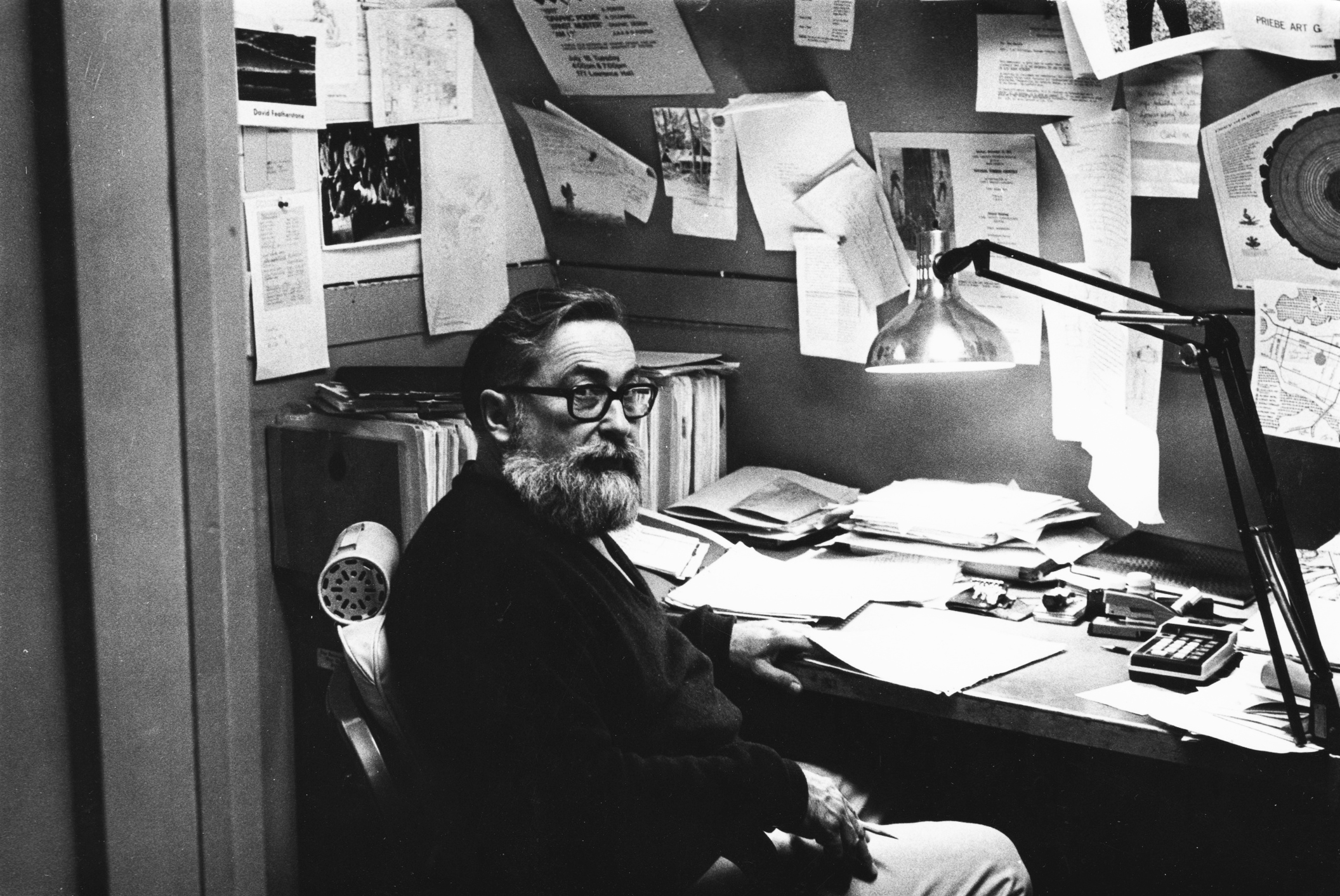
David Foster in one of his many offices at the University of Oregon.
Courtesy Kenneth O'Connell
-
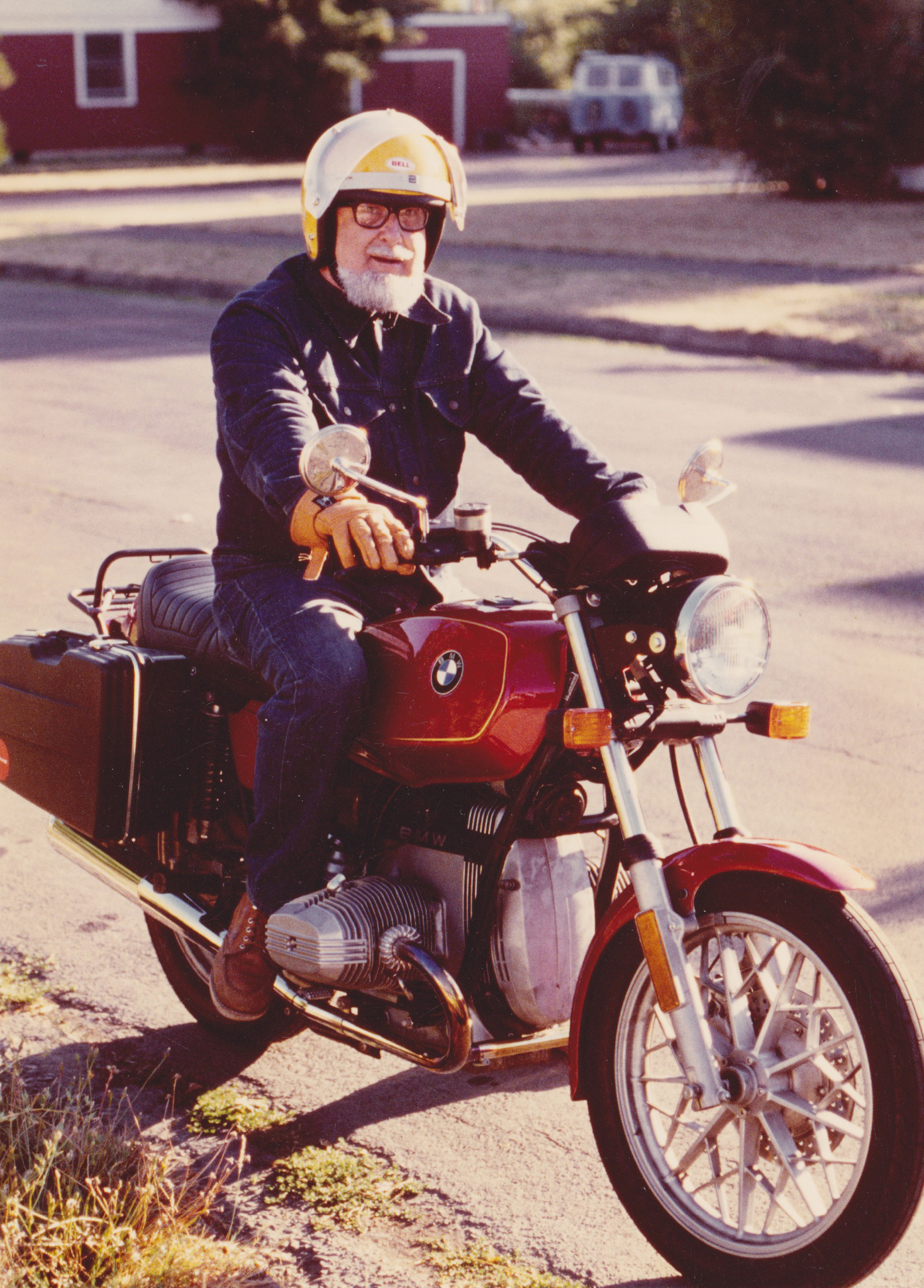
![In his lifetime Foster owned eleven motorcycles and 41 automobiles. He started a motorcycle club while teaching at Springfield High School in the 1950s.]()
David Foster sits astride his BMW motorcycle at the University of Oregon parking lot.
In his lifetime Foster owned eleven motorcycles and 41 automobiles. He started a motorcycle club while teaching at Springfield High School in the 1950s. Courtesy Kenneth O'Connell
-
![]()
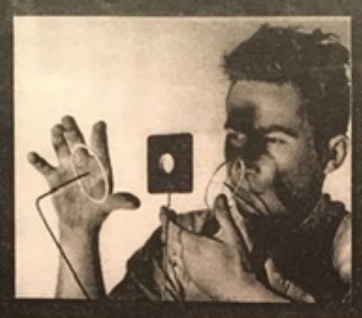
David Foster in Chicago at the Institute of Design experimenting with light and shadow, c.1950s.
Courtesy Peter Builder
-
![]()
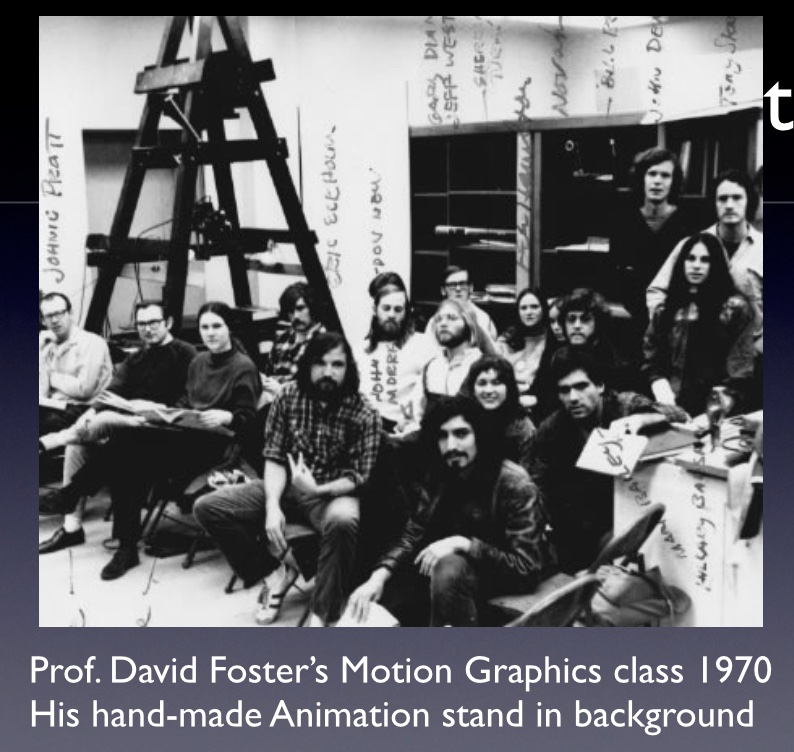
David Foster in room with students. Foster built the 16 mm camera animation stand in the background.
Courtesy Kenneth O'Connell
-
![]()
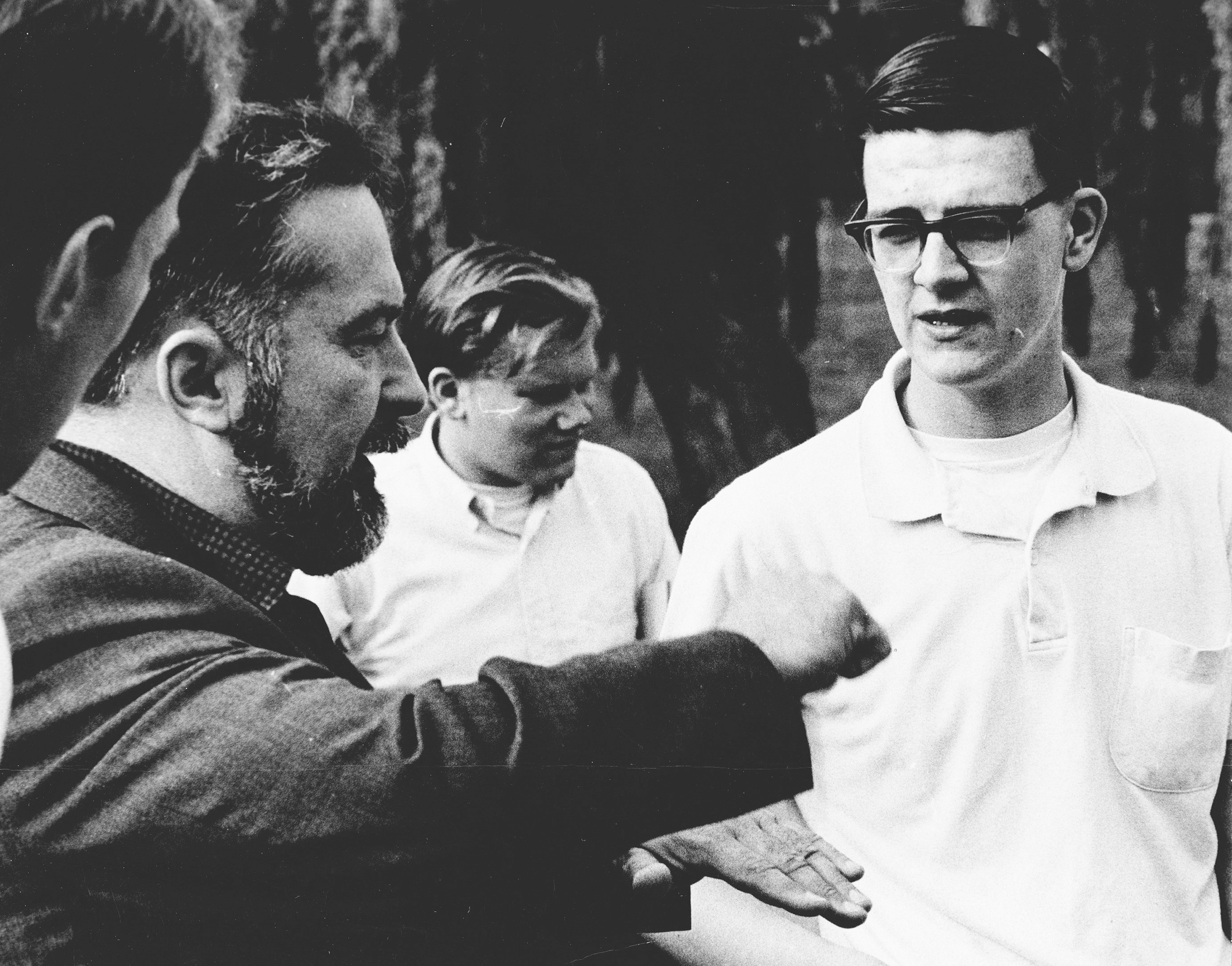
David Foster and Jack Wilkinson, both art professors are in discussion near a large mural that Jack was retouching in 1973.
Courtesy Kenneth O'Connell
Related Entries
-
![Andries Deinum (1918-1995)]()
Andries Deinum (1918-1995)
Film educator Andries Deinum transformed Portland’s cultural and intell…
-
![Constance Fowler (1907-1996)]()
Constance Fowler (1907-1996)
Constance Fowler was a painter, printmaker, author, and educator during…
-
![Eugene]()
Eugene
Eugene is a metropolitan center at the head of the Willamette Valley, a…
-
![Jordan Schnitzer Museum of Art]()
Jordan Schnitzer Museum of Art
The Jordan Schnitzer Museum of Art (JSMA), situated on the Memorial Qua…
-
![Mark Sponenburgh (1918-2012)]()
Mark Sponenburgh (1918-2012)
Mark Sponenburgh was an Oregon sculptor, art historian, educator, art c…
Map This on the Oregon History WayFinder
The Oregon History Wayfinder is an interactive map that identifies significant places, people, and events in Oregon history.
Further Reading
O'Connell, Kenneth R., ed. 99 Gold Stars: The Life and Art of David G. Foster. San Francisco, Calif.: Blurb, 2015.
Nelson, Roy Paul. The Design of Advertising. Dubuque, IA: William C. Brown, Co., 1994.
O'Connell, Kenneth. "Sketching on a Computer." School Arts Magazine (1993).
Rudin, Aimee. "Art professor dies in crash." The Daily Emerald, January 5, 2003.