


The Oregon Public Employee Collective Bargaining Act (PECBA) was enacted in 1973, the third state to pass such a law, to address the lack of a legislative framework to solve labor issues of public employees. The PECBA governs employment relations between public employers and employees in the state, counties, cities, school districts, and other local governments. It does not cover (among others) elected officials, managerial employees, or supervisory employees. Oregon’s Employment Relations Board (ERB) administers the PECBA.
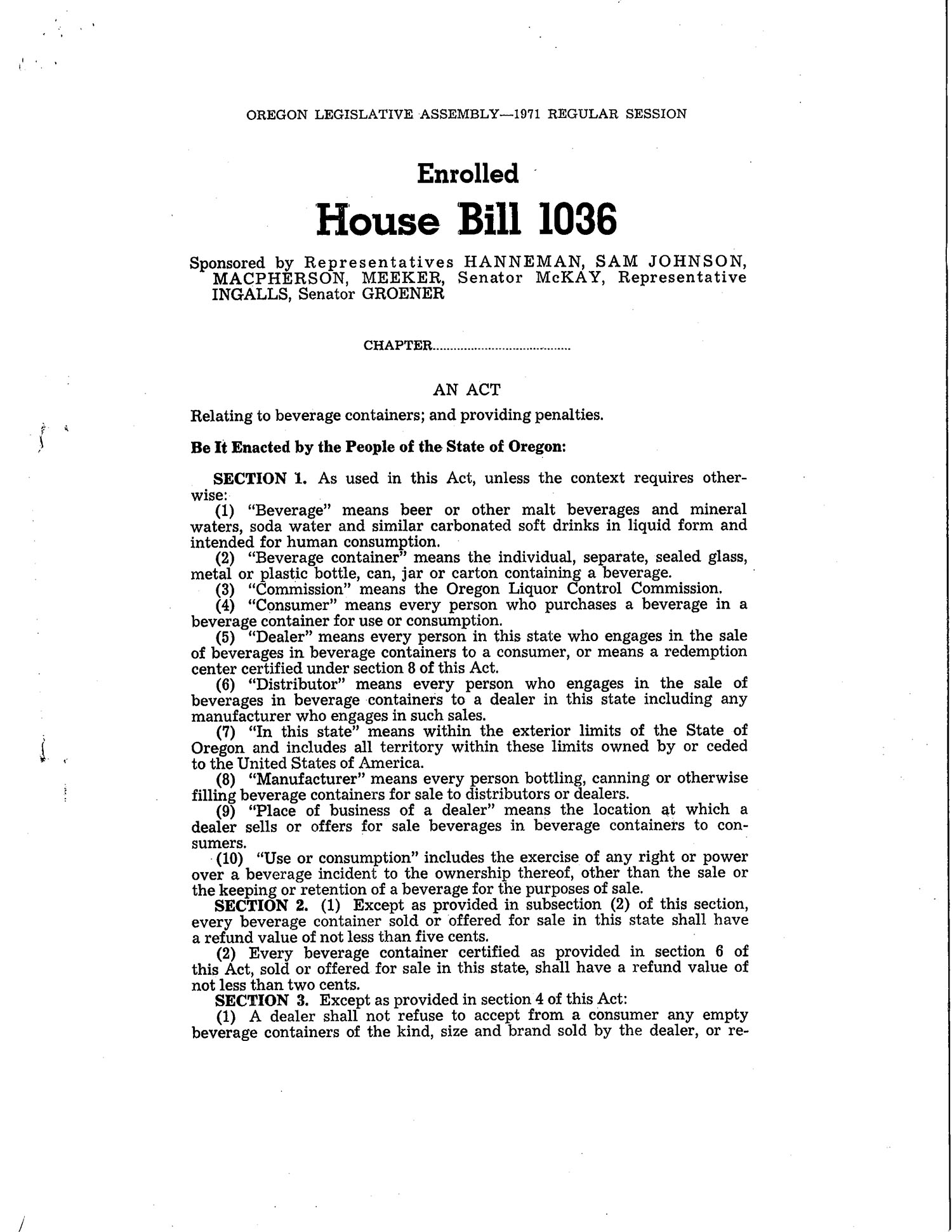
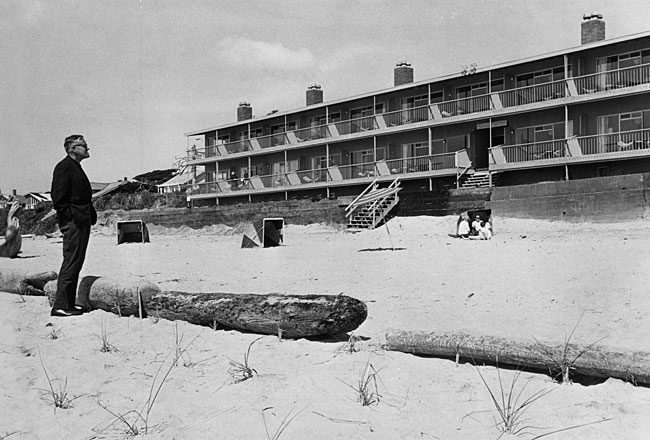
Many private-sector employees had won the right to join labor unions, collectively bargain, and strike in the National Labor Relations Act (NLRA) in 1935. Oregon was led in the late 1960s and early 1970s by a progressive Republican governor, Tom McCall, and two fairly progressive legislative chambers. These public officials saw the enactment of the Beach Bill (1967), the Bottle Bill (1971), the Bicycle Bill (1971), and statewide land use planning (1973). In this political landscape, McCall created a bipartisan Task Force on Collective Bargaining in 1971, which issued its report in late 1972. The report created a framework for public-sector collective bargaining. And none too soon. Faced with two recent public-sector job actions in Oregon—by nurses at the University of Oregon Medical School and Washington County sewage treatment workers—legislators believed that “a legal right to strike was better than unpredictable illegal strikes.”
In early 1973, the House Labor and Industrial Relations Committee introduced House Bill 2263 at the request of McCall’s task force. A Eugene lawyer, Ted Kulongoski, served as legal counsel to the committee (later serving as Governor of Oregon, 2003-2011). House amendments to the bill provided collective bargaining rights to public employees in one bargaining unit and to supervisory and managerial employees in their own bargaining unit. The bill was modeled on New York’s 1967 Taylor Law, which legalized organizing and bargaining but prohibited striking. In the middle of this 1973 legislative session, Hillsboro teachers engaged in a “technically illegal” strike, which doubtless contributed to the perceived need for—and the public’s interest in—such a law.
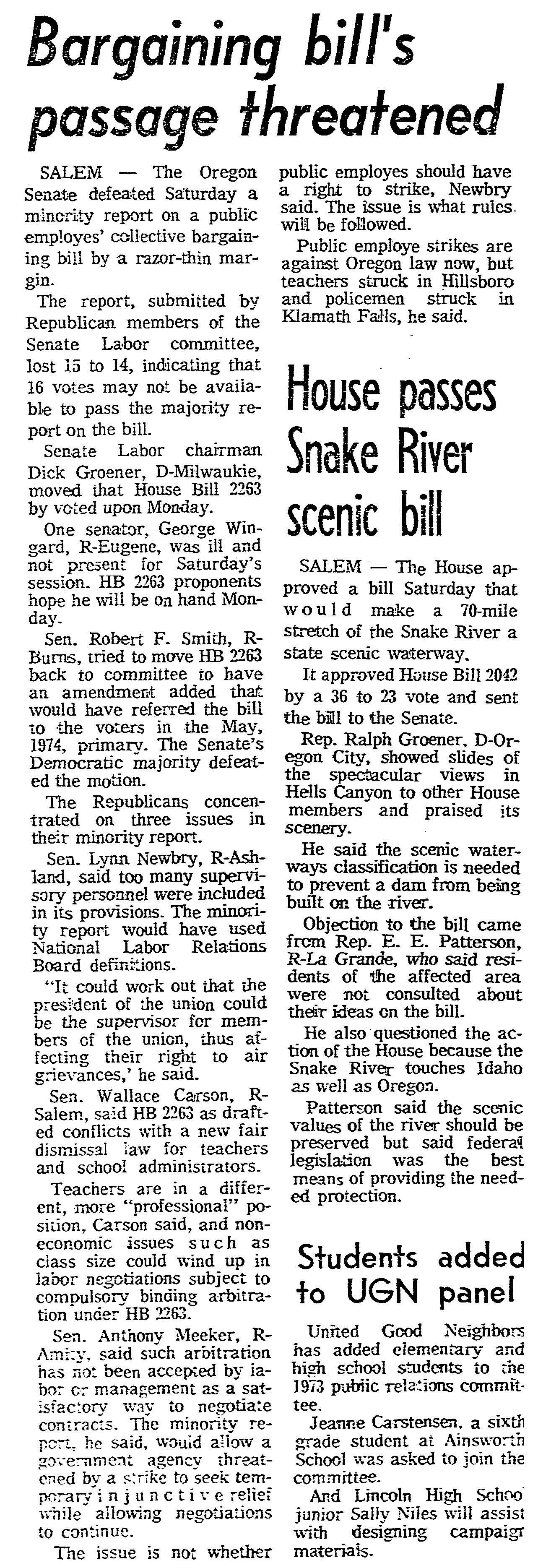
The bill passed the Oregon House fairly easily; its trip through the Senate offered high drama. The initial Senate vote was 15 ayes (all Democrats) and 14 nays (all 12 Republicans plus 2 Democrats), falling one vote short of the required 16 votes to pass. One Republican, George Wingard of Eugene, had been excused that day. A Democrat moved for reconsideration of the failed bill, which meant the bill would be the first order of business the next day.
According to Kulongoski, “I went home that night to Eugene. At about two o’clock in the morning, there was a knock on my front door. I opened the door, and there was Republican George Wingard, the absent vote.” Wingard told Kulongoski that he did not believe that school administrators—managerial and supervisory employees— belonged in a union with the right to collectively bargain. Says Kulongoski, “I had not been given the authority—by anyone—at two o’clock in the morning to agree to Senator Wingard’s proposed amendment.”
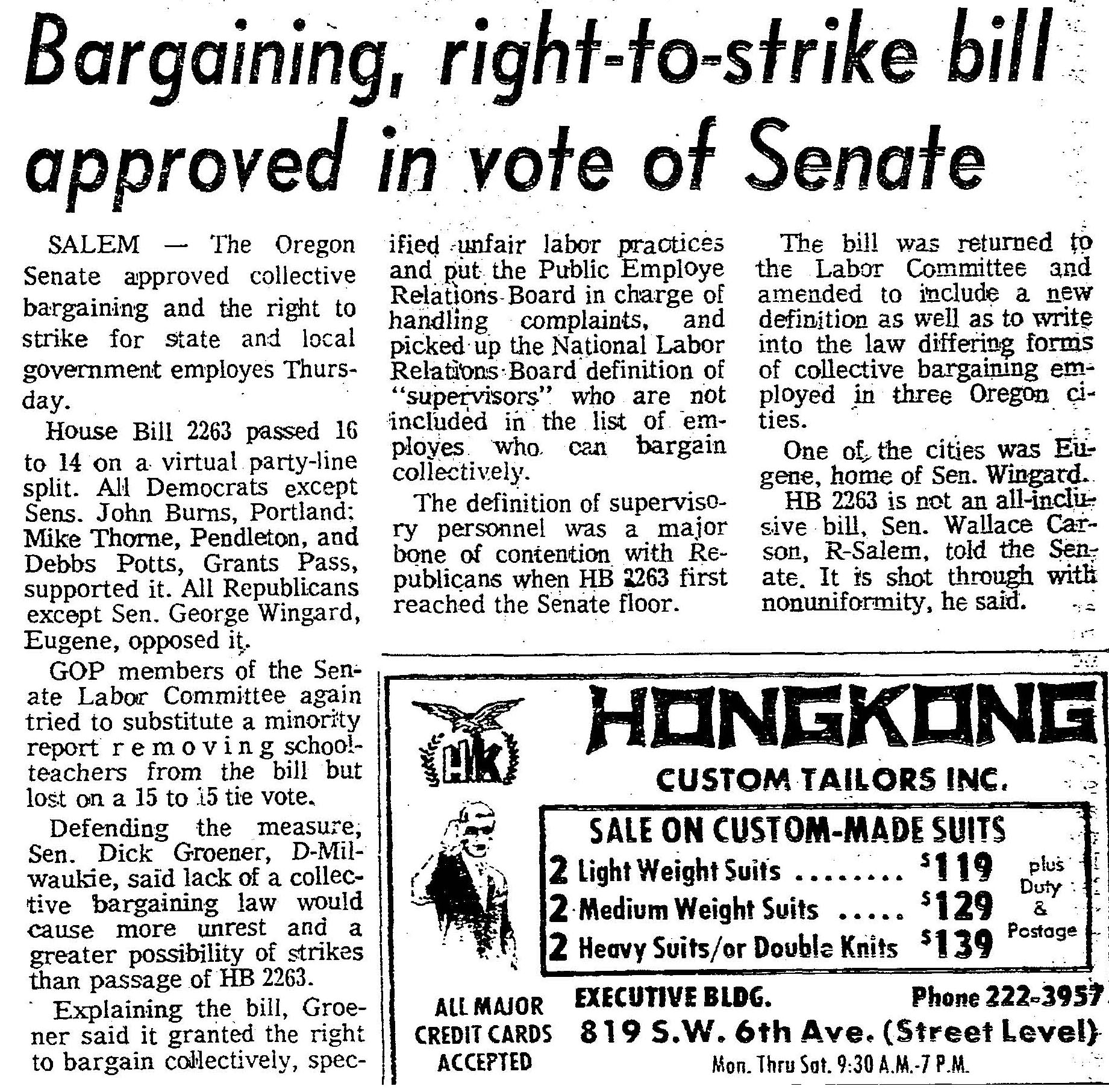
At dawn that morning, Kulongoski secured the agreement of the Oregon Education Association (OEA) lobbyist, John Danielson, to Wingard’s amendment to exclude school supervisors from the bill. Senate President Jason Boe also agreed to present the proposed amendment when the bill was reconsidered. In the Senate vote later that morning, the last vote in the roll call was Senator Wingard, who voted aye. The bill passed with 16 ayes and 14 nays, and the House concurred in the amendment. Oregon law now provided a dispute resolution process for public-sector employees.
Passage of the PECBA resulted in an immediate and enormous amount of union organizing—within two months of its passage over 200 representation election petitions were filed. The PECBA also generated many lawsuits. For example, some cities unsuccessfully objected, on constitutional home rule grounds, to PECBA bringing their city’s public employees within the public employee retirement system (PERS). In addition, management and labor in the early decades of the PECBA employed tactics to delay bargaining, such as fights over scope, the limits of the supervisory exception, the definition of mandatory subject of bargaining, and remedies for failure to bargain.
In 1995, the PECBA was extensively amended in Senate Bill 750. The political landscape had changed. A ballot measure in 1990, Measure 5, imposed restrictions on property taxes, which were a primary local source of public school funding. School districts, local governments, and their employees now had to compete with state employees for state funds from the legislature. To create a less expensive and more expeditious process, the bargaining process was limited to 150 days (after which a mediator takes over) and mandatory fact-finding was eliminated. Unconventional strikes, such as sit-downs and slowdowns, were declared outside the realm of strikes authorized by the PECBA. Secondary picketing—at the homes and businesses of public employers and legislators—was declared illegal.
Overall, the PECBA system has worked well. In the law’s first twenty years, fewer than 1% of collective bargaining negotiations resulted in strikes. Notably, Nancy Hungerford, a lawyer representing school districts of all sizes throughout the state, negotiated 600 school contracts over 48 years without a single strike.
In 2026, public employee unions are the largest unions in Oregon and a source of workplace rights and electoral and legislative power. Slightly over 50% of public employees are union members in Oregon, compared to about 7% in the private sector. The OEA, the Oregon Public Employees Union (which later became SEIU Local 503), AFSCME, the Oregon School Employees Association, and the Oregon Federation of Teachers have all become powerful unions. Using 2024-2025 teacher salaries as an example, the starting salary of teachers in states with a bargaining law is $366 more than in states without a bargaining law. Top annual pay is $15,105 higher in states with a bargaining law. In the 2023 legislative session, SEIU Local 503’s political action arm secured a historic $450 million salary pot for state workers and shepherded the passage of bills relating to housing, nurses, reproductive health care, and more.
-
![]()
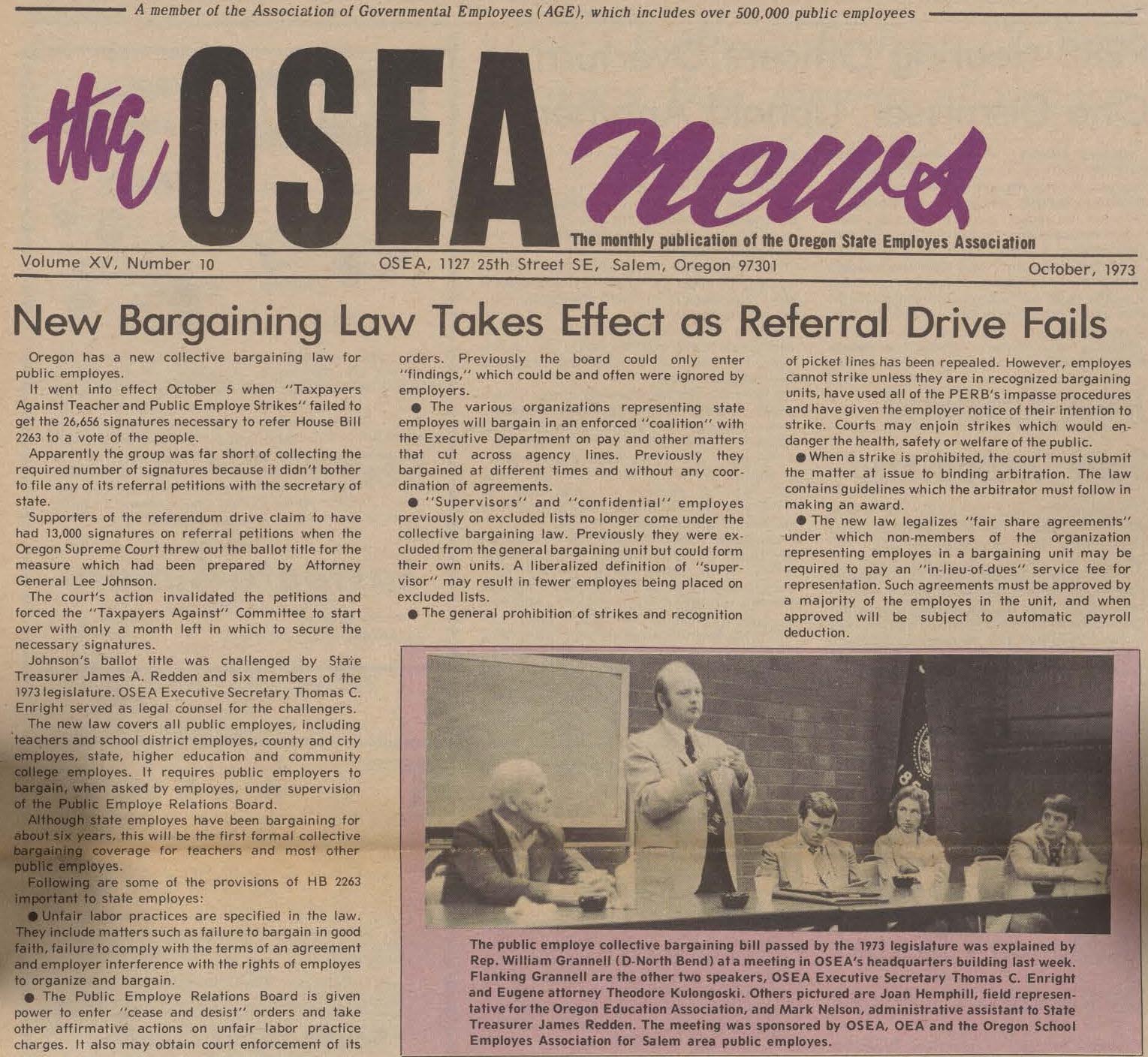
"New Bargaining Law Takes Effect as Referral Drive Fails, " The Oregon State Employees Association News, October 1973.
Courtesy Historic Oregon Newspapers, University of Oregon Libraries -
![]()
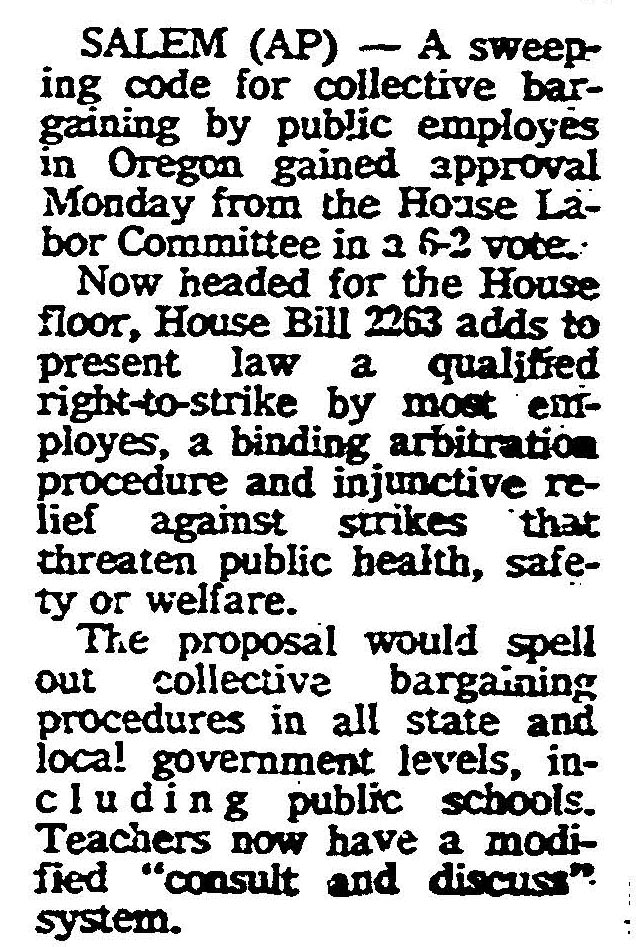
Oregonian article on the Oregon House Labor Committee Vote on House Bill 2263, April 24, 1973, p. 38.
Courtesy The Oregonian
-
![]()
"Bargaining bill's passage threatened," The Oregonian, June 24, 1973, p.28.
Courtesy The Oregonian
-
![]()
"Bargaining, right-to-strike bill approved in vote of Senate," The Oregonian, June 29, 1973, p.23.
Courtesy The Oregonian
-
![Statesman Journal photo]()
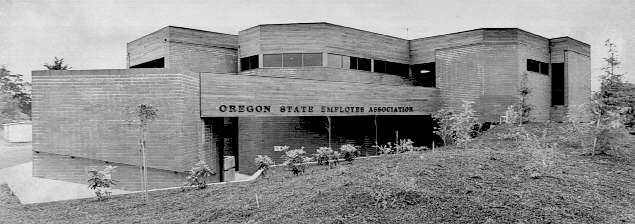
Oregon State Employee Association building in Salem, 1972.
Statesman Journal photo Courtesy City of Salem, Oregon, Historic Photographs Collections, SJ470
Related Entries
-
![Beverage Container Act (Bottle Bill)]()
Beverage Container Act (Bottle Bill)
The Oregon Beverage Container Act of 1971, popularly called the Bottle …
-
![Land Use Planning]()
Land Use Planning
In 1973, Oregon took a pioneering step in land use planning. Signed int…
-
![Oregon Beach Bill]()
Oregon Beach Bill
Oregonians struggling to maintain public access to Pacific Ocean beache…
-
![Oregon Bicycle Bill]()
Oregon Bicycle Bill
On June 11, 1971, Governor Tom McCall, with his usual flair for publici…
-
![Thomas William Lawson McCall (1913-1983)]()
Thomas William Lawson McCall (1913-1983)
Tom McCall, more than any leader of his era, shaped the identity of mod…
Map This on the Oregon History WayFinder
The Oregon History Wayfinder is an interactive map that identifies significant places, people, and events in Oregon history.
Further Reading
"The Right to Strike." National Labor Relations Board.
Duyckinck, Kristie. "The 1973 Hillsboro Teachers' Strike: A Local Surprise with Statewide Implications." Oregon Historical Quarterly 124.3 (Fall 2023): 324-349.
"Pay Pact Accepted by UOMS Nurses." Portland Oregon Journal, March 16, 1972, p. 1
"Ports File PMA-ILWU 'Trust-Busting' Suit." Portland Oregon Journal, August 2, 1972, p.1