


The mastodon (Mammut americanum) has captured the American imagination since the founding of the United States. Thomas Jefferson was enthralled by mastodons and displayed their bones in the White House for study. Jefferson instructed Meriwether Lewis and William Clark to look for evidence of the creature during their expedition to the Pacific Coast in 1803-1806. Lewis collected bones in Kentucky, but the Corps did not encounter any evidence of mastodons in the West.
While mastodons had, in fact, been extinct for over twelve thousand years by the time Lewis and Clark traveled to Oregon Country, the animals’ ability to fascinate lives on, and we continue to discover new aspects of their history. Recent discoveries suggest that two species of mastodon may have lived in Oregon in the recent past: the wide-ranging American mastodon (Mammut americanum) and the newly identified Pacific mastodon (Mammut pacificus).
Mastodons are proboscideans, an order of mammals that includes mammoths—such as Oregon’s Columbian mammoth—and modern elephants. American mastodons first appear in the fossil record approximately 3.75 million years ago. They evolved from Zygolophodon, an elephant-like creature known for its huge body and very long tusks. Mastodon fossils have been found in North America from coast to coast, including in Oregon, and from the Arctic to Central America. These animals were primarily found in mixed and open woodland environments, where coniferous trees were interspersed with bogs, marshes, and ponds.
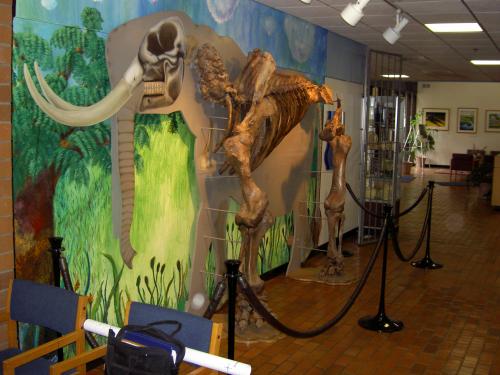
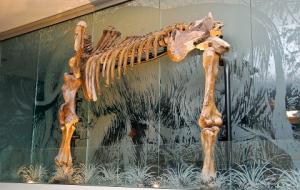
Despite surviving major climatic shifts and glacial events for several million years, mastodons went extinct along with other large land animals, such as mammoths and giant ground sloths, at the end of the Pleistocene, a period spanning from 1.8 million to 12,000 years ago. The last known mastodon in present-day Oregon was found in Tualatin and dates to approximately 13,300 years ago. Its skeleton is permanently on display at the Tualatin Public Library.
Like modern elephants, mastodons are sexually dimorphic, which means males and females had different characteristics, including body size and tusks. Male mastodons were typically nine to ten feet tall at the shoulder, while females were less than eight feet tall. Similarly, male mastodon tusks were larger than female tusks. Compared to modern elephants and extinct mammoths, mastodons were stockier, with a shorter, wider build. Their strong stature may have allowed them to run, have heavier coats, or support larger tusks.
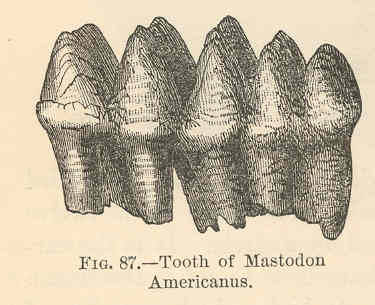
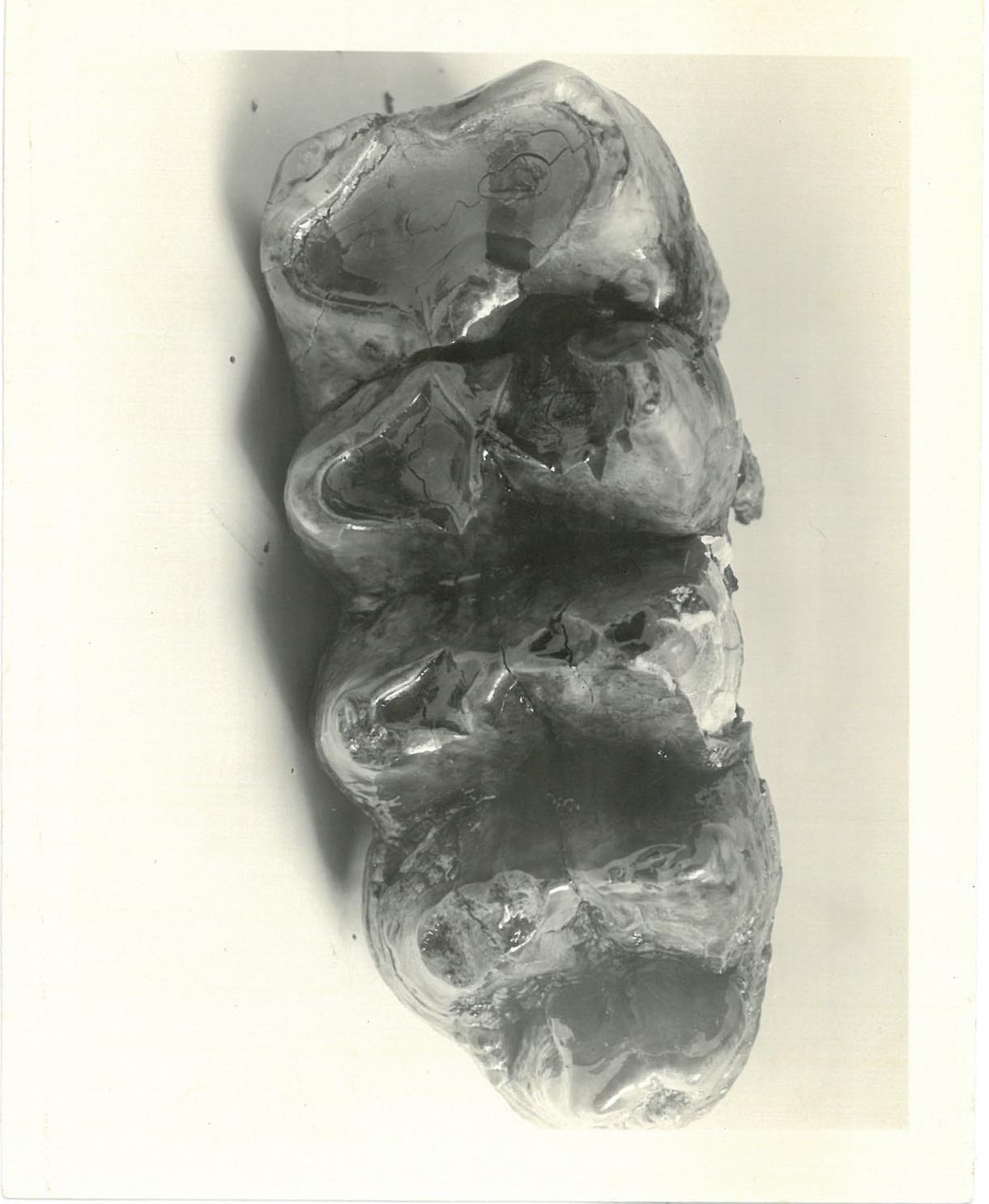
All mastodons, male and female, have tusks—long, curved, modified front teeth that are common to many proboscideans. Patterns in the way fossil tusks are scratched and worn suggest that mastodons may have used their tusks to strip bark for food. Unlike the teeth of mammoths, which were flat for grinding grasses, mastodon teeth had rounded and pointed peaks, suggesting that they ate a diet of woody browse, such as twigs, leaves, and stems. Studies of the wear patterns on the surface and the chemical composition of mastodon teeth confirm a preference for woody foods, with some variation over time and across habitat.
While researchers do not yet know whether—or how—mastodons moved in and around the Pacific Northwest, they do know that they were capable of long-distance travel. Using chemical analyses of mastodon teeth, researchers can track where animals have moved during their lifetimes. Studies have found that while individual animals occasionally moved long distances, the majority of mastodons moved within a 100-mile area during their lifetime. Similarly, modern elephants do not typically migrate with the seasons, but they do move around large home ranges and will trek long distances, over 30 miles at a time, for food or water. While modern elephant behavior may provide a clue, it is possible that mastodons behaved differently given they split from other elephants between 10 to 28 million years ago. Some researchers suggest mastodons behaved more like modern-day moose, living more solitary lives; but a few archaeological sites indicate they lived in small herds.
Both humans and mastodons lived in what we now call Oregon for at least 2,000 to 3,000 years, but there are no archaeological sites showing definitive, direct human interaction with mastodons within the state. The mastodon uncovered in 1977 at the Manis site, near Sequim, Washington, is embedded with a sharp point made of animal bone; but no other stone tools or evidence of human activity are present at the site, and there has not yet been a full examination of the assemblage or a completed report of the site.
Despite 250 years of mastodon research, scientists are still making new discoveries. Paleontologists long believed there was one species of Pleistocene mastodon—Mammut americanum—with some regional variation in shape and size. Mastodons in North America were thought to come from populations in Europe, arriving by way of a land bridge, but this appears to no longer be the whole story. While the earliest mastodon ancestors came from Europe and Asia, research shows that more recent mastodons evolved in North America.
In 2019, Alton Dooley and his colleagues published a paper describing the Pacific mastodon (Mammut pacificus), a new species of mastodon in western North America. Following this discovery, a re-examination of Oregon mastodon fossils found at least one individual from the Pacific species. That animal also represents the geologically youngest known mastodon of the new species. The Pacific mastodon is characterized by narrower teeth and a shorter body. This new evidence, along with ancient DNA studies, has started a new chapter in the study of mastodons and makes clear that the evolutionary story of Oregon’s mastodons is a local one.
-
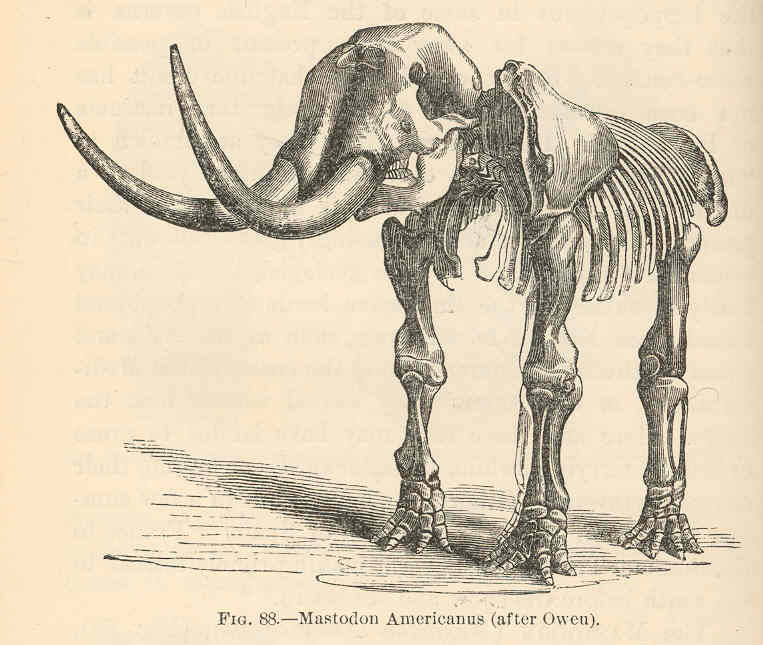
![From Man and the Glacial Period, Fig.88, by Frederick G. Wright.]()
Mastodon Americanus (after Owen), 1892.
From Man and the Glacial Period, Fig.88, by Frederick G. Wright. Courtesy University of Washington Libraries, Digital Collections -
![From Man and the Glacial Period, Fig.87, by Frederick G. Wright.]()
Tooth of Mastodon Americanus, 1892.
From Man and the Glacial Period, Fig.87, by Frederick G. Wright. Courtesy University of Washington Libraries, Digital Collections -
![]()
Helen Beck holds a mastodon's tooth from a well in Tualatin, 1937.
Oregon Historical Society Research Library, 000141 -
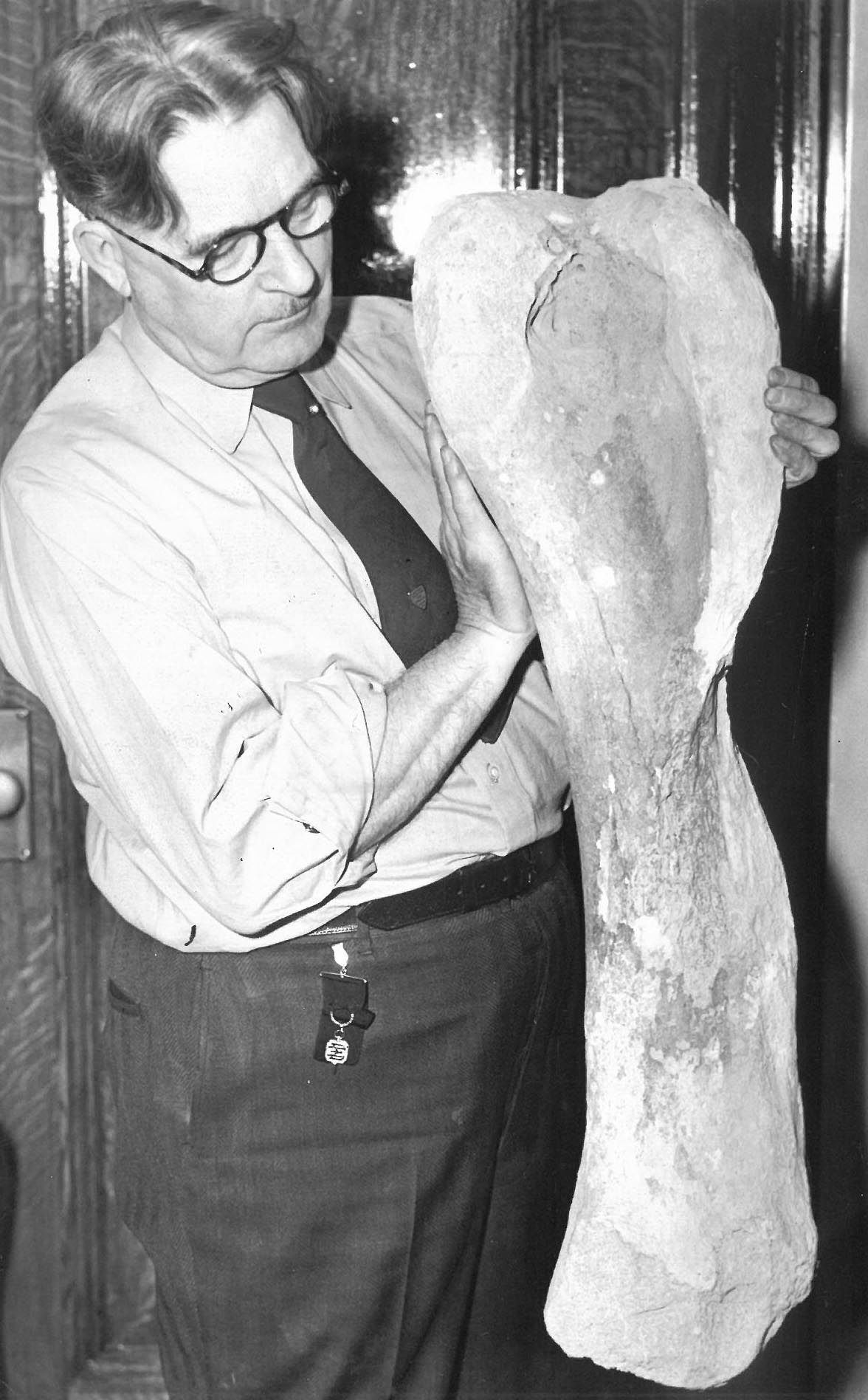
![]()
J.C. Stevens, civil engineer in charge of the Umatilla ordinance depot construction, holds a thigh bone of a mastodon, c.1941.
Oregon Historical Society Research Library, ba013470, Photo File #412
-
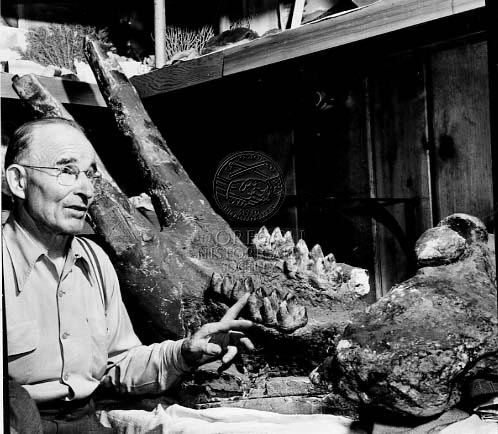
![]()
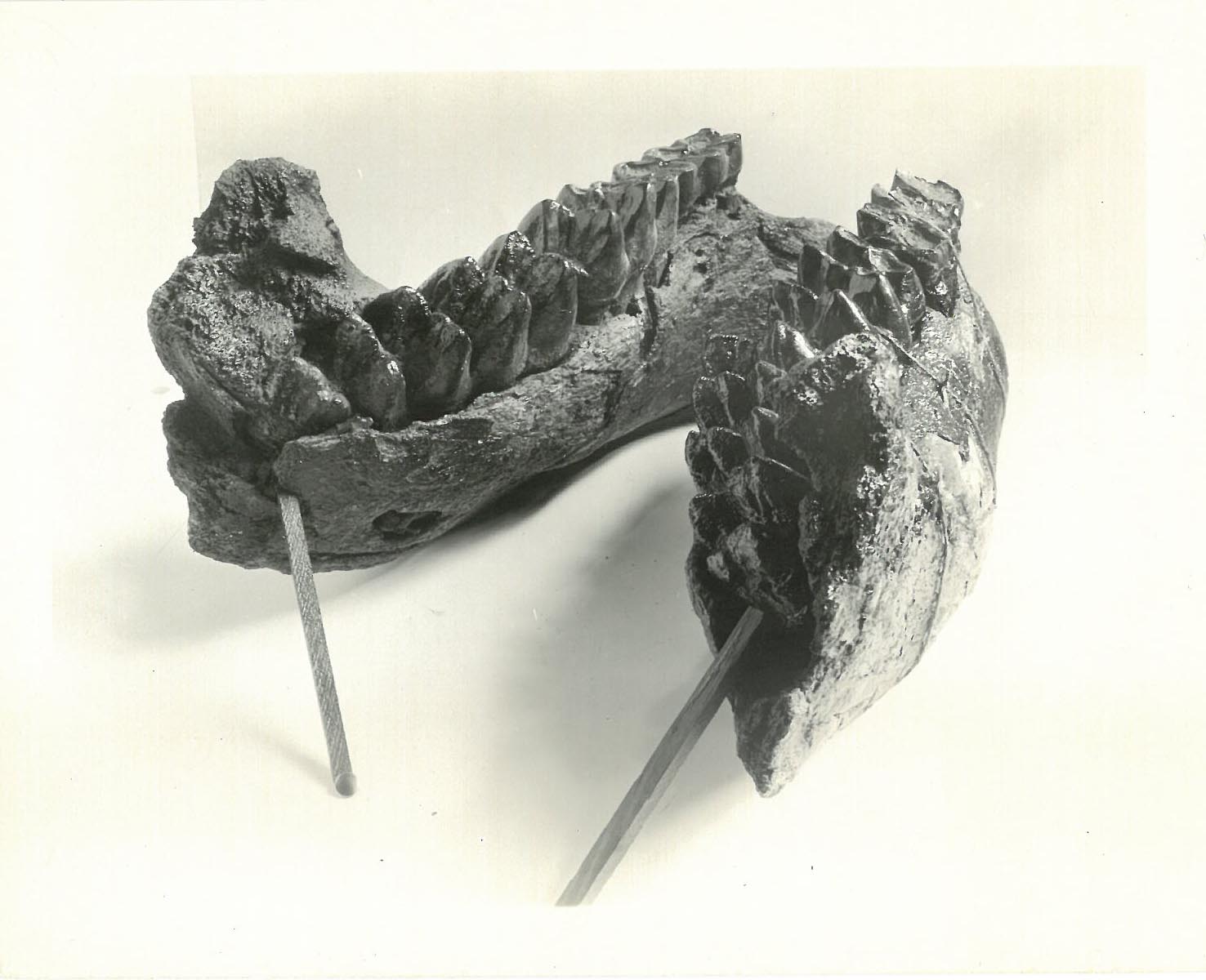
Alonzo Hancock with mastodon jaw he discovered in eastern Oregon in 1941, photo taken in 1953.
Oregon Historical Society Research Library, Oregon Journal Collection, 010688 -
![]()
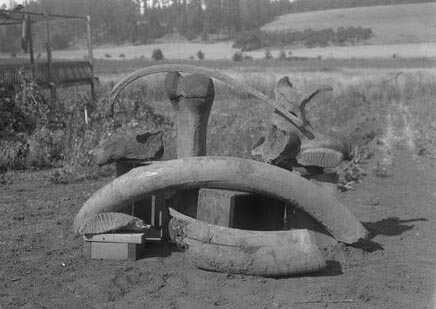
Bones, Pinson Farm, Evans Valley, Sliverton, 1949. Mammoth or Mastodon bones on display include a rib and two teeth.
Oregon Historical Society Research Library, Digital Collections -
![]()
Mastodon Fossil, dentition details.
Oregon Historical Society Research Library, ba013398, Photo File #412
-
![]()
Mastodon fossil.
Oregon Historical Society Research Library, ba013401, Photo File #412
-
![]()
Mastodon skeleton display at the Tualatin Public Library.
Courtesy Tualatin Public Library -
![]()
Partial Mastodon skeleton on display at the Tualatin Public Library.
Courtesy Tualatin Public Library

Related Entries
Related Historical Records
Map This on the Oregon History WayFinder
The Oregon History Wayfinder is an interactive map that identifies significant places, people, and events in Oregon history.
Further Reading
Bonhof, W. J., and A. J. Pryor. "Proboscideans on parade: A review of the migratory behavior of elephants, mammoths, and mastodons." Quaternary Science Reviews 277.107304 (2022).
Dooley, A. C., Jr., E. Scott, J. Green, K. B. Springer, B. S. Dooley, and G. J. Smith, G. "Mammut pacificus sp. nov., a newly recognized species of mastodon from the Pleistocene of western North America." PeerJ 7. e6614 (2019).
Gilmour, D. M., V. L. Butler, J. E. O'Connor, E. B. Davis, B. J. Culleton, D. J. Kennett, and G. Hodgins. "Chronology and ecology of late Pleistocene megafauna in the northern Willamette Valley, Oregon." Quaternary Research 83.1 (2015): 127-136.
Haynes, Gary. Mammoths, mastodons, and elephants: biology, behavior and the fossil record. Cambridge, U.K.: Cambridge University Press, 1991.
Kurtén, Björn, and Elaine Anderson. Pleistocene Mammals of North America. New York, NY: Columbia University Press, 1980.
Teale, C. L., and N. G. Miller. "Mastodon herbivory in mid-latitude late-Pleistocene boreal forests of eastern North America." Quaternary Research 78.1 (2012): 72-81.
von Koenigswald, W., C. Widga, and U. Göhlich. "New mammutids (Proboscidea) from the Clarendonian and Hemphillian of Oregon–a survey of Mio-Pliocene mammutids from North America." Bulletin of the Museum of Natural History, University of Oregon 30 (2023).